Business license and permits: what to have ready

For education only. Not legal advice. Tellbrief is not a law firm.
Which licenses and permits a business needs turns on two facts: what it does, and where. Before you ask a lawyer, write both down in detail and find everything you already hold.
In short
Write down exactly what the business does and every place it does it, including a home office, a vehicle or sales to other states. Gather the licenses and permits you already hold with their renewal dates, any letter from an agency, your lease and your formation papers. A lawyer can then check which agencies cover each activity.
On this page
- Why the details matter
- Write down what the business does
- Papers to find first
- Where you work matters too
- Renewal and opening dates
- If you bought the business or changed what it does
- Example: a taco truck adding beer
- What a lawyer may ask about the business
- What to ask about your licenses
- Questions about licenses and permits
Why the details matter
The U.S. Small Business Administration puts it plainly: “The requirements and fees vary based on your business activities, location, and government rules.”1 It adds that “Most small businesses need a combination of licenses and permits from both federal and state agencies.”1
So “we sell food” isn’t enough for a lawyer to work from. It could mean a market stall, a commercial kitchen or a website shipping across state lines, and each may involve different agencies. The more exactly you describe the work, the less time the first call spends finding out what it is.
Write down what the business does
- Each product or service you sell, in plain words.
- Where the work happens: a shop, a kitchen, a client’s site, your home, a vehicle, online.
- Who buys: the public, other businesses, or both.
- Every state, county and city where you sell or work.
- Anything you plan to add in the next year.
The SBA lists activities that need a federal license or permit, among them alcoholic beverages, aviation, firearms, commercial fishing and broadcasting. It also lists activities “commonly regulated at the local level,” including construction, dry cleaning, farming, plumbing, restaurants, retail and vending machines.1 If anything you do is on either list, put it at the top of your notes.
Papers to find first
- Your formation papers, and your operating agreement if you have one.
- Every license, permit and registration you hold now, with its number and renewal date.
- Any letter, notice or inspection report from a government agency.
- Your lease, or the address and use of each space you work from.
- Any professional license held by you or someone on your team.
- The name you sell under, if it differs from the company’s legal name.
On that last point, a trade name can raise its own questions; see what to have ready for a brand name.
Where you work matters too
The SBA says the licenses and permits you need “from the state, county, or city will depend on your business activities and business location,” and that “You may also need licenses from your county or city.”1 On zoning, it notes that “zoning ordinances can still apply even to home-based businesses.”1
List every address you work from, including a home office, a storage unit or a shared kitchen, and what happens at each one. If you’re about to take a space, see what to have ready before signing a commercial lease, and bring the listing or draft lease to the same call. If you ship to customers in other states, the online store checklist covers what to gather about where your orders go.
Renewal and opening dates
The SBA warns that “Some licenses and permits expire after a set period of time,” and says to “Keep close track of when you need to renew them.”1 Write down:
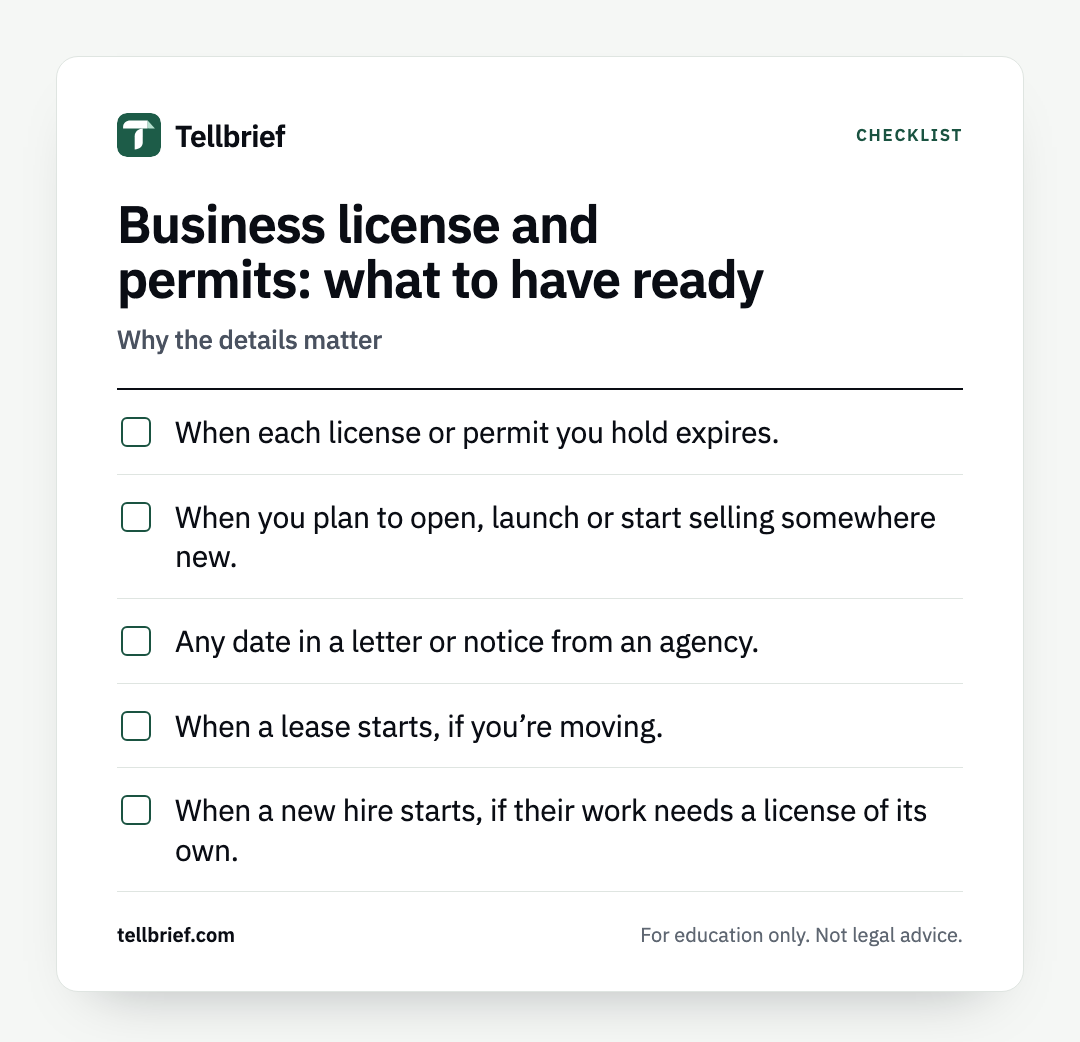
- When each license or permit you hold expires.
- When you plan to open, launch or start selling somewhere new.
- Any date in a letter or notice from an agency.
- When a lease starts, if you’re moving.
- When a new hire starts, if their work needs a license of its own.
For a first employee or contractor, the first hire guide lists what else to gather.
If you bought the business or changed what it does
Bring every license the business held before, in whose name it was issued, and the papers from the purchase. If you’re the one selling, a buyer may ask for the same list; see what to have ready when selling your company. Ask your lawyer whether each license still covers what you do now and who does it.
Example: a taco truck adding beer
Made up for this guide
My partner and I run a taco truck in two Texas cities. We got the city permits we were told to get when we started, and we prep at a shared commissary kitchen. Next spring we want to cater private events in a third city and serve beer at some of them. Our LLC is formed and we have one employee. Which licenses and permits do we need for the new city and the beer, and how long could they take?
Your version, with blanks to fill:
We [what you do] in [cities and states]. We work from [a shop, home, a kitchen, a vehicle, online]. We hold [licenses and permits, with renewal dates]. Next we plan to [new activity or place], starting [date]. Our main question: [the one that matters most].
Then see what to prepare before meeting a business lawyer.
What a lawyer may ask about the business
- What exactly do you sell or do, and where?
- Which licenses, permits and registrations do you hold now, and in whose name?
- Has any agency contacted you, inspected you or sent you a notice?
- Does anyone on your team hold a professional license?
- Do you sell to customers in other states?
- When do you plan to start the new activity or open the new place?
What to ask about your licenses
- Which agencies cover what we do, at each level of government?
- What should we apply for first, and how long might each take?
- Does anything we hold need to change if we add this activity or move?
- In whose name should each license or permit be?
- What do we keep on file, and what do we renew when?
Sources
Each quote was checked against its source on November 3, 2026. Laws and guidance can change after that date.
Questions about licenses and permits
These answers help you get ready for a lawyer. They don’t say what the law means for your situation, or what you should do.
Do I need a business license to sell online?
It can depend on what you sell, where you’re based and where your customers are. The SBA says requirements vary based on your business activities, location and government rules. Bring a list of what you sell and the states you ship to, and ask your lawyer.
How do I find out which licenses my business needs?
The SBA lists federal agencies by activity and points to your Secretary of State’s website for state requirements. A lawyer can check what applies to your activities and locations, so bring your list of both.
Does a home-based business need a permit?
The SBA notes that zoning ordinances can still apply even to home-based businesses. Bring your address, what you do at home, and whether customers or deliveries come there.
What if a license has expired?
That’s a question for your lawyer, and dates can matter. Bring the expired license, any notice you received, and the dates you’ve operated since.
Is a business license the same as registering my LLC?
The SBA lists them as separate steps: registering the business, getting tax ID numbers, and applying for licenses and permits. Bring your formation papers and every license you hold, and your lawyer can say what each covers.
Talking to a lawyer about licenses and permits?
About 30 questions, most of them one tap, free and with no account. Tellbrief turns your answers into a brief your lawyer can work from, and you keep a copy.
A lawyer? See the brief Tellbrief sends you before a first call.