Get your lawyer up to speed before the first call
Answer plain questions about what’s changing in your business. You get a brief to bring to your lawyer, so the first call can start with your questions.
- About 30 questions
- Free
- No account or card
Your answers stay in this tab until you download or send your brief. To pick follow-up questions, the site reads your answers as you go and doesn’t keep them. You read the brief first, and you decide who sees it. No lawyer has agreed to take this on yet, so leave out your plans and strategy, such as what you’d settle for or how you’d negotiate.
Are you a business lawyer? Send new clients your own Tellbrief link and know the matter before the first call. Your first three briefs are free, then $40 a brief.
See how it works for lawyersRun an accelerator or startup program? It’s free for your founders.
We’re hiring our first employee, who starts next month. We offered a salary and some equity. Until now, freelancers built our app and designed our logo.
- What’s changing
- First employee, starting next month
- Records to have ready
- Any offer you’ve made or discussed, including pay and equity
- Worth asking
- Does the company own what contractors and early contributors made?You didn’t mention this
A national retailer wants our sauces in 40 stores by spring, and they sent us their vendor agreement. A contract manufacturer makes the sauces from our recipes.
- What’s changing
- First national retailer, 40 stores by spring
- Records to have ready
- Terms from retailers or distributors
- Worth asking
- How do we protect what we keep secret when others need to see it?You didn’t mention this
We’re raising our first outside money this month. An angel investor sent us a draft SAFE to sign.
- What’s changing
- First outside investment, closing this month
- Records to have ready
- Any draft agreement, term sheet or letter from the other side
- Worth asking
- What should we clean up in our ownership records and earlier SAFEs or notes before we close?You didn’t mention this
How it works
- What’s changingAbout 29 leftWhat’s prompting this now?Preparing to launch or openSelling through retail / wholesale / a distributor✓Signing a larger B2B customer
Answer the questions
About 30 questions. Most take one tap.
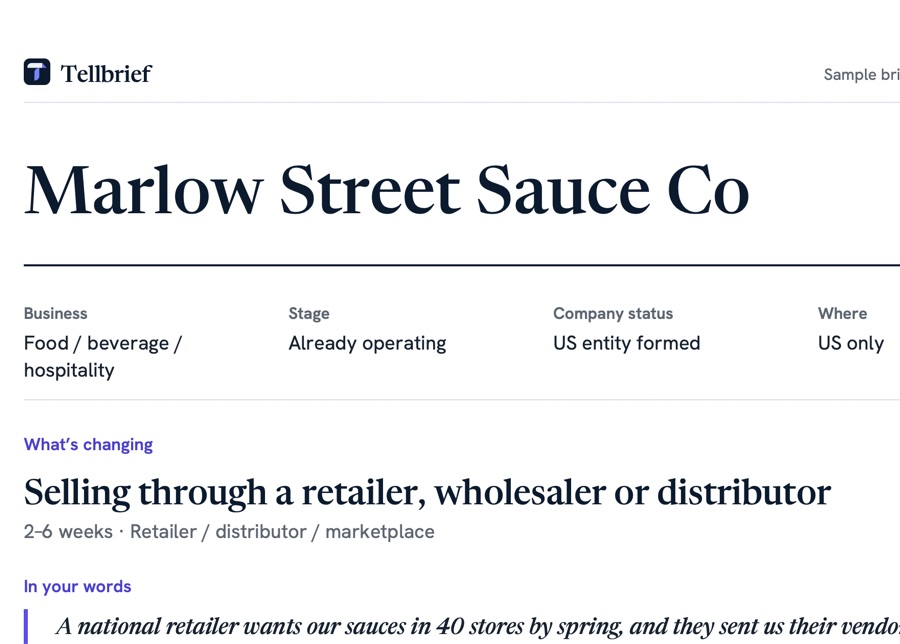 Open the sample brief (PDF, opens in a new tab)
Read your brief
You read the whole brief before it goes anywhere. Your lawyer sees the same one.
- Your briefReadyReady for the first callYour situationQuestionsRecordsPDFExample-Co-brief.pdf
Take it to your lawyer
Download it and bring it to the first call, or send it ahead. If a law firm gave you its Tellbrief link, it goes to them, and they check names for conflicts before reading it.
Next Your lawyer reads it before you meet, so the call can start with your questions. Tellbrief doesn’t keep a brief you download.
What’s in your brief
The business background, what’s changing and the question you want to ask your lawyer.
Your situation
What the business does, what has happened and what you’re unsure about, based on your answers.
Questions worth asking
Points to discuss with the lawyer, including anything you haven’t worked out yet.
Records to have ready
Agreements, company records and other documents the lawyer may ask to see.
No lawyer yet? Your brief works with any lawyer you call. The American Bar Association lists lawyer referral services by state (opens in a new tab).
Start the first call with your questions
When your lawyer has read the basics before you meet, the call can skip the background and start with questions like these.
For example: Not formed yet, using a brand name, and collecting customer details.
Questions worth asking
- Given how we plan to raise money and exit, what kind of company should we be, and when?Qualified small business stock can shield $15 million or more of a founder’s gain from federal tax. Only C corporations can issue it, and for an LLC the 3–5 year holding period starts only when it converts.1,2
- What should move from a founder’s name into the company’s name, and how?
- Is our name clear to use and register where we sell?
Records to have ready
- Trademark searches, filings or registrationsYour brand name is part of this.
- Records of who owns your domain and key accountsSome accounts or assets may not be in the company’s name.
- Your privacy policy and a list of services that handle customer dataYou collect personal information.
For example: Selling by signed agreement, with renewals, and some work made by outside people.
Questions worth asking
- What should our terms with customers cover before the first one signs?
- Does the company own what contractors and early contributors made?Under U.S. copyright law, a contractor owns the copyright in what they make unless it falls in one of nine narrow categories with a signed agreement, or they sign it over in writing.3,4
- What personal information do we collect, and does our privacy notice match it?About 1,822 data-privacy class actions were filed in 2025, up from 1,488 in 2024.5
Records to have ready
- The contract your customers sign todayIt shows how you sell now.
- Agreements with contractors and other contributorsPeople outside the company may have made work you rely on.
- Your privacy policy and a list of services that handle customer dataYou collect personal information.
For example: A retailer’s terms on the table, a contract manufacturer, a brand name and claims on the label.
Questions worth asking
- What should we look for in the retailer’s or distributor’s terms before we sign?
- Does the company own what contractors and early contributors made?Under U.S. copyright law, a contractor owns the copyright in what they make unless it falls in one of nine narrow categories with a signed agreement, or they sign it over in writing.3,4
- What should our agreement with the manufacturer or supplier cover?
Records to have ready
- Terms from retailers or distributorsYou sell, or plan to sell, through someone else.
- Your agreement with your manufacturer or supplierSomeone else makes or supplies your product.
- Trademark searches, filings or registrationsYour brand name is part of this.
For example: A first employee, after outside contractors built the early work.
Questions worth asking
- Should the people doing the work be employees or contractors?In California, knowingly misclassifying a worker as an independent contractor can bring a civil penalty of $5,000 to $15,000 for each violation.6
- What needs to be in place before our new hire starts, given where they’ll work?
- Does the company own what contractors and early contributors made?Under U.S. copyright law, a contractor owns the copyright in what they make unless it falls in one of nine narrow categories with a signed agreement, or they sign it over in writing.3,4
Records to have ready
- Any offer you’ve made or discussed, including pay and equityWhat you’ve already promised shapes the paperwork.
- Agreements with contractors and other contributorsPeople outside the company may have made work you rely on.
- Anything showing contributors signed over their workIt’s unclear whether the company owns everything it uses.
For example: An investor’s offer in hand, ownership not written down, and equity already promised.
Questions worth asking
- Which terms in the investor’s offer matter most for us?
- What should we clean up in our ownership records and earlier SAFEs or notes before we close?
- Given how we plan to raise money and exit, what kind of company should we be, and when?Qualified small business stock can shield $15 million or more of a founder’s gain from federal tax. Only C corporations can issue it, and for an LLC the 3–5 year holding period starts only when it converts.1,2
Records to have ready
- Your cap table: who owns what share of the companyRaising money or selling starts from who owns what.
- Any SAFEs, notes, options or equity promised to anyonePromises you’ve already made limit what you can offer.
- Your formation documents and founder stock agreementsThey show how the company was set up.
For example: A partner on the other side, a secret process, licensed software and a brand name.
Questions worth asking
- Who will own what we build together, and what happens if the deal ends?
- How do we protect what we keep secret when others need to see it?Under federal law, information counts as a trade secret only if its owner takes reasonable measures to keep it secret.7
- Is our name clear to use and register where we sell?
Records to have ready
- Any draft agreement, term sheet or letter from the other sideSomeone else is on the other side of this deal.
- Trademark searches, filings or registrationsYour brand name is part of this.
- Licenses for software, content or data you useYou rely on someone else’s content, software or brand.
For example: Founders who never settled ownership in writing, with some accounts in one founder’s name.
Questions worth asking
- What should the founders put in writing about who owns what, and what happens if one leaves?If founder stock vests over time, a founder who wants an 83(b) tax election has to make it within 30 days after receiving the stock.8
- What should move from a founder’s name into the company’s name, and how?
Records to have ready
- Your cap table: who owns what share of the companyA question between founders starts from who owns what today.
- Your formation documents and founder stock agreementsThey show what the founders agreed when the company was set up.
- Any SAFEs, notes, options or equity promised to anyonePromises you’ve already made limit what you can offer.
For example: A buyer on the other side, unclear contributor ownership, and assets in a founder’s name.
Questions worth asking
- What will a buyer ask to see, and what should we fix first?
- What should move from a founder’s name into the company’s name, and how?
- Does the company own what contractors and early contributors made?Under U.S. copyright law, a contractor owns the copyright in what they make unless it falls in one of nine narrow categories with a signed agreement, or they sign it over in writing.3,4
Records to have ready
- Your cap table: who owns what share of the companyRaising money or selling starts from who owns what.
- Any SAFEs, notes, options or equity promised to anyonePromises you’ve already made limit what you can offer.
- Your formation documents and founder stock agreementsThey show how the company was set up.
For example: A complaint from a supplier, with a hard deadline coming up.
Questions worth asking
- What deadlines apply to this, and what are our options?If a company is sued in federal court, its answer is generally due 21 days after it’s served. State courts set their own deadlines.9
- What should our agreement with the manufacturer or supplier cover?
Records to have ready
- Any letters, emails or papers about the dispute or complaint, with datesYou said there may be a dispute, claim or complaint.
- Your agreement with your manufacturer or supplierSomeone else makes or supplies your product.
- Contracts and policies you already haveYour lawyer will start from what you have.
See each situation in full: Launching · First customer · Retail deal · First hire · Raising money · Partnership · Founder split · Selling the company · A dispute · All situations
Sources
1. Orrick, starting as an LLC and QSBS (January 2026) (opens in a new tab). 2. 26 U.S.C. § 1202 (opens in a new tab). 3. 17 U.S.C. § 101, “work made for hire” (opens in a new tab). 4. 17 U.S.C. § 204(a) (opens in a new tab). 5. Duane Morris Class Action Review, data privacy filings (January 2026) (opens in a new tab). 6. Cal. Labor Code § 226.8 (opens in a new tab), California Legislative Information. 7. 18 U.S.C. § 1839(3) (opens in a new tab). 8. 26 U.S.C. § 83(b)(2) (opens in a new tab). 9. Federal Rule of Civil Procedure 12(a)(1)(A) (opens in a new tab). 10. Benesch, automatic renewal compliance (September 2025) (opens in a new tab). Sources 2–4 and 7–9 are from the Cornell Legal Information Institute. General information, not legal or tax advice.
Common questions
Is this legal advice?
No. Tellbrief helps you get your facts in order before your first conversation with a lawyer. It isn’t a law firm, it doesn’t draft documents, and using it doesn’t make anyone your lawyer. Legal advice comes from a licensed lawyer, once they agree to take on your matter.
What does it cost?
Your brief is free. Tellbrief’s price is for law firms that use it with their own clients. If you hire a lawyer, the scope and fee are between you and them, and Tellbrief takes no share.
Who reads my brief?
Whoever you give it to. You download it as a PDF, and Tellbrief doesn’t keep it. If a law firm sent you its Tellbrief link, the brief goes only to that firm, and they check the names for conflicts before reading it.
What situations does it cover?
Most of what a growing business runs into, from forming the company to raising money, hiring, customer contracts and disputes. If yours doesn’t fit, choose “Something else, or not sure” when you send. See every situation.
How long does it take?
About 30 questions, depending on your answers. Most take one tap, and the two that ask you to type are optional.
Why do you ask for names?
Only when you send your brief to a law firm. A lawyer has to check for conflicts before reading anything about your business, so when you send, you add the names involved, your email and what it’s about. Your brief stays locked until the lawyer clears the names, and if they can’t, it’s deleted unread.
What happens to my answers before I send?
Your draft is saved in this browser tab, not in our database. To pick follow-up questions, the site reads your answers as you go and doesn’t keep them. Its AI features are turned off.
How long do you keep my brief?
If you only download it, we don’t keep it. If you send it to a law firm, names and briefs are encrypted before they’re stored. Conflict-check records are deleted 45 days after the last step, and the lawyer’s copy 14 days after it reaches them. The privacy page lists everything Tellbrief keeps, sends and deletes.
Do you track me or sell my information?
No. There are no ad trackers, analytics scripts or cookies, and we don’t sell your information or use it for ads.
Can’t I just ask an AI chatbot?
You can, and it may give you general answers. Tellbrief asks the questions a lawyer would ask about your business and puts your answers into a brief, with a list of records to bring. It doesn’t give legal advice.
Does Tellbrief use AI?
No. Its AI features are turned off. Fixed rules pick the questions and put your answers into a brief. No answers, briefs or call notes go to an AI model.
Get ready for the first call
It’s about 30 questions, most of them one tap. You read the whole brief before anything is sent, and it’s yours to keep.
Start your briefFree. No account and no marketing email.