Non-disclosure agreement (NDA): what to have ready
For education only. Not legal advice. Tellbrief is not a law firm.
An NDA is a promise to keep something secret. Before a lawyer drafts or reviews one, they need to know what the secret is, who will see it and why.
In short
Write down exactly what you plan to share, with whom and why, and how long it needs to stay secret. Gather the other side’s NDA if they sent one, any NDA you’ve signed before, what you’ve already shared and how you protect the information today. Then mark the draft’s definition, time limit, exceptions and anything beyond secrecy.
On this page
What federal law calls a trade secret
Under 18 U.S.C. § 1839(3), a trade secret can be “all forms and types of financial, business, scientific, technical, economic, or engineering information,” but only if two things are true:
“(A) the owner thereof has taken reasonable measures to keep such information secret; and (B) the information derives independent economic value, actual or potential, from not being generally known to, and not being readily ascertainable through proper means by, another person who can obtain economic value from the disclosure or use of the information”118 U.S.C. § 1839(3)
The first part is about what the owner does. So a lawyer may want to know how you keep the information secret day to day, as well as what the NDA says.
Write down what you’ll share
- What you plan to share: a recipe, code, a customer list, prices, a design, a plan.
- Who will see it, by name and company.
- Why they need it: a possible deal, an investment, a quote, a hire.
- How you’ll share it: a meeting, a shared folder, samples, a demo.
- How long it needs to stay secret, and why.
- Whether they’ll share anything secret with you in return.
What to dig out
- The other side’s NDA, if they sent one.
- Any NDA you’ve signed before, with them or with anyone else on the same subject.
- A note of what you’ve already shown or sent them, and when.
- How you protect the information today: who can see it, passwords, labels, staff agreements.
- Any patent, trademark or copyright filing that covers it.
Who you’re sharing with
The same secret can go to very different people, and each deal has its own guide:
- A factory making your product: working with a manufacturer or co-packer.
- A company that wants to use what you made: the license agreement checklist.
- A large customer testing your product: a big customer’s contract.
- Investors looking at a round: raising your first round.
- A buyer looking at the whole company: selling your company.
If they work for you
A federal statute speaks to agreements with people who work for you. Under 18 U.S.C. § 1833(b)(3)(A):
“An employer shall provide notice of the immunity set forth in this subsection in any contract or agreement with an employee that governs the use of a trade secret or other confidential information.”218 U.S.C. § 1833(b)(3)(A)
The same section says the term employee “includes any individual performing work as a contractor or consultant for an employer.”2 If your NDA is with someone who works for you, say so on the call and bring your other agreements with them. The first hire guide covers the rest, and who owns what your business built covers the work they make.
Mark these parts of the NDA
Go through the draft and flag where it covers each of these.
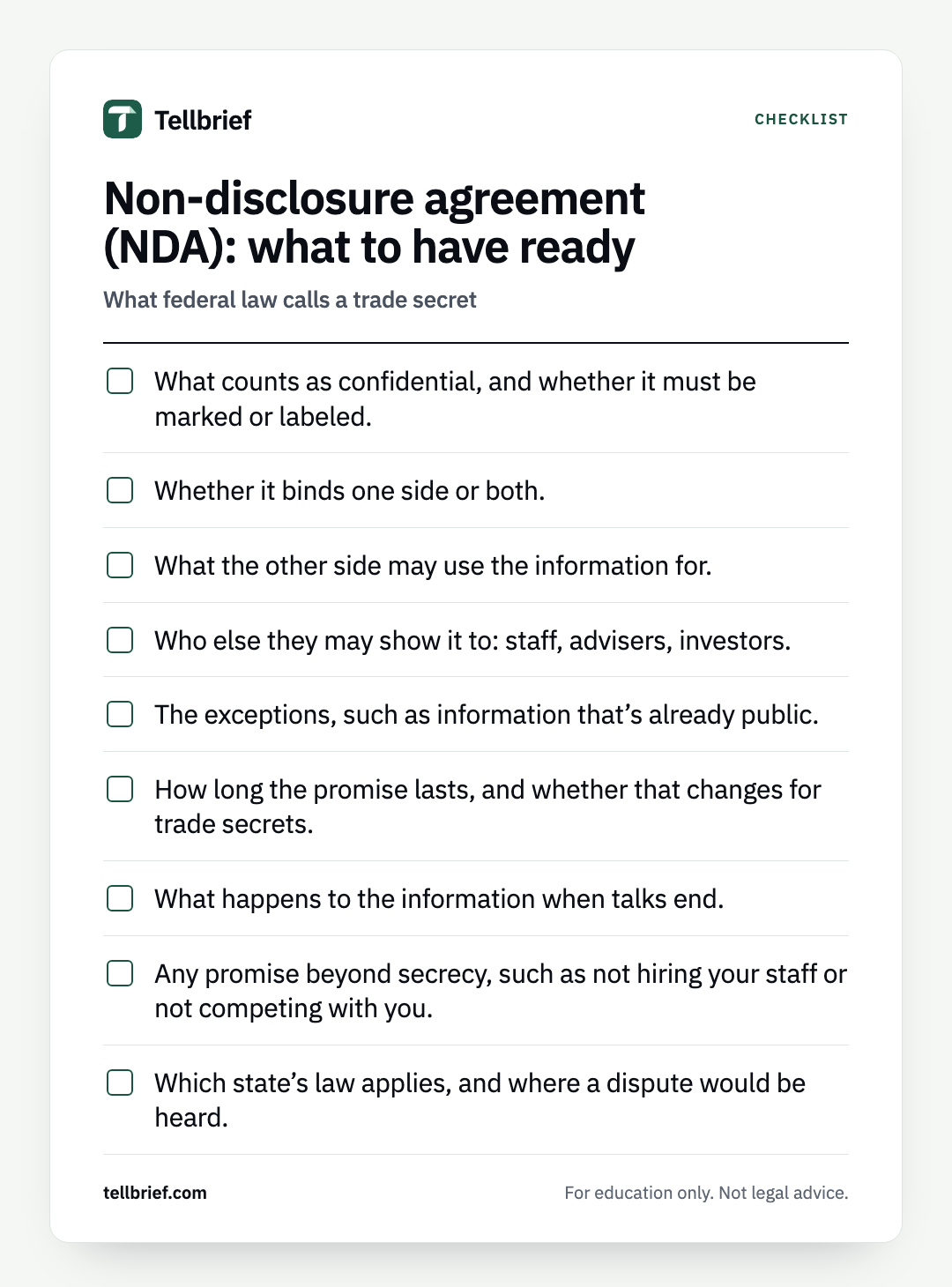
- What counts as confidential, and whether it must be marked or labeled.
- Whether it binds one side or both.
- What the other side may use the information for.
- Who else they may show it to: staff, advisers, investors.
- The exceptions, such as information that’s already public.
- How long the promise lasts, and whether that changes for trade secrets.
- What happens to the information when talks end.
- Any promise beyond secrecy, such as not hiring your staff or not competing with you.
- Which state’s law applies, and where a dispute would be heard.
Example: a recipe and a grocery chain
Made up for this guide
We make a cold-brew concentrate in Oregon, and a national grocery chain wants us to make a store-brand version. Their buyer sent a two-page NDA before they’ll share their volumes, and they want our recipe and supplier list in return. The NDA protects their information for five years and doesn’t mention ours. We’ve never asked anyone to sign an NDA before. What should we change before we sign?
Fill in your own:
We’re [your business] in [state]. [Who] wants to [the deal] and asked us to share [what]. [Their NDA / our NDA] says [the part that worries you]. We keep this secret today by [how]. Our main question: [the one that matters most].
What a lawyer may ask about the secret
- What exactly will you share, and what will they share?
- Have you already shared any of it?
- Who at their company will see it?
- How do you keep it secret inside your own company?
- What deal are you discussing, and how far along is it?
- Does the other side compete with you, or could it?
Ask about the NDA
- Should this NDA be one-way or mutual?
- Does its definition of confidential cover what we’ll share?
- How long should the promise last for each kind of information?
- Is there anything in it beyond secrecy we should know about?
- What should happen to our information if the talks end?
Sources
Each quote was checked against its source on November 3, 2026. Laws and guidance can change after that date.
Questions about NDAs
These answers help you get ready for a lawyer. They don’t say what the law means for your situation, or what you should do.
Should I get an NDA before sharing my business idea?
It can depend on what you’re sharing and with whom. Bring a short description of the idea, who you plan to tell, and what you’ve told anyone so far, and ask your lawyer.
What is the difference between a mutual and a one-way NDA?
A one-way NDA protects one side’s information; a mutual NDA protects both sides’. Bring a list of what each side will share, so your lawyer can see which fits.
How long should an NDA last?
A draft may set one period for everything, or a longer one for trade secrets. Note how long each piece of information will stay valuable to you, and ask your lawyer what period fits.
What if I shared information before the NDA was signed?
That’s a question for your lawyer, and the timing may matter. Write down what you shared, when, how and with whom.
Is an NDA enough to protect a trade secret?
The federal definition quoted above asks whether the owner “has taken reasonable measures to keep such information secret.” Bring a list of everything you do to keep it secret, not only the NDA.
Talking to a lawyer about an NDA?
About 30 questions, most of them one tap, free and with no account. Tellbrief turns your answers into a brief your lawyer can work from, and you keep a copy.
A lawyer? See the brief Tellbrief sends you before a first call.