Advisor and early employee equity checklist

For education only. Not legal advice. Tellbrief is not a law firm.
Promising “a few percent” to an advisor or a first hire takes one sentence. Turning it into a grant takes papers, approvals and dates, so gather what was promised and what the company has already given out.
In short
Write down what was promised, to whom and in what words, plus any vesting and what happens if they leave. Gather your cap table, formation papers, earlier grants and approvals, and any SAFEs or notes. Note every date: when the promise was made, when work started and when anything was issued. A federal tax election quoted below has a 30-day limit.
On this page
Write down what was promised
- Who it’s for, and their role: advisor, employee or contractor.
- What was promised, in the exact words: a percentage, a number of shares or units, options.
- What they’ll do in return, and for how long.
- Any vesting you discussed: over how long, and whether nothing vests for a first stretch.
- What happens if they leave early, or if the company is sold.
- Where the promise is written down: an offer letter, an email, a text.
Bring the exact words. “Two percent of the company” is a different number of shares after the next round than it is today, so a lawyer may want to see how it was said and when.
Ownership records to gather
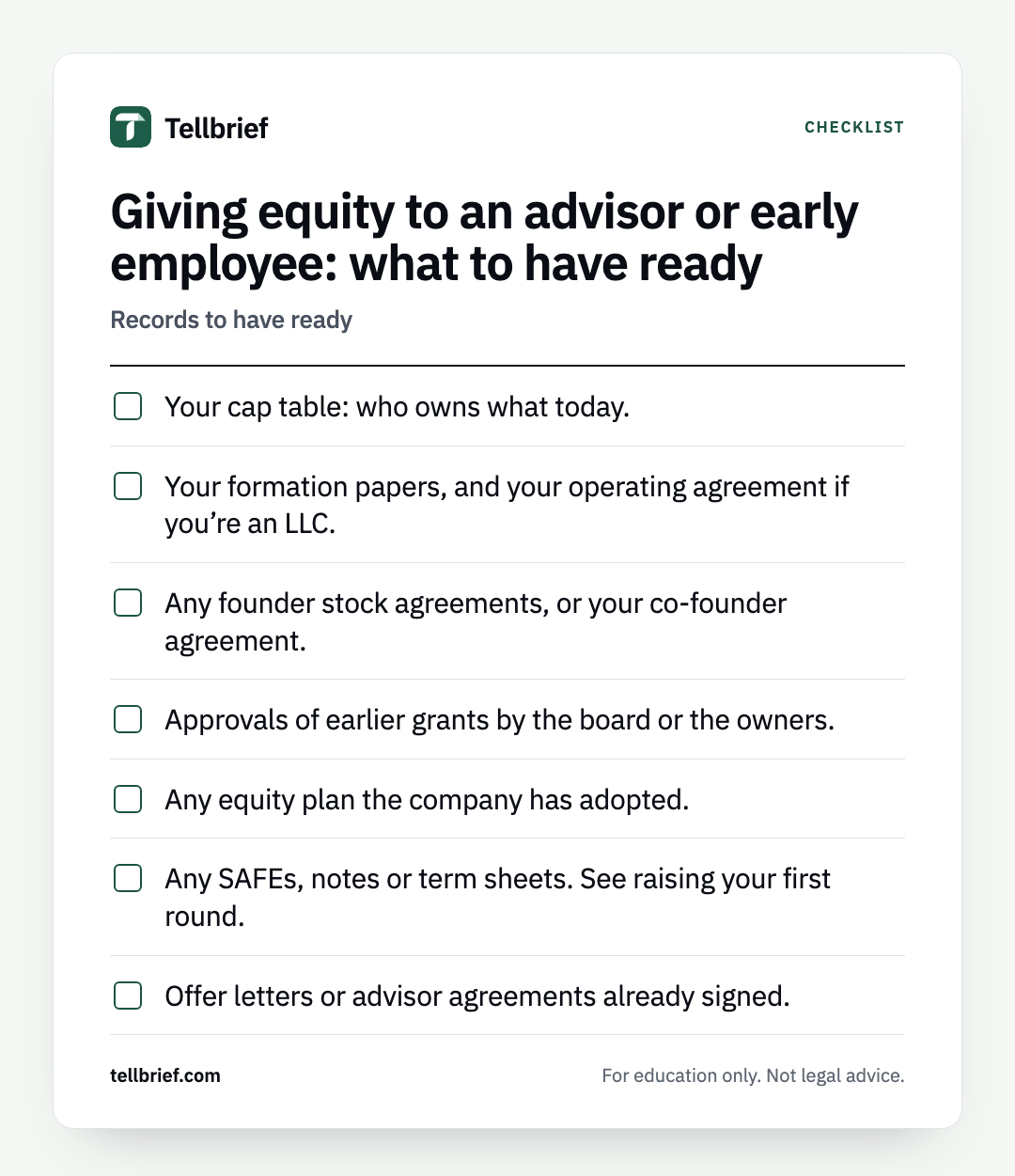
- Your cap table: who owns what today.
- Your formation papers, and your operating agreement if you’re an LLC.
- Any founder stock agreements, or your co-founder agreement.
- Approvals of earlier grants by the board or the owners.
- Any equity plan the company has adopted.
- Any SAFEs, notes or term sheets. See raising your first round.
- Offer letters or advisor agreements already signed.
Dates to pin down
Some dates in an equity grant can matter for tax. Under 26 U.S.C. § 83(b)(1), a person who performs services in connection with which property is transferred “may elect to include in his gross income for the taxable year in which such property is transferred” the property’s value at the time, less what they paid for it.1 The next paragraph sets a deadline:
“An election under paragraph (1) with respect to any transfer of property shall be made in such manner as the Secretary prescribes and shall be made not later than 30 days after the date of such transfer.”126 U.S.C. § 83(b)(2)
Whether it applies to a particular grant is a question for your lawyer or tax adviser. Write down:
- The date each promise was made.
- The date each person started work.
- The date any shares or units were issued, or will be.
- The date the board or owners approved it, if they did.
- The date a round is set to close, if one is coming.
Is the person a contractor or an employee?
An advisor who also does work for you may be a contractor or an employee, and an early hire is one or the other. Bring their contract and how they’re paid. The first hire guide covers the rest, and if they’re outside the US, see what to have ready for an international contractor. Who owns what they make is a separate question: see who owns the IP your business built.
If the company might be sold
Note any promise about unvested equity if the company is sold, and whether it’s written down. A buyer may review every grant and every promise of one; see what to have ready when selling your company.
Example: an advisor and a first engineer
Made up for this guide
We’re a two-founder Delaware corporation building scheduling software for clinics, with 10 million shares issued and one SAFE. Last spring we told a former hospital administrator they’d get “1% for advising,” and they’ve spent about four hours a month with us since. In August we hired our first engineer with an offer letter that says “options to be discussed.” Nothing has been signed for either of them. How do we give them what we promised, and is anything already late?
Now yours:
We’re a [kind of company] in [state], owned by [who, and how much]. On [date] we promised [person, role] [what, in the words used]. Since then they have [what they’ve done]. So far we’ve signed [what, if anything]. Our main question: [the one that matters most].
What a lawyer may ask about the grant
- Is the company an LLC or a corporation, and where was it formed?
- Who owns what today, and has anything else been promised?
- When was each promise made, and in what words?
- Has the person started work, and when?
- Has anything been issued to them yet?
- Are you raising money soon?
Ask about the grant
- What kind of grant fits this person: shares, options, units or something else?
- What vesting should we use, and what happens if they leave?
- What approvals do we need inside the company?
- Is there a tax deadline we need to watch for this grant?
- How will an investor or buyer see this grant later?
Sources
Each quote was checked against its source on November 3, 2026. Laws and guidance can change after that date.
Questions about equity grants
These answers help you get ready for a lawyer. They don’t say what the law means for your situation, or what you should do.
How much equity should I give an advisor?
That’s a business decision for the founders, and your lawyer can explain how the grant is papered. Bring your cap table, what the advisor will do and what has been said so far.
What is an 83(b) election?
Section 83(b) of the Internal Revenue Code, quoted above, lets a person who receives property in connection with services elect to include its value in income for the year it’s transferred, and sets a 30-day deadline. Whether it fits a grant is a question for your lawyer or tax adviser.
Should early employees get options or shares?
It can depend on the company’s structure, its value and the person’s role. Bring the cap table, the offer letter and any equity plan, and ask your lawyer.
We promised equity in an email. Is that binding?
That’s a question for your lawyer. Bring the email, any reply, and what each person has done since.
Can an LLC give equity to employees?
Bring your operating agreement, which may say whether the company can issue new units and who must approve it. Your lawyer can say what kinds of grants fit.
Talking to a lawyer about an equity grant?
About 30 questions, most of them one tap, free and with no account. Tellbrief turns your answers into a brief your lawyer can work from, and you keep a copy.
A lawyer? See the brief Tellbrief sends you before a first call.