Conflict waiver letter template for small firms
For education only. Not legal advice. Tellbrief is not a law firm.
A conflict check that finds a match doesn’t always end in a no. When it doesn’t, the waiver letter is what lets the firm go ahead.
In short
If the conflict check finds a match and you decide clients can consent to it, each affected client must give informed consent, confirmed in writing. The letter explains the conflict, what could go wrong and the alternatives, and records the yes. The guide quotes Rules 1.7 and 1.0 on what counts, then gives a waiver letter and a confirming email to copy.
On this page
- When a waiver is on the table
- What informed consent means
- What confirmed in writing means
- What the letter should explain
- When you can’t explain it
- Co-founders and other joint clients
- Waivers of future conflicts
- Get the names before the story
- A waiver letter you can copy
- A confirming email you can copy
- Questions
When a waiver is on the table
ABA Model Rule 1.7(a), as Minnesota adopted it, defines the conflict:
“A concurrent conflict of interest exists if: (1) the representation of one client will be directly adverse to another client; or (2) there is a significant risk that the representation of one or more clients will be materially limited by the lawyer's responsibilities to another client, a former client or a third person, or by a personal interest of the lawyer.”1Rule 1.7(a)
Rule 1.7(b) says the lawyer may still go ahead if four things are true:
“(1) the lawyer reasonably believes that the lawyer will be able to provide competent and diligent representation to each affected client; (2) the representation is not prohibited by law; (3) the representation does not involve the assertion of a claim by one client against another client represented by the lawyer in the same litigation or other proceeding before a tribunal; and (4) each affected client gives informed consent, confirmed in writing.”1Rule 1.7(b)
The first three are for the lawyer to decide, and a letter can’t supply them. Decide those first. If any one fails, no waiver helps, and the answer is a no. The letter covers the fourth.
What informed consent means
Rule 1.0(f) defines it:
“‘Informed consent’ denotes the agreement by a person to a proposed course of conduct after the lawyer has communicated adequate information and explanation about the material risks of and reasonably available alternatives to the proposed course of conduct.”2Rule 1.0(f)
The comment to Rule 1.7 says what the client needs to understand: each affected client must “be aware of the relevant circumstances and of the material and reasonably foreseeable ways that the conflict could have adverse effects on the interests of that client.”1 And a lack of objection isn’t a yes. The comment to Rule 1.0 says “a lawyer may not assume consent from a client's or other person's silence.”2
What confirmed in writing means
“‘Confirmed in writing,’ when used in reference to the informed consent of a person, denotes informed consent that is given in writing by the person or a writing that a lawyer promptly transmits to the person confirming an oral informed consent.”2Rule 1.0(b)
So there are two ways to do it: the client signs a letter, or the client says yes on a call and you promptly send a writing that confirms it. Rule 1.0(o) counts “electronic communications” as writing, so an email works.2 The comment to Rule 1.7 adds that the writing doesn’t replace the conversation: it “does not supplant the need in most cases for the lawyer to talk with the client, to explain the risks and advantages, if any, of representation burdened with a conflict of interest.”1
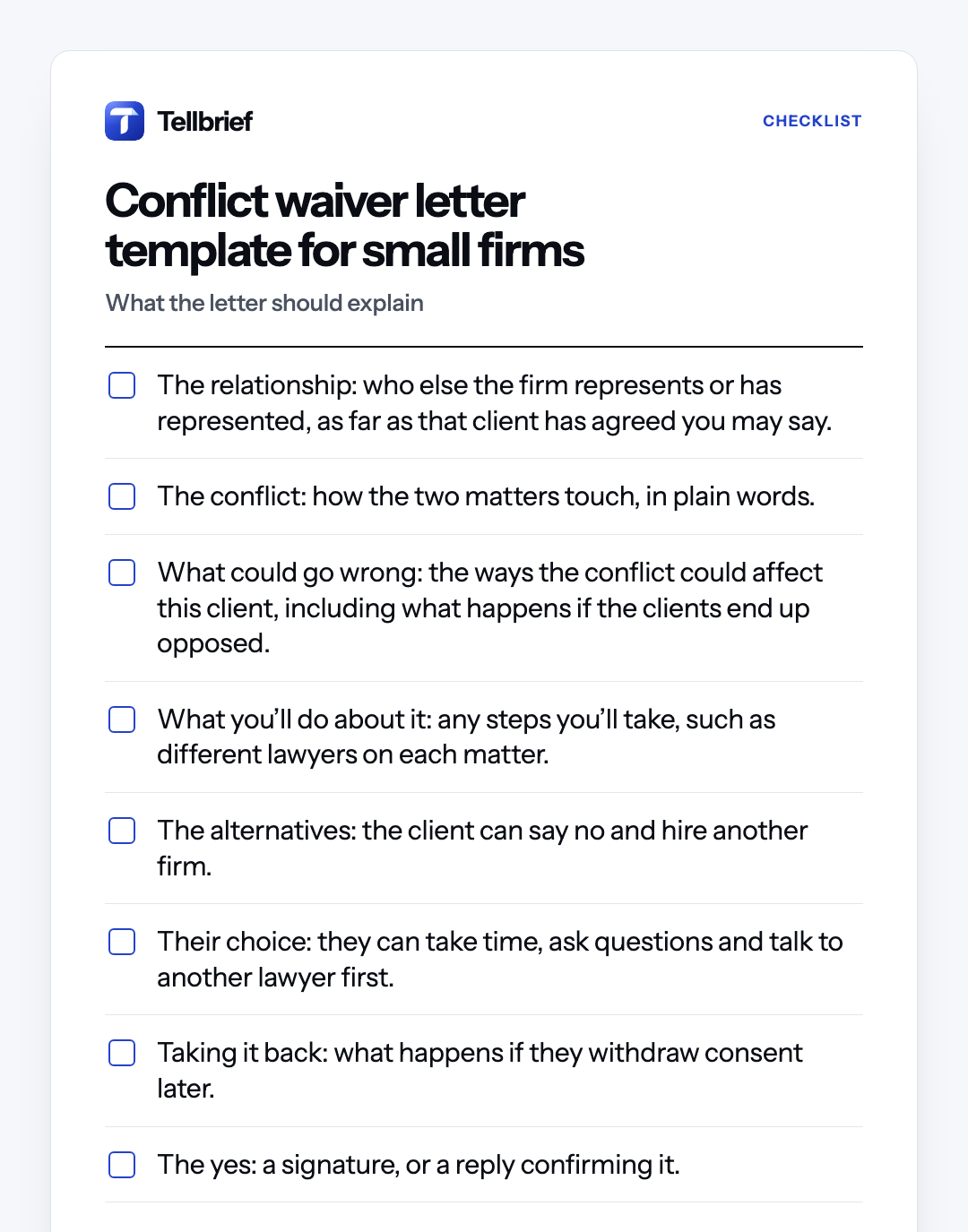
What the letter should explain
- The relationship: who else the firm represents or has represented, as far as that client has agreed you may say.
- The conflict: how the two matters touch, in plain words.
- What could go wrong: the ways the conflict could affect this client, including what happens if the clients end up opposed.
- What you’ll do about it: any steps you’ll take, such as different lawyers on each matter.
- The alternatives: the client can say no and hire another firm.
- Their choice: they can take time, ask questions and talk to another lawyer first.
- Taking it back: what happens if they withdraw consent later.
- The yes: a signature, or a reply confirming it.
On the last point, the comment to Rule 1.7 says a client “may revoke the consent to the client's own representation,” and whether that ends the firm’s work for the other client “depends on the circumstances.”1 Say so in the letter, so neither client is surprised.
When you can’t explain it
Sometimes the disclosure the waiver needs would reveal another client’s confidences. The comment covers this case: when one client won’t allow the disclosure, “the lawyer cannot properly ask the latter to consent.”1 Then the answer is a no. Send the non-engagement letter without giving the reason, so you don’t reveal the other client either.
Co-founders and other joint clients
Business lawyers meet this one on day one: two founders who want one lawyer to form their company. If you represent both, the comment to Rule 1.7 flags privilege first:
“With regard to the attorney-client privilege, the prevailing rule is that, as between commonly represented clients, the privilege does not attach. Hence, it must be assumed that if litigation eventuates between the clients, the privilege will not protect any such communications, and the clients should be so advised.”1Rule 1.7, comment [30]
The next comment says each client should be told at the start that information will be shared between them. Put both points in the letter, or start from the joint representation letter for co-founders. If you represent the company instead of the founders, say that, as the engagement letter template does.
Waivers of future conflicts
Some firms ask new clients to consent in advance to conflicts that haven’t arisen. The comment to Rule 1.7 says “the effectiveness of such waivers is generally determined by the extent to which the client reasonably understands the material risks that the waiver entails,” and that “if the consent is general and open-ended, then the consent ordinarily will be ineffective.”1 Describe the kinds of future matters specifically, or leave advance waivers out.
Get the names before the story
A waiver discussion goes better when the firm hasn’t yet heard the new client’s side in detail. The conflict check guide and the Rule 1.18 checklist cover collecting names first. Tellbrief shows you only the names when a client books, and keeps their brief locked until you clear them, so you can work out the conflict and get consent before you read the story. Start a free pilot; your first three briefs are free.
A waiver letter you can copy
Subject: Your consent to a conflict of interest: [matter]
Dear [name],
Before we take on [matter] for [client], we need your informed consent to a conflict of interest, confirmed in writing. This letter explains it. Please read it, ask us anything, and take the time you need.
The relationship. [Firm] [represents / has represented] [other client, if they’ve agreed we may name them, or: another client] in [general description of the other matter].
The conflict. [Explain how the matters relate, for example: The agreement you’ve asked us to negotiate is with a company we represent on unrelated contracts.]
What could go wrong. [Explain the risks, for example: We may be less free to press some points against them. If you and [other client] end up in a dispute, we could not represent you in it, and you would need to hire another firm.]
What we’ll do. [Steps, for example: Different lawyers will work on each matter, and we won’t share either client’s confidential information with the other.]
Your alternatives. You don’t have to agree. You can hire another firm for this matter, and you’re welcome to talk to another lawyer before you decide.
Changing your mind. You may withdraw this consent at any time by telling us. If you do, we may have to stop working on this matter, and depending on the circumstances, on [other client]’s matter too.
If you agree, please sign below and return a copy.
[Lawyer], [firm]
I have read this letter, had the chance to ask questions, and consent to [firm] representing [client] in [matter] despite the conflict described above.
______________________ [name, title], for [client], Date: __________
A confirming email you can copy
Use it when the client gave consent on a call. Send it the same day.
Subject: Confirming your consent: [matter]
Hi [name],
Thanks for talking this through today. To confirm what we discussed: [firm] [represents / has represented] [description]. That creates a conflict of interest with [matter], because [reason]. The risks are [risks]. We’ll [steps]. You could instead hire another firm, and you can withdraw this consent at any time.
You told us you consent to our representing [client] in [matter] despite this conflict. If anything here doesn’t match your understanding, please tell us right away.
[Lawyer]
Sources
Each quote was checked against its source on November 1, 2026. Laws and guidance can change after that date.
Questions
Can every conflict be waived?
No. Rule 1.7(b), quoted above, lists four conditions, and consent is only the fourth. If any of the first three fails, consent doesn’t fix it.
Does the other client have to consent too?
Rule 1.7(b)(4) says “each affected client” gives informed consent, confirmed in writing. Decide who is affected, and get consent from each.
Is an email enough?
Rule 1.0(b) counts a writing the lawyer promptly sends confirming an oral consent, and Rule 1.0(o) counts electronic communications as writing. Check your state’s version.
What if the client doesn’t reply?
The comment to Rule 1.0 says a lawyer may not assume consent from silence. Wait for a yes, or treat it as a no.
Should we ask for consent to future conflicts?
Only with a specific description of the kinds of matters. The comment to Rule 1.7 says general, open-ended consent ordinarily won’t be effective.
Try it on your next three first calls
Your first three briefs are free. Setup is one short call: you paste one line into your booking confirmation, and you see each client’s names before anything else.
For education only. This article is general information, not legal advice, and reading it doesn’t make you anyone’s client. Tellbrief is not a law firm. For advice about your situation, talk to a licensed lawyer.