Engagement letter template for business clients
For education only. Not legal advice. Tellbrief is not a law firm.
The first call ends with a yes. The engagement letter turns that yes into terms both sides can point to later, while the call is still fresh.
In short
Name the client, say what the work covers and what it leaves out, set out the fee and expenses, and say when the engagement ends. When the client is a company, say so, and say whether you also represent its founders. The guide quotes Rules 1.5(b), 1.2(c) and 1.13, then gives a letter and a scope-change email to copy.
On this page
Why put it in writing
ABA Model Rule 1.5(b), as Minnesota adopted it, sets out what has to be communicated and when:
“The scope of the representation and the basis or rate of the fee and expenses for which the client will be responsible shall be communicated to the client, preferably in writing, before or within a reasonable time after commencing the representation, except when the lawyer will charge a regularly represented client on the same basis or rate. Any changes in the basis or rate of the fee or expenses shall also be communicated to the client.”1Rule 1.5(b)
The comment explains why a written statement helps a new client in particular:
“Generally, it is desirable to furnish the client with at least a simple memorandum or copy of the lawyer's customary fee arrangements that states the general nature of the legal services to be provided, the basis, rate or total amount of the fee and whether and to what extent the client will be responsible for any costs, expenses or disbursements in the course of the representation. A written statement concerning the terms of the engagement reduces the possibility of misunderstanding.”1Rule 1.5, comment [2]
Your state’s version of the rule is the one that applies, and some states add their own requirements for fee agreements. Check yours before you settle on a form.
Name the client
A founder books the call, but the work may be for a company, for the founder, or for both. Rule 1.13(a) starts from the company:
“A lawyer employed or retained by an organization represents the organization acting through its duly authorized constituents.”2Rule 1.13(a)
When the company’s interests are adverse to those of the founder you’re talking to, the rule asks you to explain who the client is. In Minnesota’s numbering that’s paragraph (e):
“In dealing with an organization's directors, officers, employees, members, shareholders or other constituents, a lawyer shall explain the identity of the client when the lawyer knows or reasonably should know that the organization's interests are adverse to those of the constituents with whom the lawyer is dealing.”2Rule 1.13(e)
The letter is the easiest place to settle this before it matters. Name the client by its legal name. If the company isn’t formed yet, say who the client is until it is, and what happens once it exists. If you’ll also represent a founder, Rule 1.13(f) allows it “subject to the provisions of Rule 1.7,” so run the conflict analysis and, where consent is needed, get it in writing. The conflict waiver letter template covers that consent. If two founders want you to represent them both, start from the joint representation letter.
Say what the work covers, and what it leaves out
Rule 1.2(c) lets a lawyer and client agree on a narrower engagement:
“A lawyer may limit the scope of the representation if the limitation is reasonable under the circumstances and the client gives informed consent.”3Rule 1.2(c)
The comment adds a limit on the limit: a narrow engagement “would not be reasonable if the time allotted was not sufficient to yield advice upon which the client could rely.”3 For one-document or advice-only work, start from the limited-scope engagement letter template.
Scope is where a letter can head off an argument later. Describe the work as deliverables the client will recognize: “review and negotiate the retailer’s vendor agreement” reads better than “general corporate advice.” Then list what isn’t included, in the same plain terms: tax advice, filings in other states, disputes that arise from the deal, ongoing work after closing. Say what happens when new work comes up. A short email confirming the new scope and fee keeps the record straight without a new letter each time.
The first call is where scope comes from. If the client mentioned a co-founder who never signed anything, or a manufacturer who may own the recipe, decide whether that work is in or out, and say so.
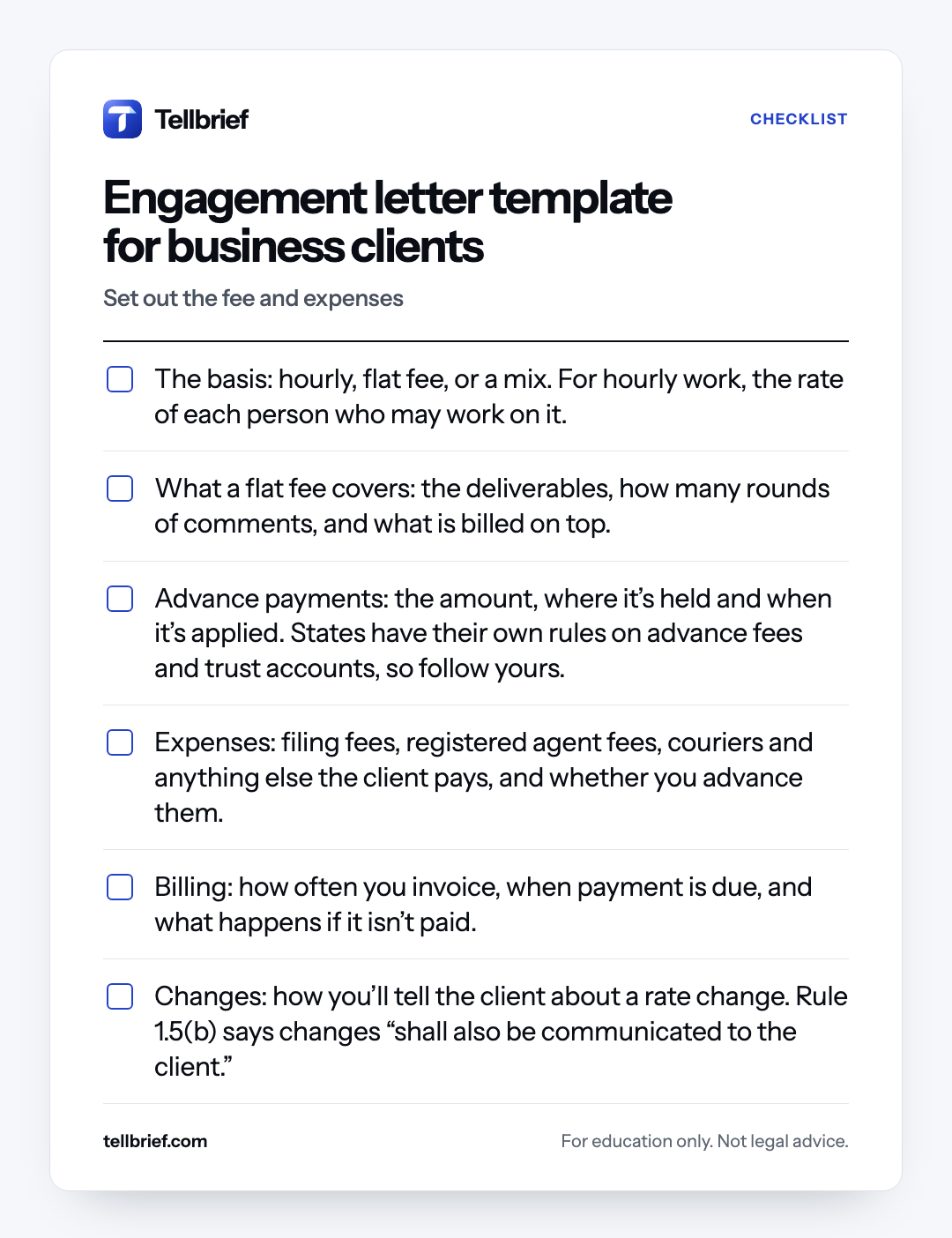
Set out the fee and expenses
- The basis: hourly, flat fee, or a mix. For hourly work, the rate of each person who may work on it.
- What a flat fee covers: the deliverables, how many rounds of comments, and what is billed on top.
- Advance payments: the amount, where it’s held and when it’s applied. States have their own rules on advance fees and trust accounts, so follow yours.
- Expenses: filing fees, registered agent fees, couriers and anything else the client pays, and whether you advance them.
- Billing: how often you invoice, when payment is due, and what happens if it isn’t paid.
- Changes: how you’ll tell the client about a rate change. Rule 1.5(b) says changes “shall also be communicated to the client.”1
Say how the work runs
Tell the client who to call and how fast to expect an answer. Name the lawyer responsible and anyone else who will work on the matter. Say how you’ll communicate, including whether email is fine for confidential matters and whether the client should avoid using a work account they share with others. List what you need from the client: documents, decisions, and who at the company can give you instructions.
Say when it ends
Write down when the engagement ends: on delivery of the work, at closing, or on a date. Then both sides know whether the company is still a current client when the next conflict check runs. Say that the client can end the engagement at any time, that you may withdraw as your state’s rules allow, and what happens to the file and any unearned advance when it ends.
Send it while the call is fresh
The longer the gap between the yes and the letter, the more the client’s memory of the scope and yours can drift. Draft it the same day, from your notes. The first-call checklist has a recap email you can send first, and the letter can follow once the client confirms. If the answer was no, use the non-engagement letter template instead.
A Tellbrief brief lists the related work a client didn’t ask about, like putting ownership in writing, and you can tick what you’d take on. That list is a starting point for the scope section. Start a free pilot; your first three briefs are free.
A template you can copy
Subject: Engagement letter: [client’s legal name]
Dear [name],
Thank you for choosing [firm]. This letter sets out the terms of our engagement. Please read it, and sign and return it if it matches your understanding.
Our client. Our client in this matter is [company’s legal name] (the “Company”). [We do not represent the Company’s founders, owners, officers or employees individually.] [Or: Until the Company is formed, our client is [founder name(s)], and once it is formed, the Company becomes our client for this matter.]
The work. We will [describe the deliverables, for example: review and negotiate the vendor agreement with [retailer], through signing].
Not included. This engagement does not include [for example: tax advice, filings outside [state], any dispute arising from the agreement, or work after signing]. If you’d like us to do more, we’ll confirm the added work and its fee by email before starting.
Fees. [We will bill at the hourly rates below: [name, rate]; [name, rate].] [Or: Our flat fee for the work above is $[amount], which covers [what it covers]. Work outside that is billed at [rate].] We will tell you in writing before any rate changes.
Advance and expenses. [We ask for an advance of $[amount], which we will hold in our trust account and apply to [invoices / the final invoice].] You are responsible for expenses such as [filing fees, registered agent fees]. [We will advance them and include them on your invoice.]
Billing. We invoice [monthly], and payment is due within [30] days.
Working together. [Lawyer] is responsible for this matter. [Others] may help. We will communicate by [email and phone]. Please send instructions from [name and title], or tell us in writing who else may give them. We need [documents and decisions] from you to do the work.
No promised outcome. We will give you our best judgment, but we can’t promise any particular result.
Ending the engagement. You may end this engagement at any time by telling us in writing. We may withdraw as the rules of professional conduct allow. Unless it ends sooner, this engagement ends when [we deliver the work above / the agreement is signed / [date]]. After it ends, we will return any unearned advance and keep your file for [period].
If this matches your understanding, please sign below and return a copy.
[Lawyer], [firm]
Agreed: ______________________ [name, title], for [Company], Date: __________
A scope-change email you can copy
Send it when new work comes up mid-matter, before you start on it.
Subject: Added work: [short description]
Hi [name],
As we discussed, you’d like us to add [new work] to our engagement for [Company]. [It’s billed at our hourly rates in the engagement letter.] [Or: Our flat fee for it is $[amount].] Everything else in the engagement letter stays the same.
Please reply to confirm, and we’ll start.
[Lawyer]
Sources
Each quote was checked against its source on November 1, 2026. Laws and guidance can change after that date.
- ABA Model Rule 1.5: Fees, with comments, as adopted in the Minnesota Rules of Professional Conduct (opens in a new tab) ↩︎
- ABA Model Rule 1.13: Organization as Client, as adopted in Minnesota (opens in a new tab) ↩︎
- ABA Model Rule 1.2: Scope of Representation, with comments, as adopted in Minnesota (opens in a new tab) ↩︎
Questions
Does an engagement letter have to be in writing?
Rule 1.5(b), quoted above, says scope and fees shall be communicated “preferably in writing.” Some states add their own requirements, so check your state’s version and any statute on fee agreements.
Should the client sign it?
A signed copy shows the client read and agreed to the terms. If your state requires a signed agreement for a kind of fee, such as a contingent fee, follow that rule.
Can we represent the company and its founders at the same time?
Rule 1.13(f), as Minnesota adopted it, allows it subject to Rule 1.7. Run the conflict analysis first and get any consent the rule calls for in writing.
What should the scope section leave out?
Anything you aren’t taking on that the client might assume you are: tax, other states, disputes, or work after the deal closes. Say it in the client’s terms.
What if the work grows after we start?
Confirm the added work and its fee in writing before you start. The scope-change email above is enough for most changes.
Try it on your next three first calls
Your first three briefs are free. Setup is one short call: you paste one line into your booking confirmation, and you see each client’s names before anything else.
For education only. This article is general information, not legal advice, and reading it doesn’t make you anyone’s client. Tellbrief is not a law firm. For advice about your situation, talk to a licensed lawyer.