Joint representation letter for co-founders
For education only. Not legal advice. Tellbrief is not a law firm.
Two founders want one lawyer to set up their company. The rules allow it, with each founder’s informed consent. The letter is where each of them hears what that means before they say yes.
In short
Rule 1.7 lets one lawyer help co-founders organize a business when their interests are generally aligned and each gives informed consent, confirmed in writing. Each founder should hear that what they tell you is shared, that privilege may not protect it between them, and that you may have to withdraw from both. It ends with a letter to copy.
On this page
When one lawyer for both can work
The comment to ABA Model Rule 1.7, as Minnesota adopted it, uses this case as its example. It says “common representation is permissible where the clients are generally aligned in interest even though there is some difference in interest among them,” and that “the lawyer may help to organize a business in which two or more clients are entrepreneurs.”1 It also gives the reason clients choose it:
“Otherwise, each party might have to obtain separate representation, with the possibility of incurring additional cost, complication or even litigation. Given these and other relevant factors, the clients may prefer that the lawyer act for all of them.”1Rule 1.7, comment [28]
It’s still a conflict. The comment says a lawyer asked to represent several people forming a joint venture “is likely to be materially limited in the lawyer's ability to recommend or advocate all possible positions that each might take because of the lawyer's duty of loyalty to the others.”1 So Rule 1.7(b) applies, and each founder must give “informed consent, confirmed in writing.”1 The conflict waiver letter template covers what those words mean.
When it can’t
The comment is blunt about how a joint engagement ends when it fails:
“Ordinarily, the lawyer will be forced to withdraw from representing all of the clients if the common representation fails.”1Rule 1.7, comment [29]
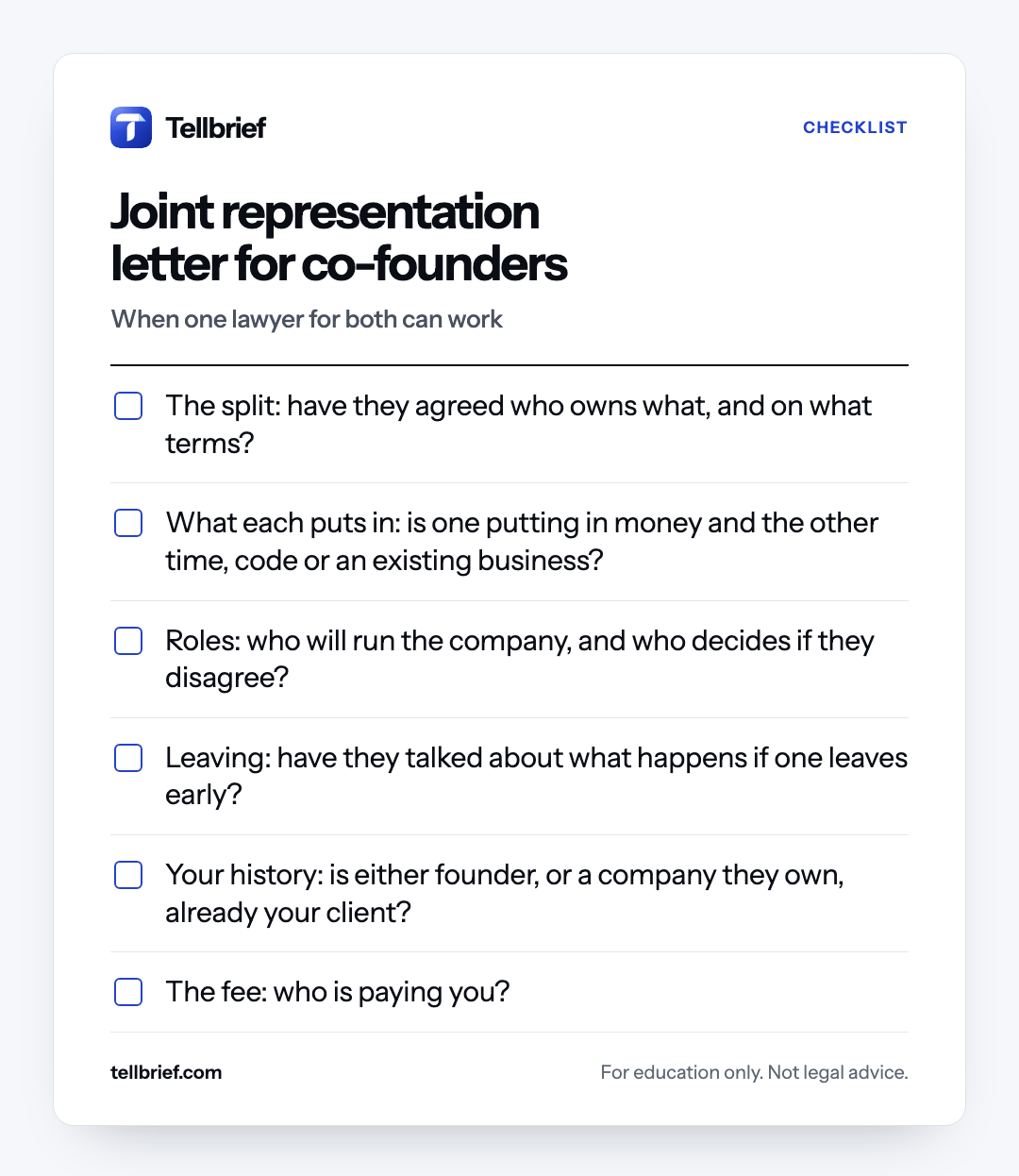
And it says where that risk starts: “Generally, if the relationship between the parties has already assumed antagonism, the possibility that the clients' interests can be adequately served by common representation is not very good.”1 So find out on the first call whether the founders already disagree. A few questions bring it out:
- The split: have they agreed who owns what, and on what terms?
- What each puts in: is one putting in money and the other time, code or an existing business?
- Roles: who will run the company, and who decides if they disagree?
- Leaving: have they talked about what happens if one leaves early?
- Your history: is either founder, or a company they own, already your client?
- The fee: who is paying you?
If they’re far apart on any of these, the work is a negotiation between them, and each may need a lawyer. The first-call checklist covers the rest of the call. If you won’t take it, the guide to declining on a call has a script.
Three ways to set it up
- Both founders, jointly. One engagement, two clients, with each founder’s informed consent, confirmed in writing. The letter below is for this.
- The company only. Rule 1.13(a) says: “A lawyer employed or retained by an organization represents the organization acting through its duly authorized constituents.”2 The founders are not your clients, and each may want a lawyer of their own for the terms between them. The engagement letter template has a line for this.
- One founder. The other founder isn’t your client. Rule 4.3 says the lawyer “shall not state or imply that the lawyer is disinterested,” and, where their interests may conflict, shall not give them advice “other than the advice to secure counsel.”3 Tell them so early, in writing.
What each founder should hear
The comment says that for a joint engagement, informed consent must cover “the implications of the common representation, including possible effects on loyalty, confidentiality and the attorney-client privilege and the advantages and risks involved.”1 Put each of these in the letter:
- Privilege: “it must be assumed that if litigation eventuates between the clients, the privilege will not protect any such communications, and the clients should be so advised.”1
- Nothing kept between them: the lawyer should “advise each client that information will be shared and that the lawyer will have to withdraw if one client decides that some matter material to the representation should be kept from the other.”1
- Your role: you won’t take one side, so “the clients may be required to assume greater responsibility for decisions than when each client is separately represented.”1
- If it fails: you may have to stop working for both of them, and each would need a new lawyer.
- The alternative: each founder can hire a separate lawyer, at more cost.
- Leaving: each founder keeps “the right to discharge the lawyer.”1
- Who pays: a lawyer may be paid by “a co-client, if the client is informed of that fact and consents.”1
If the joint engagement narrows the work, the comment says those limits “should be fully explained to the clients at the outset of the representation.”1 The limited-scope letter template shows how to write a limit down.
Check every name first
A joint engagement has more names to clear: both founders, the company, any company either founder owns now, and anyone else with a stake, like an investor or a former co-founder. The conflict check guide covers the search. Tellbrief shows you only the names when a client books, and keeps their brief locked until you clear them, so you can check both founders before either tells you their side. Start a free pilot; your first three briefs are free.
A joint representation letter you can copy
Subject: Representing you both: [company or project name]
Dear [founder 1] and [founder 2],
You’ve asked [firm] to represent you both in [forming [company] / the agreement between you as founders]. We can, if each of you agrees after reading this letter. Please read it, ask us anything, and take the time you need. You’re each free to talk to another lawyer before you sign.
Who our clients are. Our clients are [founder 1] and [founder 2], together. [Once [company] is formed, it will also be our client.] / [We don’t represent [company] / We will represent [company] only once it is formed, under a separate letter.]
What we’ll do. [For example: Form [company] in [state], prepare the [operating agreement / founder stock agreements], and advise you both on them.] We won’t [for example: negotiate for one of you against the other, or advise either of you on personal tax].
We work for you both equally. We can’t take one founder’s side on terms where your interests differ, such as the ownership split, vesting or what happens if one of you leaves. You’ll each need to decide those for yourselves, and you may each want separate advice on them.
Nothing is kept between you. Anything either of you tells us about this matter may be shared with the other. If one of you asks us to keep something important from the other, we’ll have to stop working for you both.
Privilege. If the two of you later end up in a dispute, what you’ve told us in this joint engagement will likely not be protected by attorney-client privilege as between you.
If you stop agreeing. If a disagreement between you can’t be worked out, we’ll likely have to stop representing both of you in this matter, and you’d each need to hire another lawyer. [We won’t represent either of you against the other in it afterwards.]
Your alternative. Each of you can hire your own lawyer instead. That costs more, and each of you would have someone on your side alone.
Fees. [Flat fee / hourly rates]. [Founder 1 / the company once formed / you both, equally] will pay our fees. Whoever pays, we work for you both.
Ending the engagement. Either of you can end our work for you at any time.
If you each agree, please sign below.
[Lawyer]
[Firm]I’ve read this letter and agree to [firm] representing us both on these terms.
[Founder 1], date: ______
[Founder 2], date: ______
An email if the founders stop agreeing
Rule 1.16(d) says that when representation ends, the lawyer “shall take steps to the extent reasonably practicable to protect a client's interests, such as giving reasonable notice to the client, allowing time for employment of other counsel, surrendering papers and property to which the client is entitled.”4 Send the same email to both founders.
Subject: We need to stop representing you both: [company]
Hi [founder 1] and [founder 2],
As our letter of [date] explained, we represent you both together, so we can’t act for one of you against the other. Because you now disagree about [issue, in neutral words], we have to stop representing both of you in [matter], effective [date].
[Any dates or deadlines coming up, and who needs to act on them.] We’ll send each of you a copy of your file by [date]. [Any unearned fees will be refunded to [payer].] We suggest each of you hire your own lawyer soon, and we’ll send your file to them if you ask.
[Lawyer]
Sources
Each quote was checked against its source on November 1, 2026. Laws and guidance can change after that date.
- ABA Model Rule 1.7: Conflict of Interest: Current Clients, with comments, as adopted in the Minnesota Rules of Professional Conduct (opens in a new tab) ↩︎
- ABA Model Rule 1.13: Organization as Client, as adopted in Minnesota (opens in a new tab) ↩︎
- ABA Model Rule 4.3: Dealing with Unrepresented Person, as adopted in Minnesota (opens in a new tab) ↩︎
- ABA Model Rule 1.16: Declining or Terminating Representation, as adopted in Minnesota (opens in a new tab) ↩︎
Questions
Can one lawyer represent both co-founders?
The comment to Rule 1.7 says a lawyer may help organize a business for two or more entrepreneurs when their interests are generally aligned. Each founder must give informed consent, confirmed in writing. Check your state’s version.
Is what co-founders tell a joint lawyer privileged?
Comment [30] to Rule 1.7 says that between commonly represented clients the prevailing rule is that the privilege doesn’t attach, and the clients should be told so.
Can one founder ask the lawyer to keep something from the other?
Comment [31] says the lawyer should tell both at the start that information will be shared, and that the lawyer will have to withdraw if one decides something material should be kept from the other.
What happens if the founders fall out?
Comment [29] says the lawyer will ordinarily have to withdraw from representing all of them. Say so in the letter.
Should the lawyer represent the company instead?
That’s one option. Under Rule 1.13(a), a lawyer retained by an organization represents the organization. The founders then aren’t clients, and each may want their own lawyer.
Try it on your next three first calls
Your first three briefs are free. Setup is one short call: you paste one line into your booking confirmation, and you see each client’s names before anything else.
For education only. This article is general information, not legal advice, and reading it doesn’t make you anyone’s client. Tellbrief is not a law firm. For advice about your situation, talk to a licensed lawyer.