Limited scope engagement letter template
For education only. Not legal advice. Tellbrief is not a law firm.
A founder wants one lease read, or an hour on one decision, and nothing more. Rule 1.2(c) allows that. The letter is what keeps both sides clear on where the work stops.
In short
A limited engagement is allowed when the limit is reasonable and the client gives informed consent. Name the one thing you’ll do, list what you won’t, say what that means for the client, and close it in writing when the work is done. The guide quotes Rules 1.2(c), 1.0(f) and 1.5(b), then gives a letter and a closing email to copy.
On this page
What the rule allows
ABA Model Rule 1.2(c), as Minnesota adopted it, is one sentence:
“A lawyer may limit the scope of the representation if the limitation is reasonable under the circumstances and the client gives informed consent.”1Rule 1.2(c)
The comment gives the client’s side of it: “A limited representation may be appropriate because the client has limited objectives for the representation.”1 The terms can also leave out steps “that the client thinks are too costly.”1 For a business lawyer, a limited engagement might be:
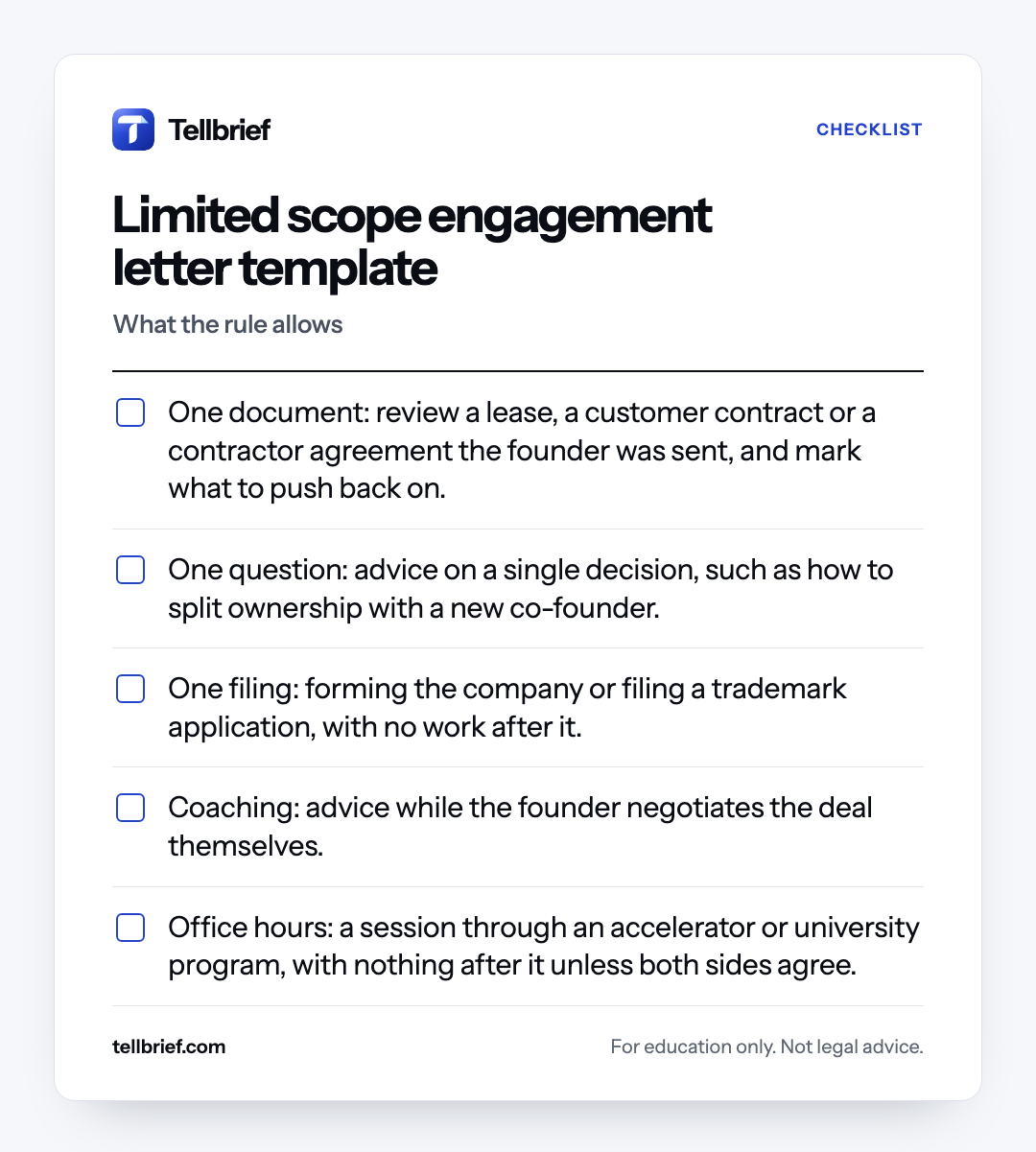
- One document: review a lease, a customer contract or a contractor agreement the founder was sent, and mark what to push back on.
- One question: advice on a single decision, such as how to split ownership with a new co-founder.
- One filing: forming the company or filing a trademark application, with no work after it.
- Coaching: advice while the founder negotiates the deal themselves.
- Office hours: a session through an accelerator or university program, with nothing after it unless both sides agree.
When a limit isn’t reasonable
The comment draws the line with an example:
“If, for example, a client's objective is limited to securing general information about the law the client needs in order to handle a common and typically uncomplicated legal problem, the lawyer and client may agree that the lawyer's services will be limited to a brief telephone consultation. Such a limitation, however, would not be reasonable if the time allotted was not sufficient to yield advice upon which the client could rely.”1Rule 1.2, comment [7]
The same comment says a narrow engagement doesn’t lower the bar on competence. The limit is “a factor to be considered when determining the legal knowledge, skill, thoroughness, and preparation reasonably necessary for the representation.”1 So fit the work to what you can do well in the time. If the question needs more, say so before you start. The first-call checklist covers what to find out on the call.
What informed consent asks for
Rule 1.0(f) defines informed consent as agreement “after the lawyer has communicated adequate information and explanation about the material risks of and reasonably available alternatives to the proposed course of conduct.”2 For a limited engagement, that means telling the client what you won’t do and what it could cost them. If you review a contract but don’t negotiate it, they need to know nobody is checking the final version. If you form the company but don’t draft an agreement between the founders, they need to know none exists yet.
Rule 1.5(b) adds that the scope and fee “shall be communicated to the client, preferably in writing.”3 A letter is the record both sides can point to if the client later thinks you were handling more. Some states add their own requirements for limited-scope work, especially in court matters, so check your state’s version.
What the letter should say
- The one thing: the document, question or filing, named the way the client would name it.
- What you won’t do: the steps a client might assume come with it, like negotiating with the other side, drafting changes, reviewing later drafts, making filings or tracking deadlines.
- What that means for them: the risk of the narrower work, in one plain sentence, and that they can hire you or another lawyer for the whole matter instead.
- The facts you relied on: your advice rests on what the client told you and the documents they sent, and they should tell you if anything is wrong or missing.
- Their part: the steps they’ll take themselves, and any deadlines that are theirs to keep.
- The fee: flat or hourly, and what it covers.
- When it ends: on delivery of the advice or the filing, and how to ask for more.
Close it in writing
A limited engagement ends sooner than a client may expect. A short email when the work is done tells them you’ve stopped, and tells your firm whether they’re a current client the next time a conflict check runs. The second template below does that. If they come back with more, the scope-change email in the engagement letter template confirms the added work.
Know the facts before the call
A short engagement leaves little time to learn the background. A Tellbrief brief is the client’s own answers in writing, sent before the call: who is involved, what the business does, what they want and what worries them. That gives you a record of the facts they gave you, which is what a limited-scope letter says your advice rests on. Start a free pilot; your first three briefs are free.
A limited-scope letter you can copy
Subject: Our limited engagement: [short description]
Dear [name],
Thank you for asking [firm] to help with [short description]. This letter sets out what we’ll do, what we won’t, and what it costs. Please read it, and sign and return it if it matches your understanding.
Our client. Our client is [client’s legal name].
What we’ll do. We will [for example: review the [lease / contract] you sent us on [date] and give you our comments in [a marked-up copy / a call of up to [60] minutes]].
What we won’t do. We will not [for example: negotiate with [the other side], draft changes, review later versions, make any filing, or track deadlines for you]. You will [for example: handle the negotiation yourself]. If you’d like us to do more, we’ll confirm the added work and its fee in writing before starting.
What this means for you. Because our work is limited, [explain the risk in plain words, for example: no lawyer will review the final version before you sign it]. You’re welcome to hire us or another lawyer for the whole matter instead.
The facts. Our advice will rest on what you’ve told us and the documents you’ve sent. If anything is missing or changes, please tell us, because it may change our advice.
Fee. [Our flat fee is $[amount].] [Or: We will bill at $[rate] an hour, and expect this to take about [hours].] [Payment is due [when].]
When it ends. This engagement ends when we [deliver our comments / finish the call / make the filing]. After that, we won’t be working on this matter unless we agree in writing to do more.
If this matches your understanding, please sign below and return a copy.
[Lawyer], [firm]
Agreed: ______________________ [name, title], for [client], Date: __________
A closing email you can copy
Send it the day the work is done.
Subject: Finished: [short description]
Hi [name],
[Our comments on the [document] are attached.] [Or: Thanks for the call today.] That completes the work in our engagement letter of [date], so we’re no longer working on this matter.
[What they do next, for example: You’ll take the changes we marked to [the other side] yourself.] If you’d like us to do more, reply and we’ll confirm the work and fee before we start.
[Lawyer]
Sources
Each quote was checked against its source on November 1, 2026. Laws and guidance can change after that date.
Questions
Does a limited-scope engagement have to be in writing?
Rule 1.2(c), quoted above, asks for the client’s informed consent, and Rule 1.5(b) says scope is communicated “preferably in writing.” Some states require more, so check your state’s version.
How narrow is too narrow?
Comment [7] to Rule 1.2 says a limit isn’t reasonable if the time allowed isn’t enough to give advice the client can rely on. If the question needs more, say so before you start.
Does a limited engagement lower the standard of care?
Comment [7] says it doesn’t exempt the lawyer from the duty of competence, though the limit is a factor in what competence calls for.
What should the letter say we won’t do?
The steps a client might assume come with the work: negotiating, drafting changes, reviewing later drafts, filings and deadlines. Say it in the client’s terms.
What if the client wants more once we start?
Confirm the added work and its fee in writing before you start on it. The scope-change email in the engagement letter template works here.
Try it on your next three first calls
Your first three briefs are free. Setup is one short call: you paste one line into your booking confirmation, and you see each client’s names before anything else.
For education only. This article is general information, not legal advice, and reading it doesn’t make you anyone’s client. Tellbrief is not a law firm. For advice about your situation, talk to a licensed lawyer.