Business ownership and estate planning: what to have ready
For education only. Not legal advice. Tellbrief is not a law firm.
A business share can be the largest asset in a plan and the hardest to hand over. What happens to it is decided by documents many owners have never read together.
In short
The business facts a plan turns on: what you own and in what form, who else owns it, whether a written agreement says what happens when an owner dies or leaves, and what you want for your share and your family. The agreement, if there is one, is the first document the lawyer will want.
On this page
What the lawyer needs to establish
Start with the form: sole proprietorship, partnership, or company, and your share of it.1 Then the other owners, and the key document question: is there a written agreement between the owners about what happens when one dies, leaves, or cannot work? Such agreements (called buy-sell agreements) can set who may buy the share, at what value, and how it is paid for. A buy-sell agreement may establish purchase rights, transfer restrictions, valuation methods and payment arrangements. What it provides on value and payment is a matter of the agreement’s own terms, and its effect depends on those terms, the entity’s governing documents and applicable law. A will does not necessarily override those arrangements, so the lawyer needs to examine the documents together. If there is no written agreement, that does not mean the estate plan alone determines what happens. The entity’s governing documents and applicable state law may supply rules about ownership, transfer and management.23 Delaware’s LLC statute, for example, treats an assignment of an LLC interest as transferring the economic interest; the assignee does not automatically become a member or gain management rights, which depend on the LLC agreement or the consent of the members as provided by statute.4 The lawyer should examine those arrangements and explain what additional planning would be needed to protect the family and the business.
The ownership facts
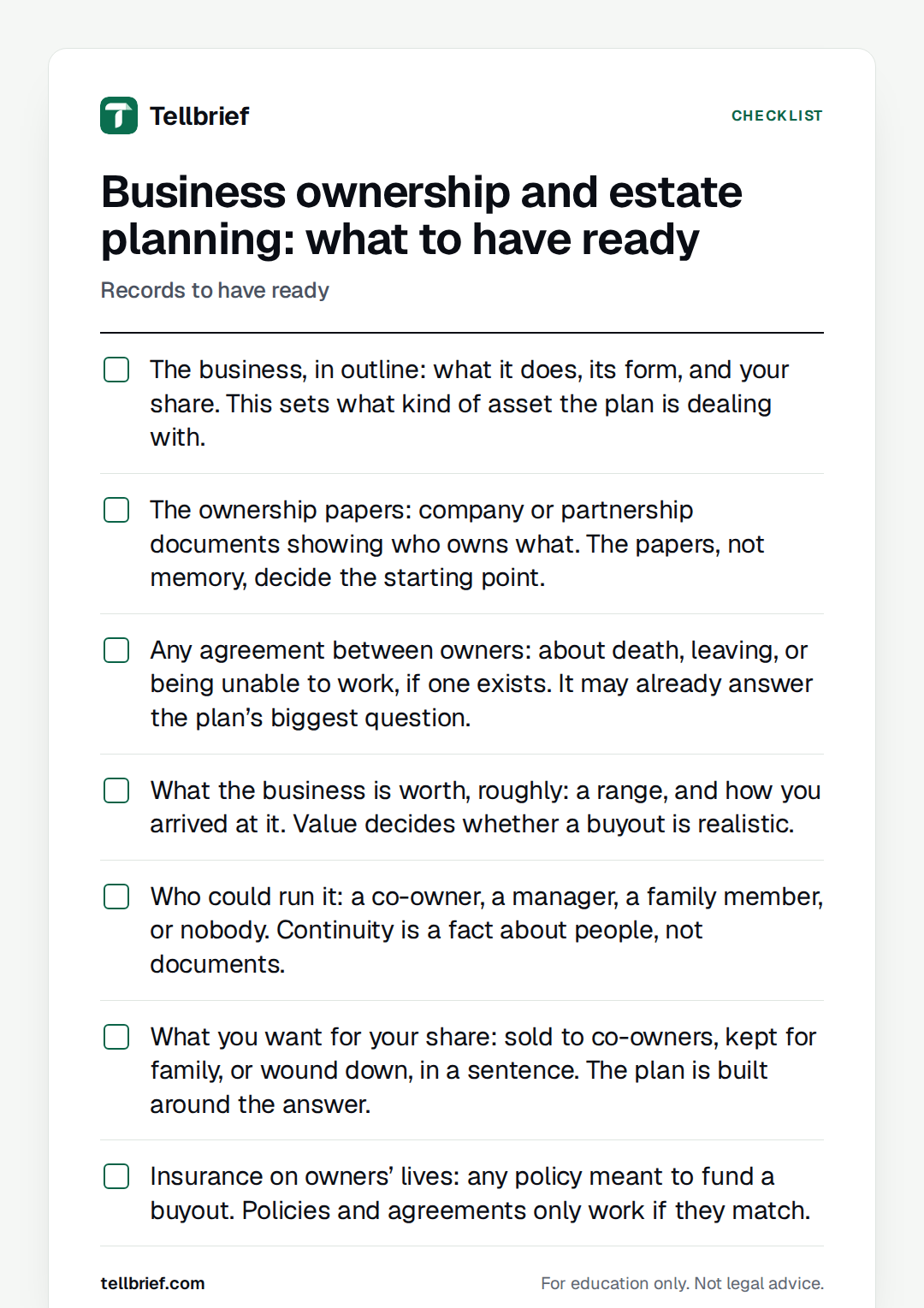
- The business, in outline: what it does, its form, and your share. This sets what kind of asset the plan is dealing with.
- The ownership papers: company or partnership documents showing who owns what. The papers, not memory, decide the starting point.
- Any agreement between owners: about death, leaving, or being unable to work, if one exists. It may already answer the plan’s biggest question.
- What the business is worth, roughly: a range, and how you arrived at it. Value decides whether a buyout is realistic.
- Who could run it: a co-owner, a manager, a family member, or nobody. Continuity is a fact about people, not documents.
- What you want for your share: sold to co-owners, kept for family, or wound down, in a sentence. The plan is built around the answer.
- Insurance on owners’ lives: any policy meant to fund a buyout. Policies and agreements only work if they match.
The family side of the same question
It can help to think about what your family would actually receive, and when: a salary stops at once, while a share may take time to turn into money. If a spouse or child works in the business, or depends on it, that belongs in the meeting too, along with who holds any powers of attorney for the business if you cannot act. The estate plan and the business’s own arrangements are handled in the same conversation, or at least need to agree with each other.
Example: half a plumbing company and a handshake
Made up for this guide
I own half of a plumbing company with a partner I started it with twelve years ago. We have articles and a handshake understanding that the survivor buys the other’s share, but nothing written about price or timing. My wife does not work in the business. Our main question: what should be written down so that, if I died, she is paid fairly for my share and he can keep the business running?
What the lawyer needs to establish
Have a short answer ready for each. “I don’t know yet” is a fine answer.
- What is the business’s form, and what share do you own?
- Is there a written agreement about an owner dying or leaving?
- Roughly what is your share worth, and how would that be worked out?
- Who could run the business without you?
- Does anyone in your family work in it, or depend on it?
- What would you want to happen to your share?
Questions worth asking your lawyer
- Does my will or trust deal with the share, or does the owners’ agreement control it?
- What should an agreement between us cover, if we make one?
- How is a value set, and kept current?
- What happens to the business while the estate is being sorted out?
If you would rather answer questions than gather papers, Tellbrief asks plain-language questions about your family, assets and existing documents, most of them one tap. It turns your answers into a brief your lawyer can read before the first call. You can download and keep a copy. See the estate planning sample brief to see what the lawyer receives.
Sources
Each quote was checked against its source on November 16, 2026. Laws and guidance can change after that date.
- U.S. Small Business Administration: Choose a Business Structure (opens in a new tab) ↩︎
- Minn. Stat. § 323A.0503: Transfer of a partner’s transferable interest (Minnesota Uniform Partnership Act) (opens in a new tab) ↩︎
- Delaware General Corporation Law, 8 Del. C. § 202: Restrictions on transfer and ownership of securities (opens in a new tab) ↩︎
- Delaware Limited Liability Company Act, 6 Del. C. § 18-702: Assignment of limited liability company interest (an LLC example) (opens in a new tab) ↩︎
Questions about a business in a plan
These answers help you get ready for a lawyer. They don’t say what the law means for your situation, or what you should do.
There is no agreement between us as owners. Is that unusual?
No, it is common in businesses started between friends or family. It means the governing documents and state law may supply more of the answer than owners expect, and the meeting can cover what an agreement should say.
Can I just leave my share to my spouse in my will?
Your will can express what you want to happen to property you own, but an entity’s governing documents, an enforceable buy-sell agreement or applicable law may restrict how a business interest can be transferred. The result depends on the business structure and the documents. Bring the ownership records and any agreement so the lawyer can examine how they work together.
How is a share valued for a buyout?
Agreements handle it different ways: a fixed figure reviewed yearly, a formula, or an independent valuation at the time. What matters is that the method is written down before it is needed.
Should the business plan and the estate plan be done together?
They need to agree, at least. If different lawyers handle them, each should see the other’s documents; the meeting can start that exchange.
Find the owners’ agreement before the meeting
Plain-language questions in the set, most of them one tap, free and with no account. Tellbrief turns your answers into a brief your lawyer can work from, and you keep a copy.