Will or revocable living trust: what to have ready
For education only. Not legal advice. Tellbrief is not a law firm.
“Should we have a trust?” is the second question. The first is what you own, how it is held, and who the plan has to work for.
In short
The choice turns on facts a lawyer will want to establish: what you own and how it is titled, whether you own property in another state, young children, and how much administration you want to leave behind. Have those ready and the comparison can be about your situation, not the general case.
On this page
What the lawyer needs to establish
A will and a revocable living trust do overlapping work in different ways. A will sets out instructions for distributing property that passes through the estate and can nominate a guardian for minor children. The legal effect of that nomination and the appointment process depend on applicable state law.1 A trust holds assets under a trustee’s management. A revocable living trust may also provide for management of its assets if you cannot manage them yourself, but that depends on its terms, the assets actually transferred into it and the arrangements for a successor trustee.2 Assets held in the trust pass under its terms, rather than under a will,3 and who would take over as trustee if you became unable to act is part of what the terms need to settle. Which fits depends on facts: what you own, how it is titled, where it is, and who depends on you. A lawyer advises on the comparison once those are on the table.
The facts the choice turns on
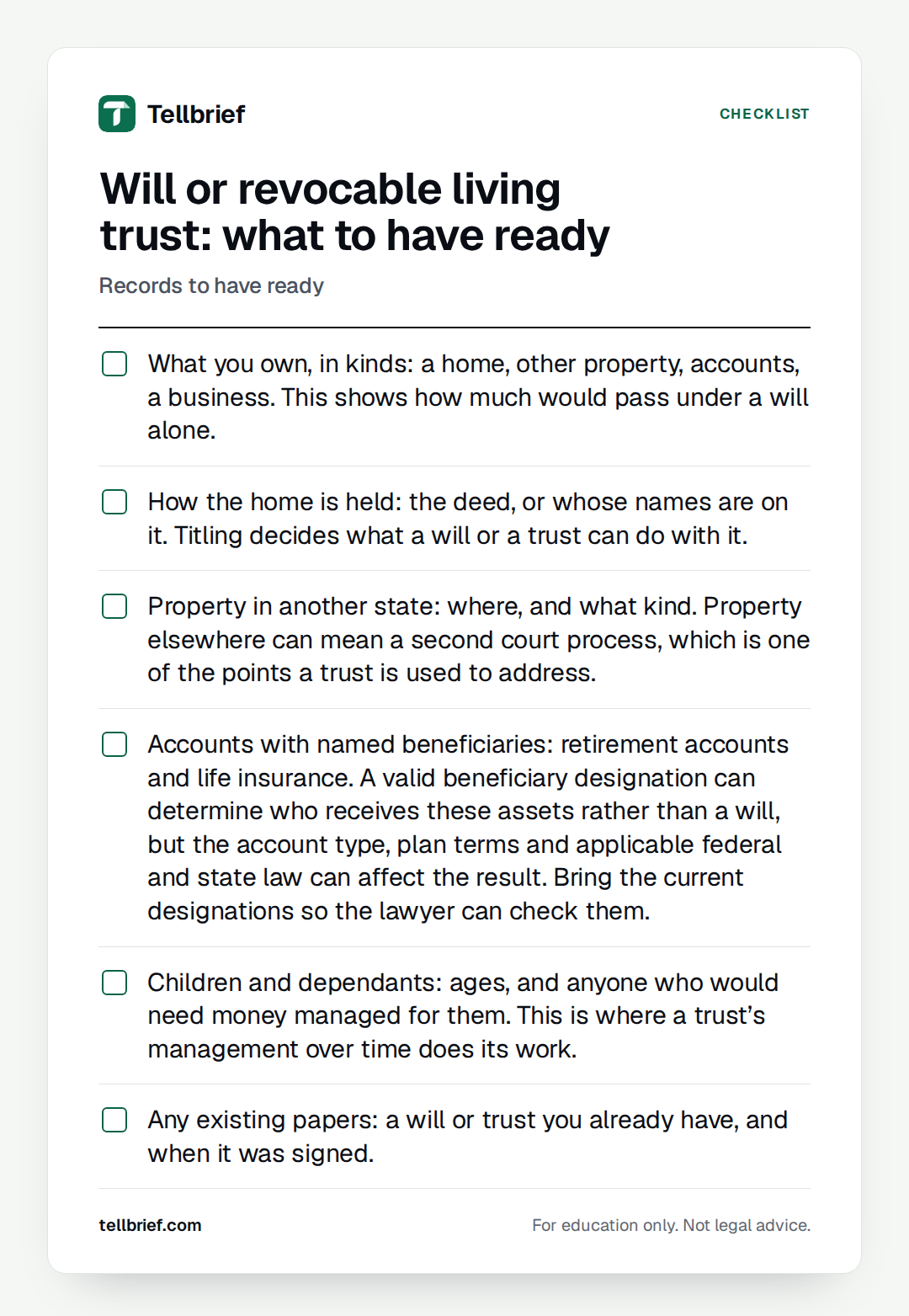
- What you own, in kinds: a home, other property, accounts, a business. This shows how much would pass under a will alone.
- How the home is held: the deed, or whose names are on it. Titling decides what a will or a trust can do with it.
- Property in another state: where, and what kind. Property elsewhere can mean a second court process, which is one of the points a trust is used to address.
- Accounts with named beneficiaries: retirement accounts and life insurance. A valid beneficiary designation can determine who receives these assets rather than a will, but the account type, plan terms and applicable federal and state law can affect the result. Bring the current designations so the lawyer can check them.
- Children and dependants: ages, and anyone who would need money managed for them. This is where a trust’s management over time does its work.
- Any existing papers: a will or trust you already have, and when it was signed.
What you would still have to do with a trust
A trust only governs what is put into it: the home, and accounts retitled to it.2 Lawyers call this funding the trust, and a plan that stops at signing may leave the main assets outside it. It can help to ask what the funding steps would be for your assets, and who does them, before you compare costs: the document is the smaller half of the work.
Capacity, and whose idea this is
Whichever document you choose, a lawyer will want to be satisfied about two things: that the person making the plan understands what it does, and that the choices are their own. If you are arranging the meeting for someone else, expect the lawyer to want time with that person directly, and to ask who chose the terms. That is not suspicion; it is what makes the document hold up if it is ever questioned, and it protects the person whose plan it is.
Example: a house, a flat in another state, two children
Made up for this guide
We own our house and a small rental flat in another state. Our children are nine and six. We have retirement accounts naming each other, and no wills. We keep hearing we “need a trust” because of the flat. Our main question: for our assets, what would a trust do that a will would not, and what would we have to do to set it up properly?
What the lawyer needs to establish
Have a short answer ready for each. “I don’t know yet” is a fine answer.
- What do you own, and how is the main property titled?
- Do you own property in another state?
- Who would need money managed for them, and for how long?
- What worries you about a will on its own: the court process, privacy, delay, cost?
- Who would you put in charge under each document?
- What papers do you already have?
Questions worth asking your lawyer
- For our assets, what does each document actually change?
- What would we have to retitle, and who does that work?
- How do the costs compare over time, not just at signing?
- What happens to each plan if we move state?
- Where do guardians for the children get named in each?
If you would rather answer questions than make lists, Tellbrief asks plain-language questions about your family, assets and existing documents, most of them one tap. It turns your answers into a brief your lawyer can read before the first call. You can download and keep a copy. See the estate planning sample brief to see what the lawyer receives.
Sources
Each quote was checked against its source on November 16, 2026. Laws and guidance can change after that date.
Questions about wills and trusts
These answers help you get ready for a lawyer. They don’t say what the law means for your situation, or what you should do.
Is a trust only for wealthy people?
No. The points that drive the choice are property in another state, young children, and wanting someone able to manage assets if you cannot. Size is one factor among several, and a lawyer can weigh them for your assets.
Does a trust avoid probate?
Assets held in the trust pass under its terms rather than through the court process a will goes through. Assets left outside it may not. That is why the funding steps matter, and why the comparison is about your assets specifically.
Can I have both?
Yes: a trust for the assets, with a will covering what is left and naming guardians. Ask how the two would fit together in your case.
We already have wills. Is a trust still worth discussing?
It can be, if what you own or your family has changed since. Bring the wills and the changes list, and the meeting can start from what the current plan does not cover.
Bring the facts the choice turns on
Plain-language questions in the set, most of them one tap, free and with no account. Tellbrief turns your answers into a brief your lawyer can work from, and you keep a copy.