Choosing guardians and protecting inheritances for minors
For education only. Not legal advice. Tellbrief is not a law firm.
Most parents have thought about who would raise their children. Fewer have thought about the second question: who would hold the money, and hand it over when.
In short
Two decisions: who would raise the children, with a backup, and how any money for them should be managed until they are old enough, and by whom. The people for the two jobs need not be the same. Rough thinking is enough to bring; the meeting is where the choices get tested.
On this page
What the lawyer needs to establish
First, the people: who you would choose to raise the children, whether they know, and who is next if they cannot. Parents can nominate a person they would want to raise their children in their wills or other documents recognized by state law. That nomination is an important part of planning, but it does not itself guarantee that the person will be appointed. The applicable law and court process determine the appointment. Ask the lawyer how your state treats the nomination and what would happen if your first choice could not serve.1 Second, the money: when a child inherits property, an adult may need to manage it until the child reaches the legally relevant age. Depending on the amount, how the property passes and state law, the arrangement might involve a trust, a custodial account2 or a court-appointed guardian of the child’s property, so the plan has to say who manages it and on what terms, until what age or ages. Whether the same person should do both jobs is a real question: the best home and the best money manager are not always the same household, and splitting the roles is common.
The people, and the money decisions
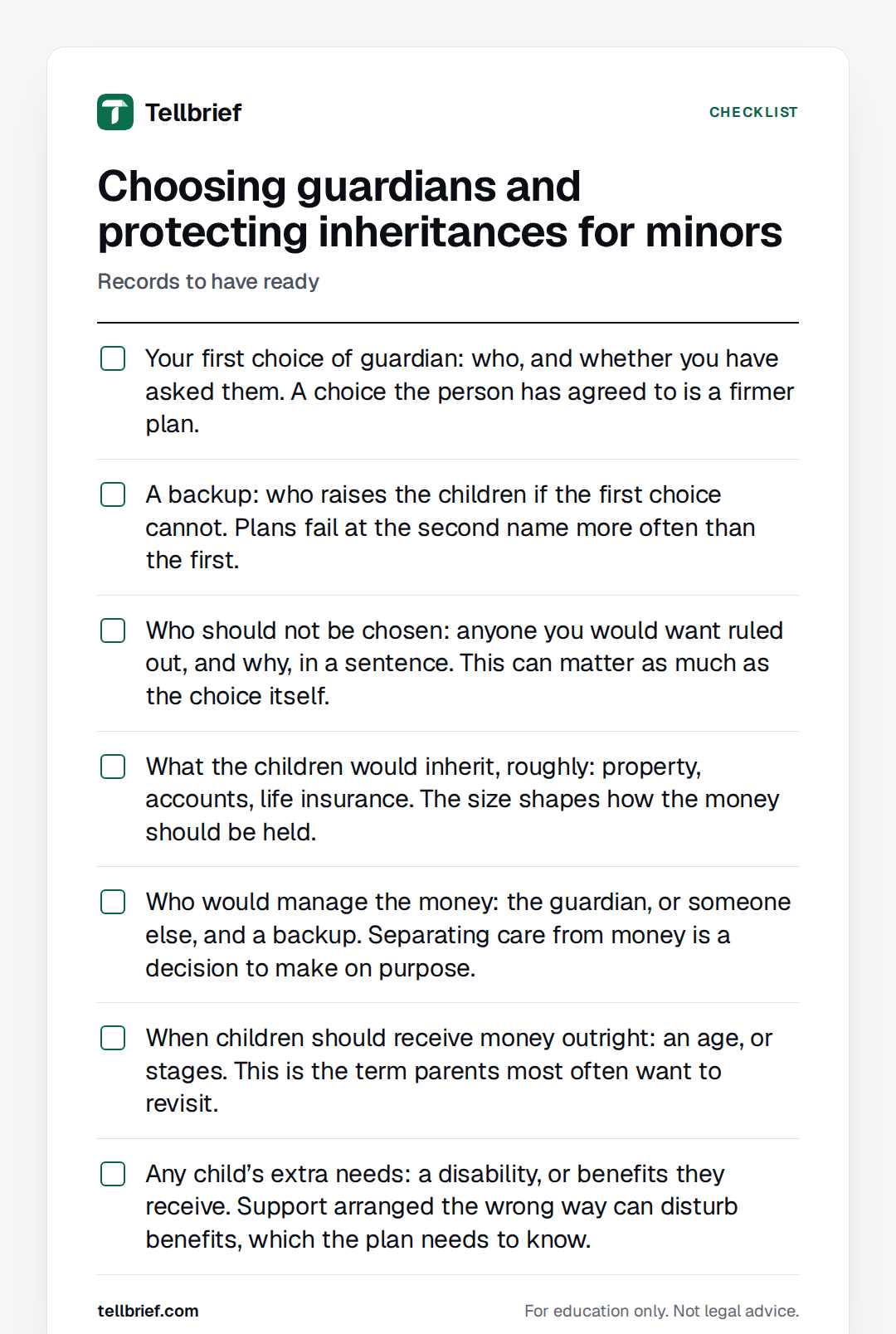
- Your first choice of guardian: who, and whether you have asked them. A choice the person has agreed to is a firmer plan.
- A backup: who raises the children if the first choice cannot. Plans fail at the second name more than the first.
- Who should not be chosen: anyone you would want ruled out, and why, in a sentence. This can matter as much as the choice itself.
- What the children would inherit, roughly: property, accounts, life insurance. The size shapes how the money should be held.
- Who would manage the money: the guardian, or someone else, and a backup. Separating care from money is a decision to make on purpose.
- When children should receive money outright: an age, or stages. This is the term parents most want to revisit.
- Any child’s extra needs: a disability, or benefits they receive. Support arranged the wrong way can disturb benefits, which the plan needs to know.3
Protecting the inheritance itself
Money left for a child can be held in a trust under the plan, released in stages, or held for purposes like education and health, and the differences are about control and timing rather than size. One point worth raising whatever you choose: money passing through an account beneficiary designation or joint ownership may not follow the arrangements in your will or trust. That can affect how money intended for a child is managed. Bring the beneficiary forms and ownership information so the lawyer can check whether those arrangements match the protections in your plan.
Example: a sister to raise them, a brother for the money
Made up for this guide
Our children are five and two. We would ask my sister to raise them; she knows and has agreed. Her husband is kind and hopeless with money, so we would rather my brother handled the finances, but we have not asked him. Between the house and life insurance the children would inherit a substantial amount. Our main question: how do we set it up so the money supports them growing up, and is not simply handed over at 18?
What the lawyer needs to establish
Have a short answer ready for each. “I don’t know yet” is a fine answer.
- Who would raise the children, and who is your backup?
- Have you asked them, and what did they say?
- Should the same people manage the money?
- At what age, or in what stages, should children receive money outright?
- Does any child have needs or benefits the plan should protect?
- Is there anyone you would want to rule out?
Questions worth asking your lawyer
- How is a guardianship choice written so a court follows it?
- What are the ways of holding money for children, and how do they differ?
- What happens if our first-choice guardian cannot act when the time comes?
- How do we change the names later?
If you would rather answer questions than start from a blank page, Tellbrief asks plain-language questions about your family, assets and existing documents, most of them one tap. It turns your answers into a brief your lawyer can read before the first call. You can download and keep a copy. See the estate planning sample brief to see what the lawyer receives.
Sources
Each quote was checked against its source on November 16, 2026. Laws and guidance can change after that date.
Questions about guardians and inheritances
These answers help you get ready for a lawyer. They don’t say what the law means for your situation, or what you should do.
What if we cannot agree on a guardian?
Bring both views, with the reasons. It is one of the most common points parents stall on, and a lawyer can talk through what courts look at and what a compromise nomination can look like.
Should the guardian also manage the money?
Not necessarily. Many plans split the roles: one person raises the children, another manages funds, each checking the other. Ask what the split involves in practice.
Our children are teenagers. Does this still matter?
Yes, though the emphasis shifts: a 16-year-old needs a guardian for a shorter time, but the money questions, and who manages it into their twenties, matter more, not less.
What if the person we chose moves abroad or their life changes?
Plans are reviewed when life changes. A backup named now is the simplest protection, and the plan can be updated as circumstances do.
Have both names picked before you meet
Plain-language questions in the set, most of them one tap, free and with no account. Tellbrief turns your answers into a brief your lawyer can work from, and you keep a copy.