Which assets go through probate: what to gather
For education only. Not legal advice. Tellbrief is not a law firm.
Two neighbours with the same wealth can leave very different amounts of court process behind. The difference is not the size; it is how each asset is held.
In short
Assets divide by how they pass: some under a will through a court process, others by the name on them, a joint title, or a trust. A lawyer sorts yours from a list of what you own and how each item is held. Kinds and titles are what to gather; exact values can wait.
On this page
What the lawyer needs to establish
Probate is a court-supervised process for establishing the validity of a will where required and administering a person’s estate after death.1 It can involve identifying and collecting assets, addressing debts and taxes, and distributing property. Which assets pass through that process depends on how they are owned, titled and designated, as well as the applicable state law: an account with a named beneficiary, property held jointly with rights of survivorship, and assets already in a trust may all pass outside it.2 A lawyer planning with you, or advising a family after a death, needs the same starting list either way: everything owned, and how each item is held. The process, its cost and its timing vary by state, and by the size and kind of what is left, which is why the sorting is done asset by asset rather than by a general rule. Where there is no will, the estate passes under the state’s intestacy rules instead.3
The sorting list
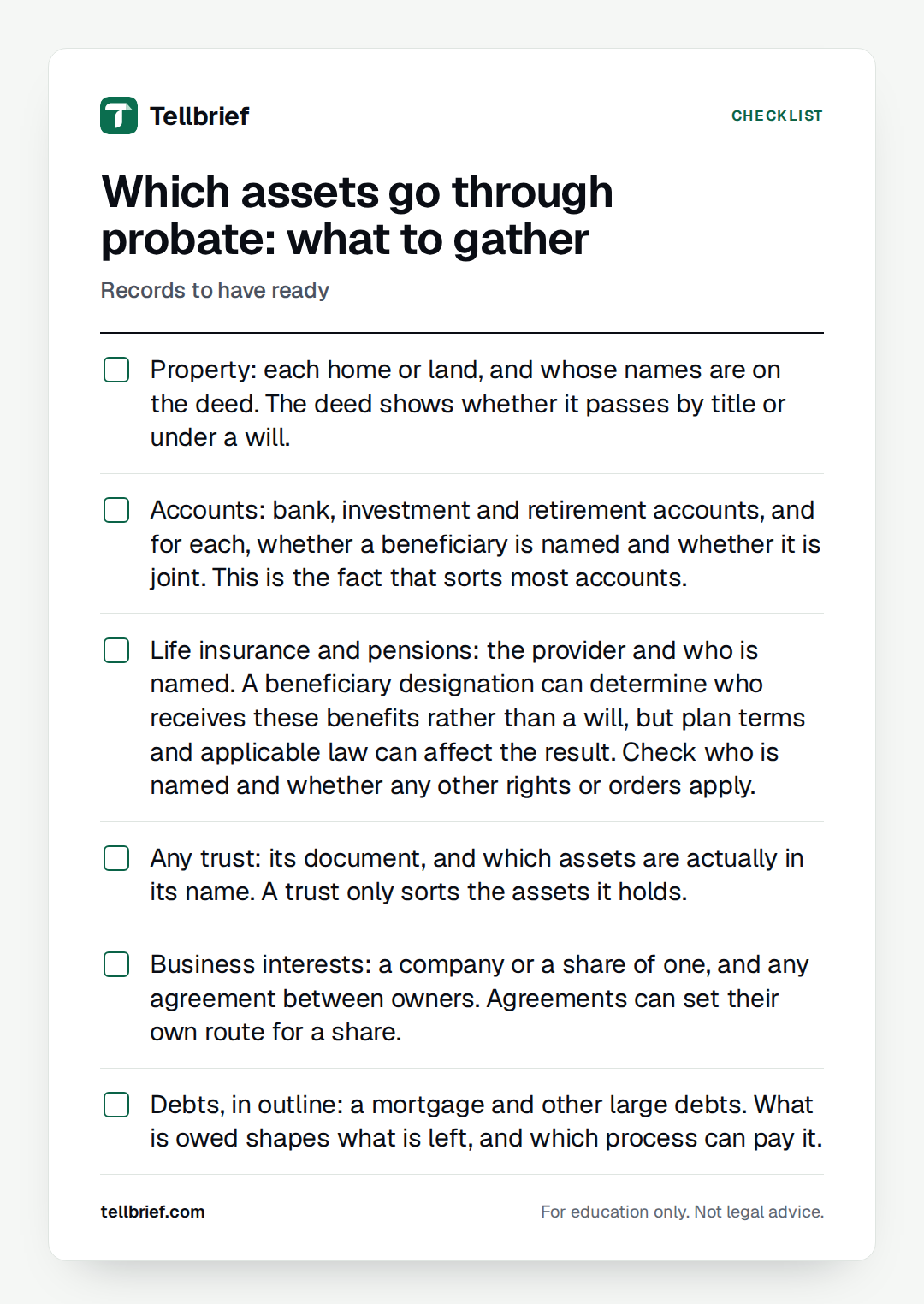
- Property: each home or land, and whose names are on the deed. The deed shows whether it passes by title or under a will.
- Accounts: bank, investment and retirement accounts, and for each, whether a beneficiary is named and whether it is joint. This is the fact that sorts most accounts.
- Life insurance and pensions: the provider and who is named. A beneficiary designation can determine who receives these benefits rather than a will, but plan terms and applicable law can affect the result. Check who is named and whether any other rights or orders apply.
- Any trust: its document, and which assets are actually in its name. A trust only sorts the assets it holds.
- Business interests: a company or a share of one, and any agreement between owners. Agreements can set their own route for a share.
- Debts, in outline: a mortgage and other large debts. What is owed shapes what is left, and which process can pay it.
If you are gathering after a death
The same list, made for the person who died, is the starting point, plus their will if there is one and the death certificate details the lawyer asks for. It can help to note what you could not find: an account you know existed but have no paper for is a fact worth handing over, not a gap to hide. Nothing needs to be moved or closed before the meeting; the sorting comes first, and some steps have an order to them that advice can set out.
Example: a house, a pension and a joint account
Made up for this guide
My father died last month. He had a will from 2016 leaving everything equally to me and my brother. The house was in his name alone. His retirement account names my mother, who died two years ago, with no backup. One bank account is joint with me because I helped him with bills. Our main question: which of these goes through the court process, and what should we do first?
What the lawyer needs to establish
Have a short answer ready for each. “I don’t know yet” is a fine answer.
- What is owned, in kinds, and how is each item held?
- Which accounts name a beneficiary, and is that person living?
- Is anything in a trust’s name?
- Is there a will, and when was it signed?
- What is owed, in rough terms?
- Has anything already been moved, closed or paid out?
Questions worth asking your lawyer
- Which of these assets pass outside the court process, and which do not?
- What does the process look like in our state, and roughly how long does it take?
- What should not be touched until we have sorted this?
- What will it cost, and how is it charged?
If you would rather answer questions than build the list, Tellbrief asks plain-language questions about your family, assets and existing documents, most of them one tap. It turns your answers into a brief your lawyer can read before the first call. You can download and keep a copy. See the estate planning sample brief to see what the lawyer receives.
Sources
Each quote was checked against its source on November 16, 2026. Laws and guidance can change after that date.
- Minnesota Judicial Branch: Probate, Wills and Estates (opens in a new tab) ↩︎
- Minn. Stat. § 524.3-101: Devolution of estate at death; restrictions (Minnesota Uniform Probate Code) (opens in a new tab) ↩︎
- Minn. Stat. § 524.2-101: Intestate estate (Minnesota Uniform Probate Code) (opens in a new tab) ↩︎
Questions about probate and assets
These answers help you get ready for a lawyer. They don’t say what the law means for your situation, or what you should do.
Is probate something to avoid at all costs?
It depends on the state and the assets. In some places the process is slow and public; in others it is comparatively simple. A lawyer can tell you what it involves for your assets before you plan around avoiding it.
Does a joint account always pass to the other owner?
It depends on the account. Whether a joint account passes to the surviving owner depends on the account contract, the way the title is worded, and the law that applies, which is why the lawyer will want to see how each account is actually held.
There is no will. What happens?
State rules provide a default order for who inherits, and a court process still applies to assets in the person’s own name. Bring what you have; the absence of a will is a starting fact, not a barrier.
Can we just divide things between us as a family?
Family members may agree about how they would like property divided, but that agreement does not automatically transfer legal ownership or complete the estate administration. Debts, taxes, court requirements, titles and account procedures may still need to be addressed. Ask the lawyer what must happen before anything is transferred or distributed.
Bring the list and how each item is held
Plain-language questions in the set, most of them one tap, free and with no account. Tellbrief turns your answers into a brief your lawyer can work from, and you keep a copy.