Estate planning for blended families: what to have ready
For education only. Not legal advice. Tellbrief is not a law firm.
Blended families can have different goals for a surviving spouse, children from earlier relationships and property each partner brought into the relationship. A plan that does not account for those differences may leave important questions unresolved.
In short
The facts that drive a blended family plan: who is in each branch of the family, what each of you brought in, what you hold together, and what each of you wants to protect, for a spouse and for your own children. Where you disagree is as useful to bring as where you agree.
On this page
What the lawyer needs to establish
Three things, in order. The full family map: each partner’s children, their ages, and where everyone lives. What each of you owns separately and together, including anything from before the relationship. And what each of you wants the plan to do twice over: look after the surviving partner, and protect your own children’s share. Those two aims can pull against each other, and a lawyer’s work is largely in how they are balanced: outright, over time, or through a trust. In community-property states, property acquired during marriage while the couple is domiciled there is generally treated as community property, subject to exceptions for separate property and other rules under state law.1 This can affect what each spouse can leave through an estate plan. That is one reason the brought-in list below matters. What happens without a plan depends on state law, the ownership of the assets and the family’s circumstances: Minnesota’s probate code, for example, sets a default share for a surviving spouse.2 Ask the lawyer what the default rules would mean for your particular family.
The family map and the lists
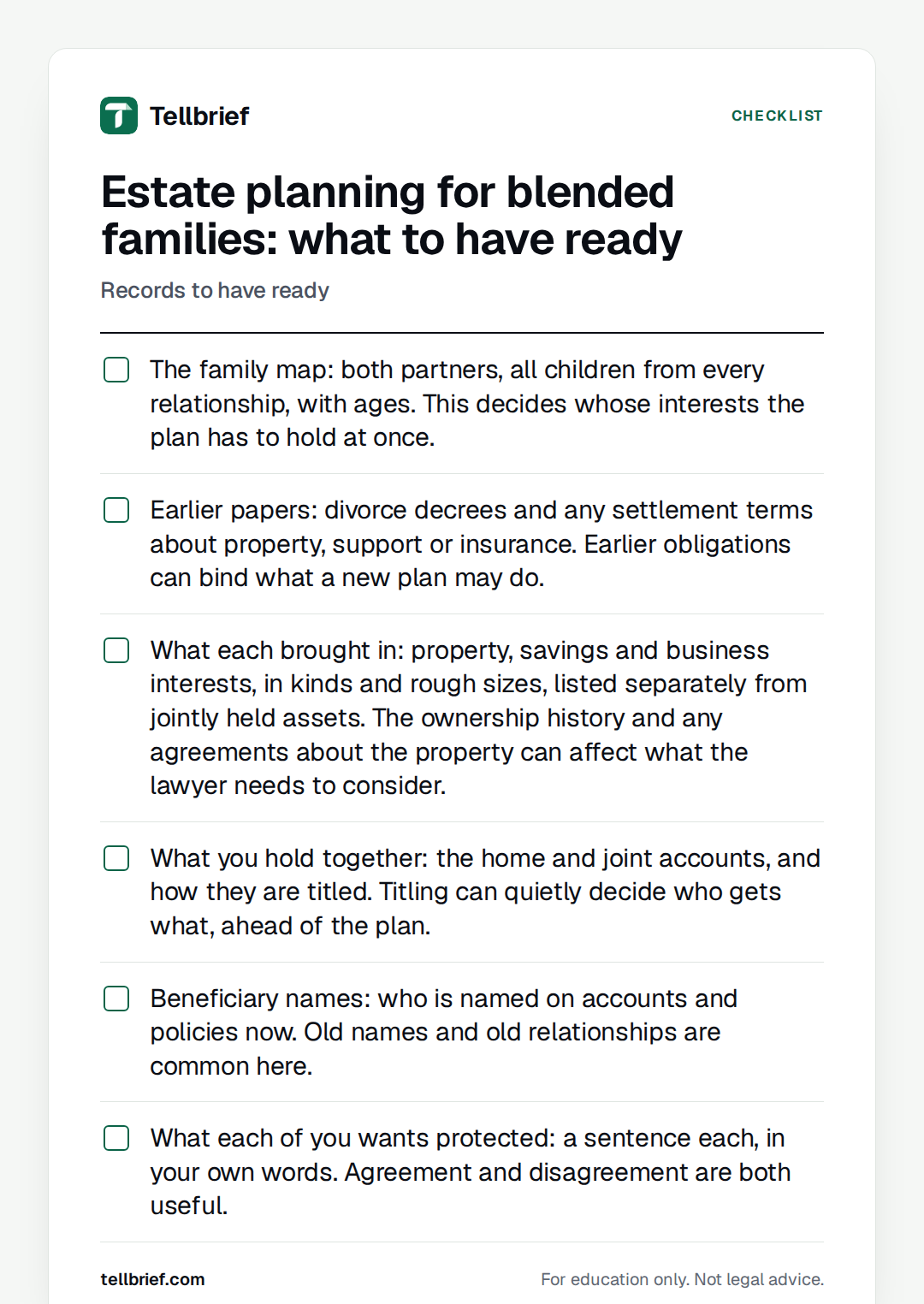
- The family map: both partners, all children from every relationship, with ages. This decides whose interests the plan has to hold at once.
- Earlier papers: divorce decrees and any settlement terms about property, support or insurance. Earlier obligations can bind what a new plan may do.
- What each brought in: property, savings and business interests, in kinds and rough sizes, listed separately from jointly held assets. The ownership history and any agreements about the property can affect what the lawyer needs to consider.
- What you hold together: the home and joint accounts, and how they are titled. Titling can quietly decide who gets what, ahead of the plan.
- Beneficiary names: who is named on accounts and policies now. Old names and old relationships are common here.
- What each of you wants protected: a sentence each, in your own words. Agreement and disagreement are both useful.
Saying the hard parts early
Two questions are better asked in the meeting than discovered after a death: whether either of you expects to leave anything unequally, and whether anyone is likely to be unhappy with the plan. A lawyer can design around both, and can explain the tools that make a balance hold: a trust that supports a spouse for life and then passes to children, for example. What cannot be designed around is a fact that surfaces later. If one partner is arranging everything and the other has not been part of the conversation, expect the lawyer to want to hear from both: plans made under one person’s direction, for another’s assets, are the ones that get questioned.
Example: two sets of children and a house in one name
Made up for this guide
We married four years ago. I have two children, 14 and 11, from my first marriage; my wife has a daughter of 17. I brought the house, which is still in my name alone; we have joint savings. My will predates the marriage and leaves everything to my children. My wife has no will. Our main question: how do we make sure whoever survives is housed and supported, and that each set of children is treated as we intend?
What the lawyer needs to establish
Have a short answer ready for each. “I don’t know yet” is a fine answer.
- Who is in the family, on both sides, and how old are the children?
- What did each of you bring into the marriage, and what is held together?
- Do any earlier divorce terms affect property, support or insurance?
- What should happen to the home when the first of you dies?
- Do you expect to treat the children equally, or differently?
- Is anyone likely to be unhappy with the plan?
Questions worth asking your lawyer
- What would happen by default, in our state, if we did nothing?
- How can a plan support the survivor and still protect each set of children?
- Should we each have our own lawyer?
- What should we review when the children reach adulthood?
If you would rather answer questions than draw the family map, Tellbrief asks plain-language questions about your family, assets and existing documents, most of them one tap. It turns your answers into a brief your lawyer can read before the first call. You can download and keep a copy. See the estate planning sample brief to see what the lawyer receives.
Sources
Each quote was checked against its source on November 16, 2026. Laws and guidance can change after that date.
Questions about blended family planning
These answers help you get ready for a lawyer. They don’t say what the law means for your situation, or what you should do.
My will predates my marriage. Does it still count?
It may, and it may not do what you would now want: marriage, divorce and new children all interact with older documents in ways that vary by state. Bring it, with the dates, and ask what it would do today.
Should we use one lawyer between us?
Couples can, and blended families are where the question deserves a real answer: your interests overlap but are not identical. Ask the lawyer how they handle that, and whether separate advice is wise.
What if we disagree about the children’s shares?
Bring the disagreement. Designing a plan around an honest difference is normal work; pretending it is not there is how plans fail families.
Does a prenuptial agreement change the planning?
It can: its terms may set what each of you can leave to whom. Bring it, or note that it exists, so the plan is built around it rather than against it.
Draw the family map before you meet
Plain-language questions in the set, most of them one tap, free and with no account. Tellbrief turns your answers into a brief your lawyer can work from, and you keep a copy.