How to prepare for an estate planning lawyer
For education only. Not legal advice. Tellbrief is not a law firm.
A first meeting about a will or a trust starts with your family and what you own. Have the outline ready and the meeting can spend its time on the decisions.
In short
It helps to be able to say who is in your family, what you own in rough terms, and what papers you already have: a will, a trust, powers of attorney, beneficiary forms. Add why you are doing this now and the one thing you most want settled, and the meeting can start there.
On this page
Why now
A lawyer may ask what prompted the call: a new baby, a marriage, a divorce, a move, an illness in the family, or simply getting around to it. One or two sentences is enough. It tells the lawyer which parts of the plan may need care first.
What to gather first
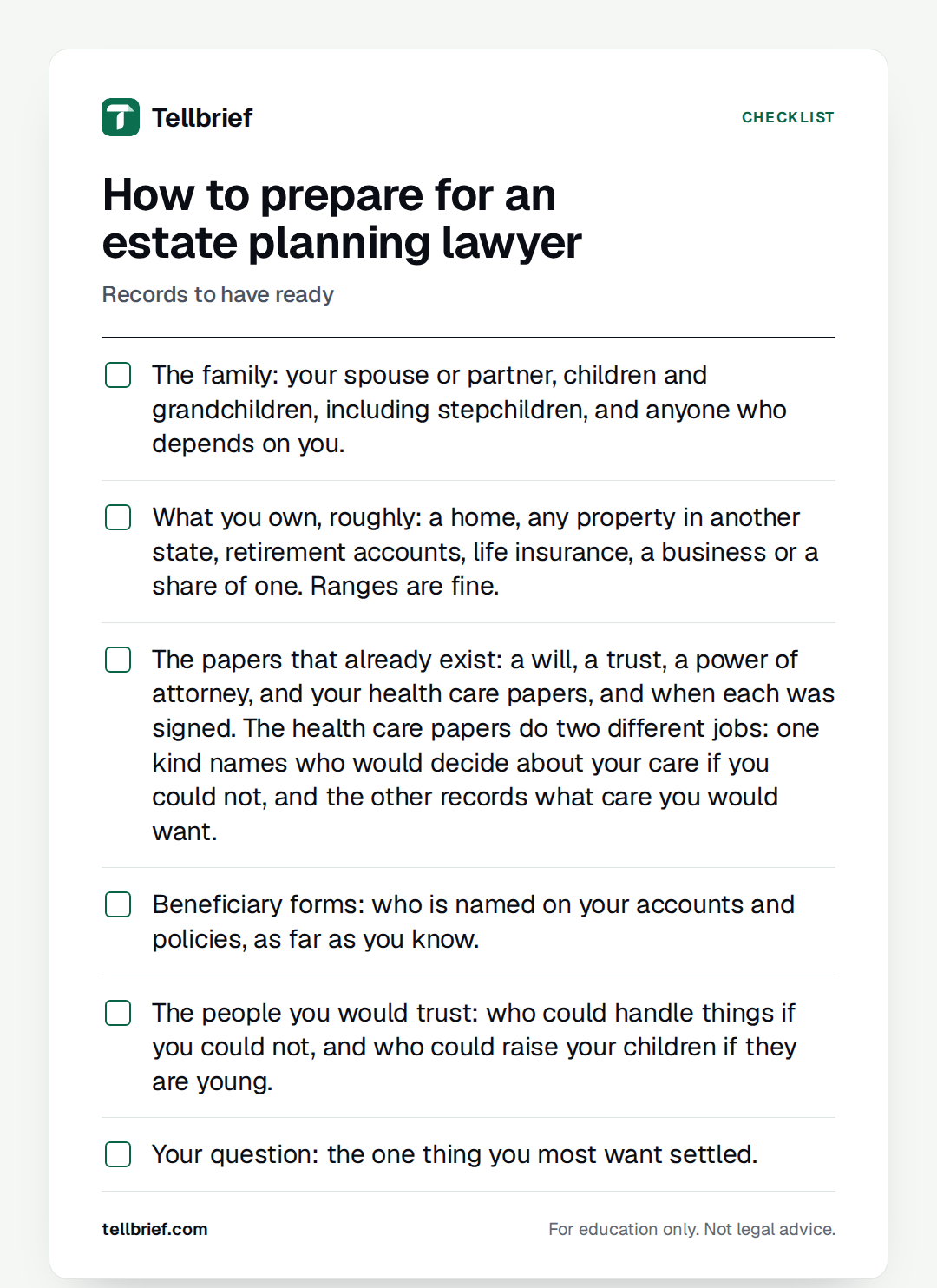
- The family: your spouse or partner, children and grandchildren, including stepchildren, and anyone who depends on you.
- What you own, roughly: a home, any property in another state, retirement accounts, life insurance, a business or a share of one. Ranges are fine.
- The papers that already exist: a will, a trust, a power of attorney, and your health care papers, and when each was signed. The health care papers do two different jobs: one kind names who would decide about your care if you could not, and the other records what care you would want.1
- Beneficiary forms: who is named on your accounts and policies, as far as you know.
- The people you would trust: who could handle things if you could not, and who could raise your children if they are young.
- Your question: the one thing you most want settled.
What you own, in rough terms
Exact balances can wait. A lawyer planning a first conversation works from kinds and rough sizes: the house, the retirement savings, the insurance. Account numbers and statements are not needed before the meeting, and the firm can say how it wants them sent when they are.
If you are planning as a couple
Both names go on the list, and it can help to talk through the big choices together first: who raises the children, who handles money, what each of you would want if the other could not decide. Where you disagree, the meeting is a good place to say so. One lawyer may be able to act for both of you, but that is not automatic. Your interests may differ even where your broad goals agree, and the lawyer has to consider whether there is a conflict, whether the professional rules allow it to be handled, including each of you giving informed consent, and whether each of you understands what acting for both would mean.2 Whether joint representation is appropriate in your case, or whether separate lawyers are needed, is worth a question early.
Example: two children, no wills yet
Made up for this guide
We are in our forties, married, with two children under ten and a house with a mortgage. Neither of us has a will. My wife has a retirement account from an old job naming her mother as beneficiary. We have talked about my sister raising the children if something happened to us both, but have not asked her. Our main question: what do we need to decide before anything is written?
To write yours, fill in the brackets:
We are [ages, married or single], with [children and their ages]. We own [a home, accounts, a business, in rough terms]. We have [a will from (year), no papers yet]. We would want [name] to [raise the children, handle things]. Our main question: [the one that matters most].
What the lawyer may ask you
Have a short answer ready for each. “I don’t know yet” is a fine answer.
- Who is in the family, including children from earlier relationships?
- What do you own, in rough terms, and how is it titled?
- What papers do you already have, and when were they signed?
- Who would you trust to act for you, and who would raise the children?
- Does anyone you would provide for receive government benefits?
- What prompted this now?
Questions worth asking your lawyer
- Is the first meeting free, and how long is it?
- Whose names do you need before we talk about the details?
- How do you charge for a plan like ours: a fixed fee, by the hour, or something else?
- What should we decide before you write anything?
- How often should a plan be looked at again?
- How should we send documents, and what should we leave out for now?
What to leave out at first
Until the lawyer has checked for conflicts and said they can act for you, the names and a line on what it is about can be enough. Account numbers, statements and health details can wait. The lawyer can say what to send and when.
If you would rather answer questions than write, Tellbrief asks plain-language questions about your family, assets and existing documents, most of them one tap. It turns your answers into a brief your lawyer can read before the first call. You can download and keep a copy. See the estate planning sample brief to see what the lawyer receives.
Sources
Each quote was checked against its source on November 16, 2026. Laws and guidance can change after that date.
Questions about a first meeting
These answers help you get ready for a lawyer. They don’t say what the law means for your situation, or what you should do.
What should I bring to a first estate planning meeting?
The outline is enough: who is in the family, what you own in rough terms, and any papers you already have. Exact balances and statements can wait until the lawyer asks for them.
Do I need a will before I meet a lawyer?
No. Having no papers yet is a common starting point, and saying so is useful information in itself.
Should both spouses prepare together?
It can help to agree on the big choices first: who raises the children and who handles money. Where you disagree, the meeting is a good place to raise it.
How much does an estate plan cost?
It depends on the lawyer and the plan, so ask before you book: how they charge, and what the fee covers.
What if I don’t know what I own exactly?
Rough terms are fine for a first meeting. Kinds of accounts and ranges tell the lawyer what kind of plan to discuss.
Have the family and the papers on one page
Plain-language questions in the set, most of them one tap, free and with no account. Tellbrief turns your answers into a brief your lawyer can work from, and you keep a copy.