Powers of attorney and incapacity planning: what to have ready
For education only. Not legal advice. Tellbrief is not a law firm.
Incapacity planning involves two decisions: who would handle your money, and who would make medical decisions if you could not. Separate documents can also record the care you would want. Choosing them is most of the work.
In short
The key decisions are who would handle your money, who would speak for you about medical care, and what treatment wishes you would want recorded. Have a first choice and a backup for each decision where appropriate.
On this page
The two jobs
A financial power of attorney names someone to handle money and property for you, within the authority the document grants: paying bills, dealing with accounts, signing for a house. Health care is covered by different documents, and the names vary by state. A health care power of attorney or proxy document names someone to make medical decisions for you if you cannot make or communicate them yourself. A living will or other advance directive records your treatment wishes instead of naming a person.1 Some states combine these in one document. The lawyer can identify which documents your state recognizes and how they work together. The same person may be right for both roles, and the choices do not have to be the same. In some states the financial power of attorney law does not cover health care decisions at all, which is one reason the two are kept separate.2
Names and notes to bring
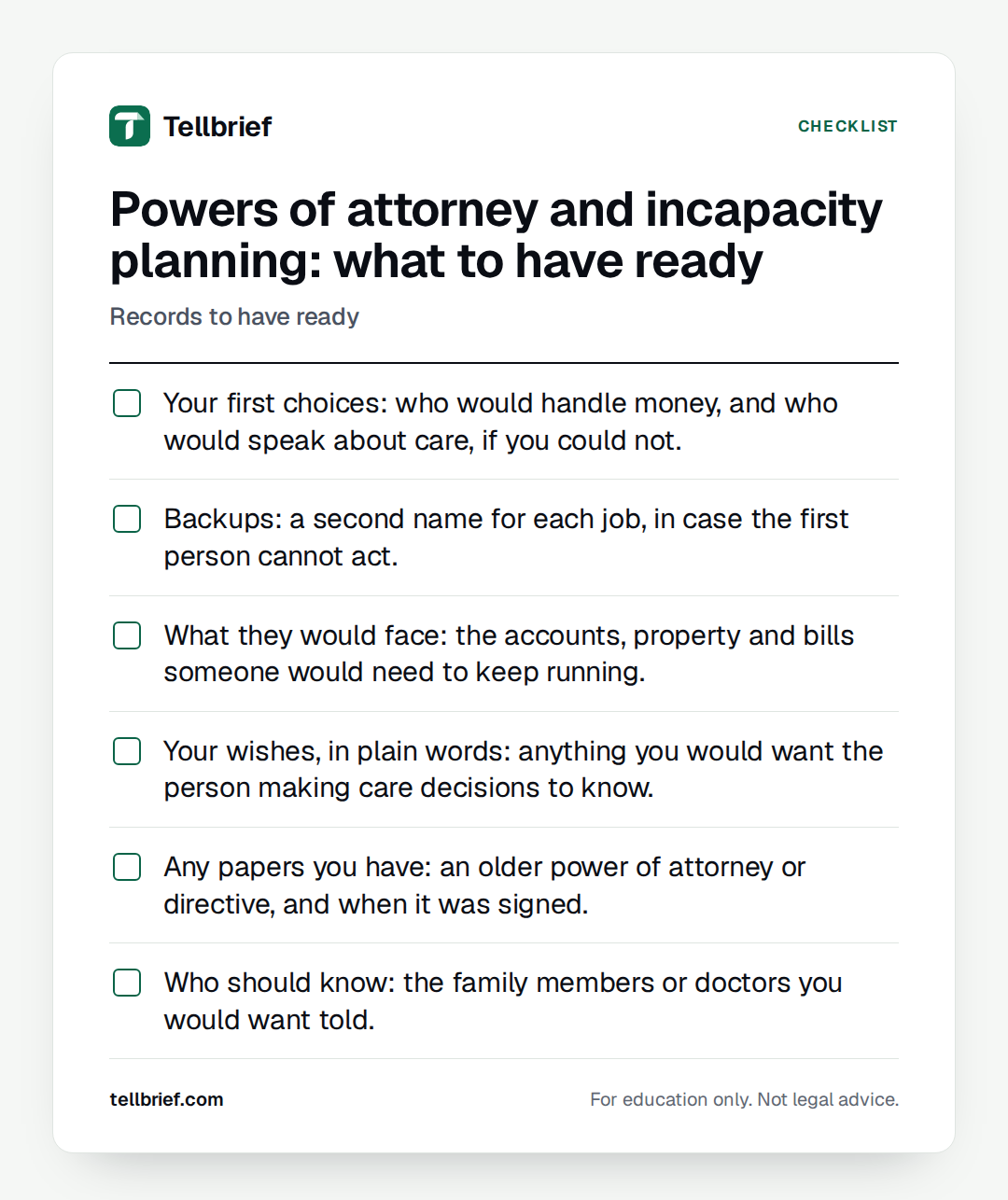
- Your first choices: who would handle money, and who would speak about care, if you could not.
- Backups: a second name for each job, in case the first person cannot act.
- What they would face: the accounts, property and bills someone would need to keep running.
- Your wishes, in plain words: anything you would want the person making care decisions to know.
- Any papers you have: an older power of attorney or directive, and when it was signed.
- Who should know: the family members or doctors you would want told.
Choosing the people
It can help to think about who is good with paperwork, who lives close enough to act quickly, and who the rest of the family will accept in the role. Whether you have asked them yet is worth noting: the meeting can cover how to tell them, and what they would hold.
When the powers start
The timing depends on the document, its wording and applicable state law. Some financial powers of attorney can be used as soon as they take effect; others are designed to take effect when a specified condition is met, such as a determination that you cannot act for yourself.2 Health care decision-making documents have their own activation rules. Ask the lawyer when each document would become effective, how that is established and what a bank or health care provider would require before accepting it. Having a view on timing, even a rough one, gives the meeting a starting point.
Capacity, and pressure from others
These documents are signed by someone whose ability to decide may later be questioned, so a lawyer will want to establish two things while there is time: that the person signing understands what the document does, in their own words, and that the choices in it are theirs. Expect the lawyer to want time with the person signing, alone, and to take care where a relative is arranging everything, answering every question, or would benefit from the choices. That care is not an accusation. It is what makes the document dependable when it is needed, and it protects the person whose name is on it. If there is a concern about the person’s ability to understand or make the decision, the lawyer should hear about it before any document is signed. The lawyer can assess what the person understands, whether the instructions are voluntary and what lawful planning options remain under the applicable state rules.
Example: a daughter ten minutes away
Made up for this guide
I am 67 and live alone. My daughter lives ten minutes away and already helps with my bills; my son is abroad. I have a power of attorney from 2010 naming my late husband. I would want my daughter to handle money and speak to doctors, with my son as backup for money only. My main question: what needs replacing, and what should my daughter be given copies of?
What you may be asked about your choices
Have a short answer ready for each. “I don’t know yet” is a fine answer.
- Who would you trust with your accounts, and who with decisions about care?
- Who is your backup for each?
- Do you have older documents, and who is named in them?
- When would you want the powers to start?
- Is there anything about your care you feel strongly about?
- Who else should know these documents exist?
Questions worth asking your lawyer
- What do the two documents each cover, and what do they leave out?
- Who should hold copies, and where should the originals live?
- What makes a bank or a hospital accept the document?
- How do we change the people later?
If you would rather answer questions than write, Tellbrief asks plain-language questions about your family, assets and existing documents, most of them one tap. It turns your answers into a brief your lawyer can read before the first call. You can download and keep a copy. See the estate planning sample brief to see what the lawyer receives.
Sources
Each quote was checked against its source on November 16, 2026. Laws and guidance can change after that date.
Questions about powers of attorney and incapacity
These answers help you get ready for a lawyer. They don’t say what the law means for your situation, or what you should do.
Can the same person hold both roles?
Yes, one person can be named in both documents, and many people choose that. Others split them because the person best with money is not the person closest to their care.
Do I need to ask the person first?
It helps, and it is worth noting if you have not yet. The lawyer can cover what the person would be taking on.
What if I already have a power of attorney?
Bring it, or its date and who it names. An older document naming someone who has died, or who you would no longer choose, is a common reason to update.
Where do the signed documents go?
Ask the lawyer: who should hold copies, and where the originals are kept, so the right person can find them quickly.
Have your people picked before you meet
Plain-language questions in the set, most of them one tap, free and with no account. Tellbrief turns your answers into a brief your lawyer can work from, and you keep a copy.