Conflict check form for business clients
For education only. Not legal advice. Tellbrief is not a law firm.
A conflict check is only as good as the names that go into it. A short form asks for each one before the client tells you anything else.
In short
A conflict check form collects every name that could matter before the client tells you their story: the client, their company and its owners, related companies, the other side and anyone else involved. The comment to Rule 1.7 says a lawyer should adopt reasonable procedures to determine the persons involved. It ends with a form to copy.
On this page
Why ask for names first
The comment to ABA Model Rule 1.7, as Minnesota adopted it, asks for a procedure:
“To determine whether a conflict of interest exists, a lawyer should adopt reasonable procedures, appropriate for the size and type of firm and practice, to determine in both litigation and nonlitigation matters the persons and issues involved.”1Rule 1.7, comment [3]
Timing matters too. Rule 1.18(b) says: “Even when no client-lawyer relationship ensues, a lawyer who has consulted with a prospective client shall not use or reveal information obtained in the consultation, except as Rule 1.9 would permit with respect to information of a former client.”2 Asking for names alone first keeps the rest until you know you can help. The Rule 1.18 intake checklist covers that rule in full.
And the check covers the whole firm. Rule 1.10(a) says: “While lawyers are associated in a firm, none of them shall knowingly represent a client when any one of them practicing alone would be prohibited from doing so by Rule 1.7 or 1.9, unless the prohibition is based on a personal interest of the prohibited lawyer and does not present a significant risk of materially limiting the representation of the client by the remaining lawyers in the firm.”3 So run each name against every lawyer’s current and former clients.
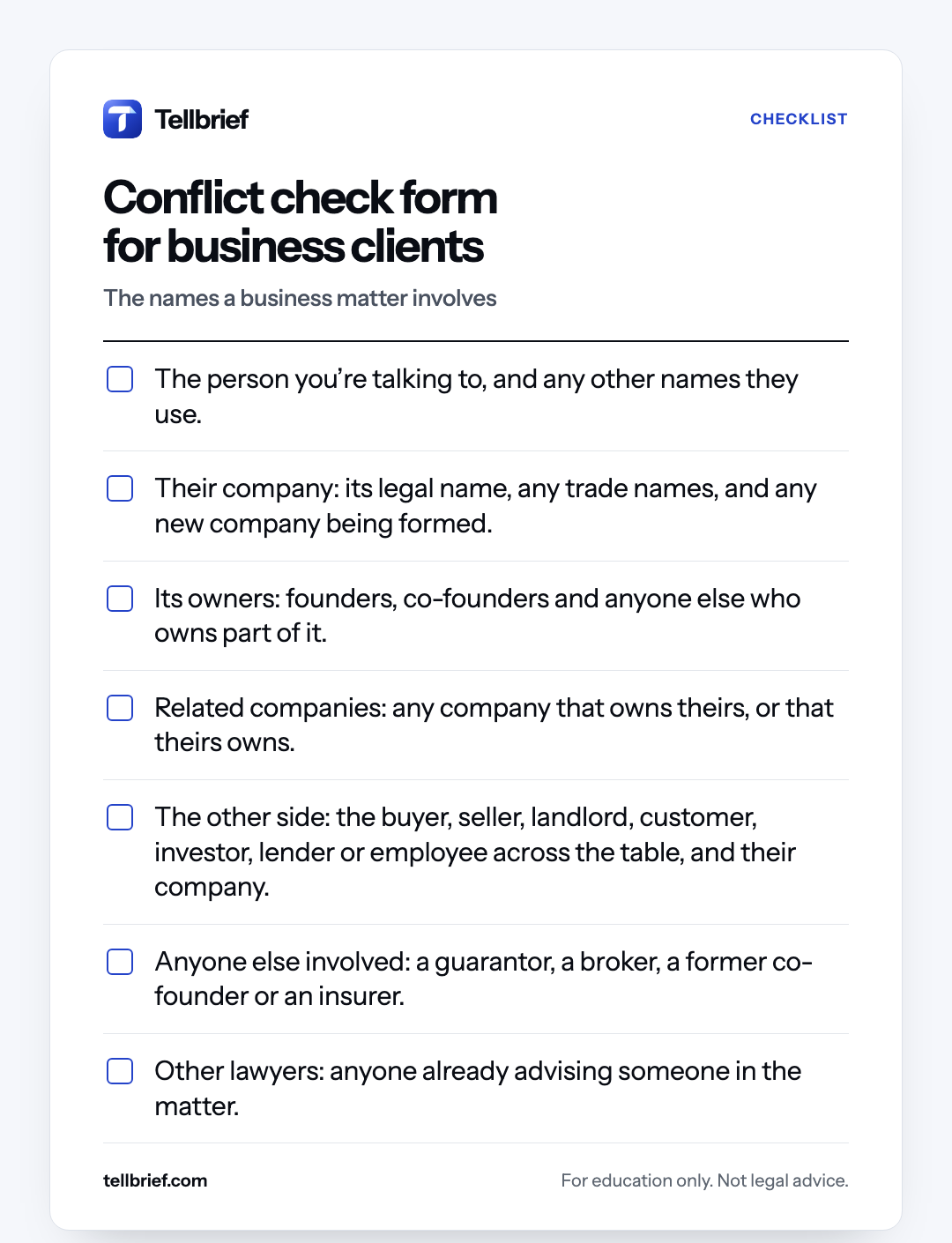
The names a business matter involves
- The person you’re talking to, and any other names they use.
- Their company: its legal name, any trade names, and any new company being formed.
- Its owners: founders, co-founders and anyone else who owns part of it.
- Related companies: any company that owns theirs, or that theirs owns.
- The other side: the buyer, seller, landlord, customer, investor, lender or employee across the table, and their company.
- Anyone else involved: a guarantor, a broker, a former co-founder or an insurer.
- Other lawyers: anyone already advising someone in the matter.
What to leave off the form
- The story. What happened and what they want can wait until the names clear.
- Attachments. Don’t ask for documents yet.
- Anything confidential. Add a short caution line, like the one in the consultation confirmation email.
The intake form template splits the whole intake the same way: names at booking, the rest once they clear.
What to do with the results
- No match: go ahead, and send your engagement letter if they hire you.
- A current client: Rule 1.7 applies. The conflict waiver letter template covers informed consent.
- A former client: check whether this is “the same or a substantially related matter” and whether the interests are “materially adverse,” the words of Rule 1.9(a).4
- A conflict you can’t resolve: decline without saying why. The guide to declining on a call has a script, and there’s a non-engagement letter template for the written no.
Keep a record of each check either way. The conflict check guide covers the search and what to write down.
Let the booking ask for the names
Tellbrief does this part for you. When a client books, you see only the names: the client, their company and anyone else involved, with “Copy names” to paste into your conflict check. Their brief stays locked until you clear them, and if you decline, it’s deleted unread. Start a free pilot; your first three briefs are free.
A conflict check form you can copy
Before we talk: names for our conflict check
Before you tell us about your matter, we need to check that we’re free to help. Please list the names below, and don’t include any details about the matter yet. Booking a call doesn’t make you our client.
1. You: [your full name, and any other names you use]
2. Your company: [its legal name, any trade names, and the state it’s formed in]
3. Its owners: [everyone who owns part of it]
4. Related companies: [any company that owns yours, or that yours owns]
5. The other side: [each person or company across the table, if there is one]
6. Anyone else involved: [for example a guarantor, a broker, an investor or a former co-founder]
7. Other lawyers: [any lawyer already advising anyone in this matter]
We’ll confirm whether we can help before we ask about the matter itself.
Sources
Each quote was checked against its source on November 1, 2026. Laws and guidance can change after that date.
- ABA Model Rule 1.7: Conflict of Interest: Current Clients, with comments, as adopted in the Minnesota Rules of Professional Conduct (opens in a new tab) ↩︎
- ABA Model Rule 1.18: Duties to Prospective Client, as adopted in Minnesota (opens in a new tab) ↩︎
- ABA Model Rule 1.10: Imputation of Conflicts of Interest, as adopted in Minnesota (opens in a new tab) ↩︎
- ABA Model Rule 1.9: Duties to Former Clients, as adopted in Minnesota (opens in a new tab) ↩︎
Questions
What should a conflict check form ask?
The names of everyone who could matter: the client, their company and its owners, related companies, the other side, anyone else involved and other lawyers. It leaves out the story until the names clear.
Why collect names before details?
Rule 1.18(b) says a lawyer who has consulted with a prospective client shall not use or reveal information obtained in the consultation, even when no client-lawyer relationship ensues. Asking for names first keeps the rest until you know you can help.
Does the check cover the whole firm?
Rule 1.10(a) says that while lawyers are associated in a firm, none of them shall knowingly represent a client when any one of them practicing alone would be prohibited from doing so by Rule 1.7 or 1.9. It has an exception for some conflicts based on one lawyer’s personal interest. Check your state’s version.
What if a name matches a former client?
Rule 1.9(a) covers the same or a substantially related matter where the new client’s interests are materially adverse to the former client’s. A match isn’t always a conflict, but it needs a look.
Try it on your next three first calls
Your first three briefs are free. Setup is one 15-minute call: you paste one line into your booking confirmation, and you see each client’s names before anything else.