Disengagement letter template
For education only. Not legal advice. Tellbrief is not a law firm.
The deal closed or the documents are signed. Unless you say the work is over, a business client may think you’re still looking after it. A short letter settles that.
In short
A disengagement letter tells a client that a matter is finished and that you’re no longer working for them on it. The comment to Rule 1.3 says doubt about whether the relationship still exists should be clarified by the lawyer, preferably in writing. The letter can say what was done, what wasn’t, what happens to the file and what comes up next.
On this page
Why put the end in writing
The comment to ABA Model Rule 1.3, as Minnesota adopted it, says when a limited engagement ends: “If a lawyer's employment is limited to a specific matter, the relationship terminates when the matter has been resolved.”1 It also says a client who has worked with you for a while may see it differently:
“If a lawyer has served a client over a substantial period in a variety of matters, the client sometimes may assume that the lawyer will continue to serve on a continuing basis unless the lawyer gives notice of withdrawal.”1Rule 1.3, comment [4]
The same comment puts the job on the lawyer: “Doubt about whether a client-lawyer relationship still exists should be clarified by the lawyer, preferably in writing, so that the client will not mistakenly suppose the lawyer is looking after the client's affairs when the lawyer has ceased to do so.”1
The end date also matters at your next conflict check, because a former client is checked under a different rule from a current one. Rule 1.9(a) says a lawyer who has formerly represented a client in a matter “shall not thereafter represent another person in the same or a substantially related matter in which that person's interests are materially adverse to the interests of the former client unless the former client gives informed consent, confirmed in writing.”2
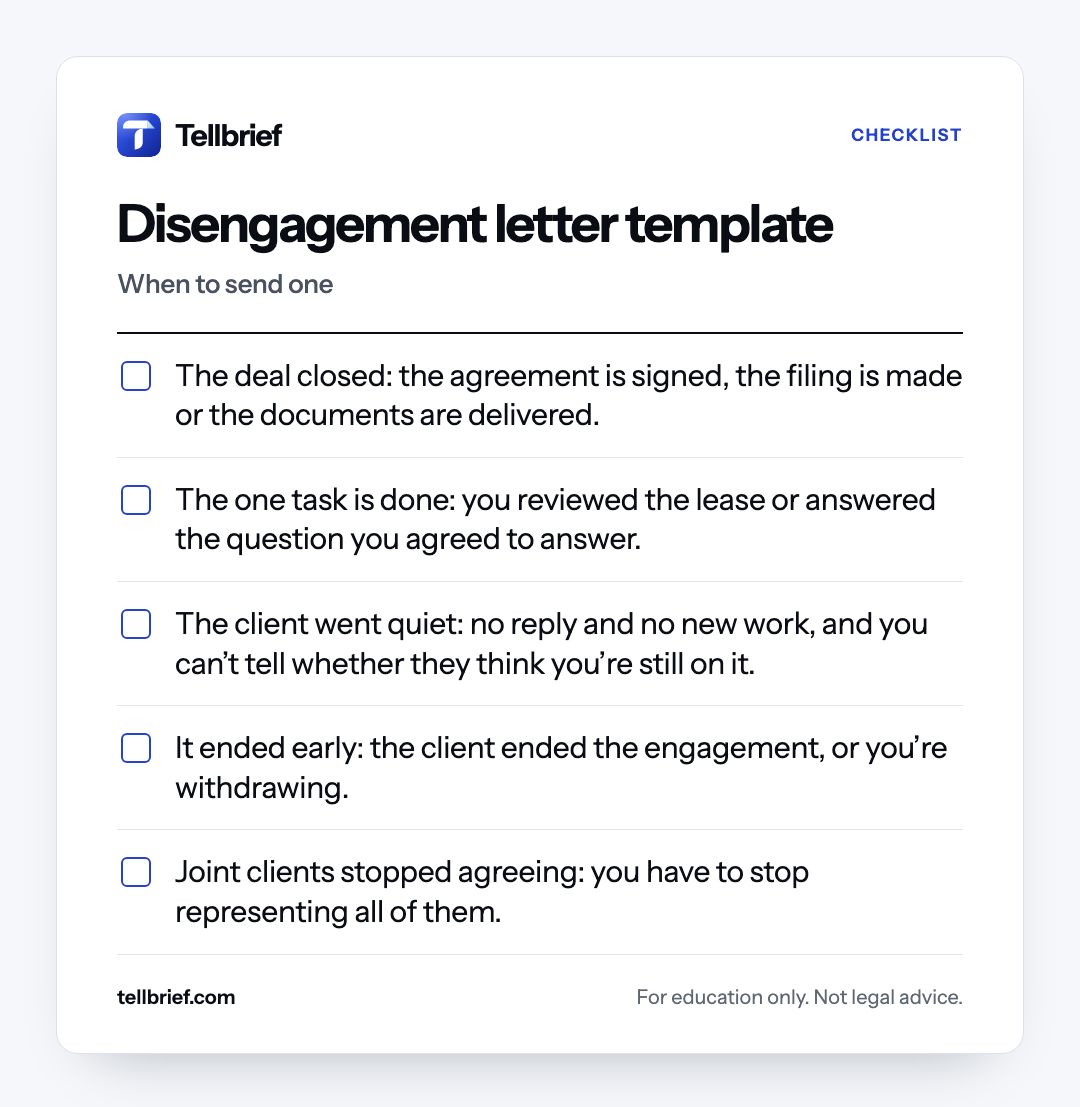
When to send one
- The deal closed: the agreement is signed, the filing is made or the documents are delivered.
- The one task is done: you reviewed the lease or answered the question you agreed to answer.
- The client went quiet: no reply and no new work, and you can’t tell whether they think you’re still on it.
- It ended early: the client ended the engagement, or you’re withdrawing.
- Joint clients stopped agreeing: you have to stop representing all of them.
For one-task work, the end is easier to show if the start set it out. The limited-scope letter template covers that, and the joint representation letter has an email for founders who stop agreeing.
What the letter should cover
- The matter, by name, and that your work on it is finished.
- What you did, in a sentence or two, and what you didn’t do. If your engagement letter set the scope, use its words.
- What comes up next: dates you know about, like a renewal, a filing or a vesting date, and that the client is now the one watching them.
- The file: what you’re sending back, what you’re keeping and for how long.
- Money: the final invoice, or any unearned fee you’re refunding.
- Coming back: new work starts with a new engagement letter and a new conflict check.
If the representation ends before the work is done, Rule 1.16(d) applies. It says the lawyer “shall take steps to the extent reasonably practicable to protect a client's interests, such as giving reasonable notice to the client, allowing time for employment of other counsel, surrendering papers and property to which the client is entitled, and refunding any advance payment of fees or expenses that has not been earned or incurred.”3
Minnesota’s version adds a paragraph on what the file includes. In every representation, it covers “the papers and property delivered to the lawyer by or on behalf of the client and the papers and property for which the client has paid the lawyer's fees and reimbursed the lawyer's costs.”3 Check your state’s version before you write the file paragraph.
What to leave out
- An offer to keep watching. “Let me know if anything changes” is fine. “We’ll keep an eye on it” contradicts the rest of the letter.
- New advice. Keep it to the matter that ended. A new question is a new engagement.
- A sales pitch. One line saying you’d be glad to help again is enough.
Start the next matter with the names
When the client comes back, the next matter starts where this one did: with a conflict check. Tellbrief shows you only the names when a client books, and keeps their brief locked until you clear them. If you decline, the brief is deleted unread. Start a free pilot; your first three briefs are free.
A disengagement letter you can copy
Subject: [Matter name]: our work is complete
Dear [client name],
Thank you for working with [firm] on [matter]. That work is now complete, and this letter confirms that our engagement for it has ended.
What we did. [For example: We prepared and negotiated the supply agreement with [other party], which was signed on [date].] As agreed, we didn’t [for example: advise on tax or review your other contracts].
What comes next. [Dates or deadlines coming up, if any, such as the agreement’s renewal date.] We won’t be tracking these for you, so please put them on your own calendar.
Your file. [We’ve enclosed / We’ll send by [date]] [the signed documents and the papers you gave us]. We’ll keep our copy of the file for [period], after which it may be destroyed. If you’d like anything else from it, tell us by [date].
Fees. [Our final invoice is enclosed. / We’re refunding [amount] of your advance, which we didn’t use.]
If something new comes up, we’d be glad to help. New work starts with a new engagement letter and a new conflict check.
[Lawyer]
[Firm]
An email for a client who has gone quiet
Subject: Closing our file on [matter]
Hi [name],
We haven’t heard from you since [date], when we [last step]. Unless you tell us otherwise by [date], we’ll treat our work on [matter] as complete and close our file. After that, we won’t be watching [the deadline or issue] for you.
If you’d like us to keep going, just reply and we’ll pick it up.
[Lawyer]
Sources
Each quote was checked against its source on November 1, 2026. Laws and guidance can change after that date.
- ABA Model Rule 1.3: Diligence, with comments, as adopted in the Minnesota Rules of Professional Conduct (opens in a new tab) ↩︎
- ABA Model Rule 1.9: Duties to Former Clients, as adopted in Minnesota (opens in a new tab) ↩︎
- Minnesota Rule of Professional Conduct 1.16: Declining or Terminating Representation (opens in a new tab) ↩︎
Questions
What is a disengagement letter?
A letter telling a client that a matter is finished and that the lawyer is no longer working for them on it. The comment to Rule 1.3 says doubt about whether the relationship still exists should be clarified by the lawyer, preferably in writing.
When should a lawyer send one?
When the matter is resolved, when a one-task engagement is done, or when the representation ends early. If the client may think you’re still working for them, it’s worth putting the end in writing.
What file does the client get back?
Rule 1.16(d) lists surrendering papers and property to which the client is entitled. Minnesota’s Rule 1.16(e) says what that includes. Check your state’s version.
Is a disengagement letter the same as a non-engagement letter?
No. A non-engagement letter goes to someone you didn’t take on. A disengagement letter goes to a client when the work ends.
Try it on your next three first calls
Your first three briefs are free. Setup is one 15-minute call: you paste one line into your booking confirmation, and you see each client’s names before anything else.