Evidence after a car accident: what to keep and write down
For education only. Not legal advice. Tellbrief is not a law firm.
The facts of a crash are easiest to gather in the first days: names, photos, and a short account written while it is still fresh.
In short
Write down the date, place and what happened in order, the other driver’s and any witnesses’ details, and keep photos of the scene and the damage. Then keep every letter and note every call. Memory fades faster than paperwork.
On this page
Write it down soon
Memory of a crash fades and rearranges itself. A short account written in the first days, in the order things happened, is worth more than a detailed one written months later. Note what you are unsure about as unsure: “I think the light had just changed” is more useful than a guess presented as fact.
What to keep
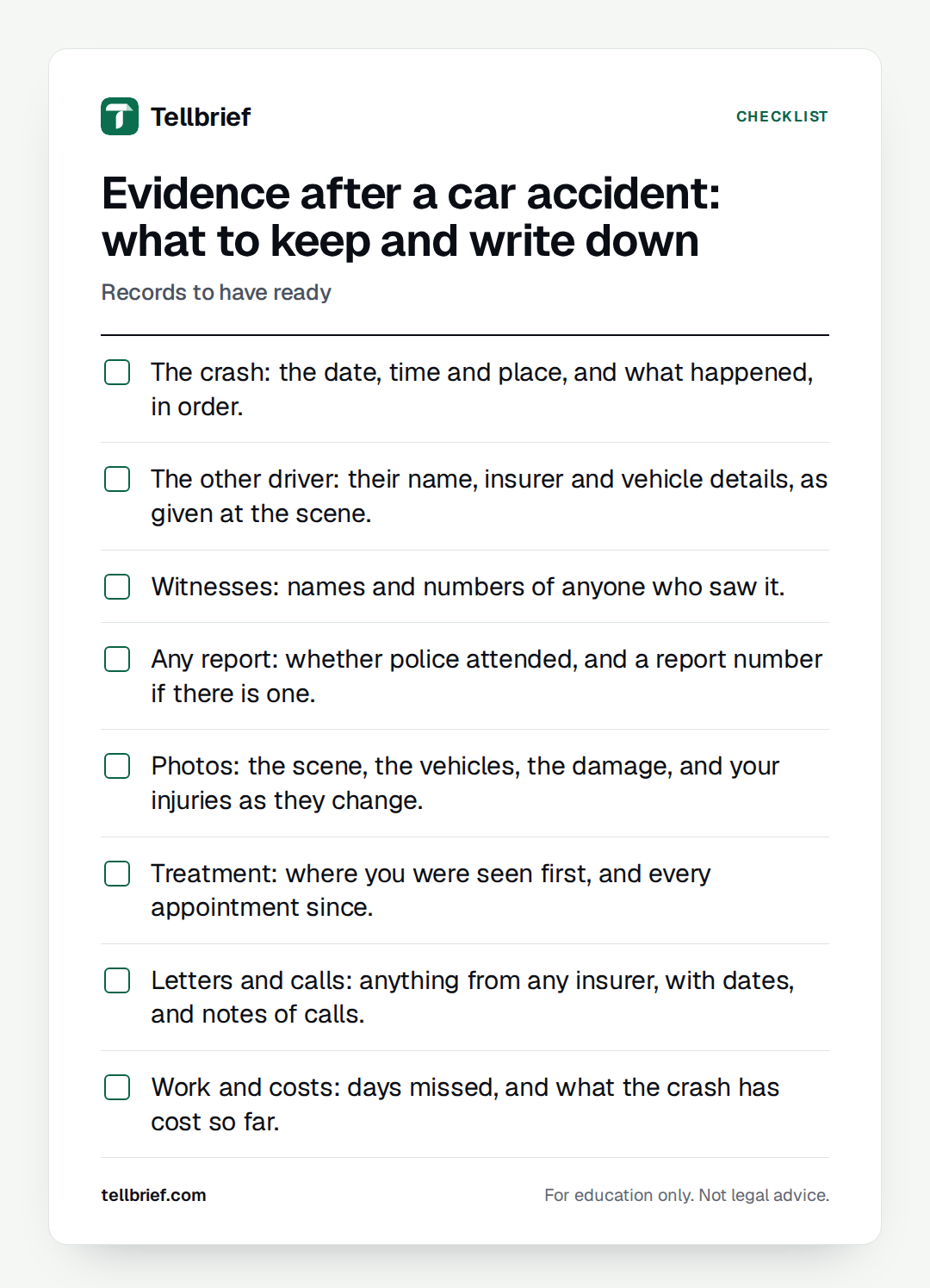
- The crash: the date, time and place, and what happened, in order.
- The other driver: their name, insurer and vehicle details, as given at the scene.
- Witnesses: names and numbers of anyone who saw it.
- Any report: whether police attended, and a report number if there is one.
- Photos: the scene, the vehicles, the damage, and your injuries as they change.
- Treatment: where you were seen first, and every appointment since.
- Letters and calls: anything from any insurer, with dates, and notes of calls.
- Work and costs: days missed, and what the crash has cost so far.
Photos and the car
Photos taken at the scene can show what words cannot: positions, damage, the road and the weather. Keep the originals, not just copies sent in messages. If the car is repaired or scrapped, the photos may be all that is left of the damage, so it can help to ask before the car goes.
Records held by other people
Some of the best evidence is not yours to keep, because someone else holds it: camera footage from a shop, a bus or a doorbell, the other insurer’s file, an employer’s incident record if a work vehicle was involved. Some records held by other people may be deleted or overwritten under their own retention policies. Note who holds the footage or record, where it is located, and when you learned about it. Ask a lawyer promptly about preserving it.
The dates
Claims have deadlines, and they vary by state and claim type: Minnesota’s statutes, for example, set different periods for different kinds of action12. Note the date of the crash exactly, and ask about deadlines early rather than working one out yourself. Insurers’ letters may carry their own dates; keep them with the letters. If the other driver turns out to be uninsured, your own policy may be the route: in Minnesota, uninsured and underinsured motorist coverages must be provided in every policy for a vehicle registered or principally garaged in the state3.
Example: a junction, a witness and no police
Made up for this guide
On 12 October, at about 5.40pm, a car pulled out of a side road into mine at the junction by the station. The other driver gave his name and insurer at the scene; a woman waiting for a bus saw it and gave me her number. Police did not attend. I photographed both cars and the junction. I was seen at urgent care that evening for a sore neck and shoulder, and my GP has since referred me for physio. My insurer knows; the other insurer has written asking for my account.
What you may be asked about the crash
Have a short answer ready for each. “I don’t know yet” is a fine answer.
- When and where did it happen, and what happened, in order?
- Who was the other driver, and who saw it?
- Was there a police or incident report?
- Where have you been treated, and what is planned?
- What have the insurers sent or asked?
- What work have you missed, and what has it cost so far?
Questions worth asking your lawyer
- What deadlines apply to a claim like mine?
- Should I give the other insurer my account, or a recorded statement?
- What should I keep from now on?
- How do you charge, and what costs come on top?
If you would rather answer questions than write, Tellbrief asks them for you, most of them one tap, and it turns your answers into a brief your lawyer can work from. See the personal injury sample brief to see what the lawyer receives.
Sources
Each quote was checked against its source on November 16, 2026. Laws and guidance can change after that date.
Questions after a crash
These answers help you get ready for a lawyer. They don’t say what the law means for your situation, or what you should do.
The police did not attend. Does that matter?
Police do not attend every crash. What matters for preparing your account is what you have instead: names, photographs, witnesses, and a written account made soon after.
Should I talk to the other driver’s insurer?
You can note what they ask and say you are taking advice first. Whether to give a statement, and what to say, is worth a lawyer’s view before you do.
I felt fine at the scene but hurt later. Is that a problem?
If pain begins later, record when it started, where you were seen, and what you were told. Give the lawyer the timeline as it happened.
What if the other driver had no insurance?
Tell the lawyer early. In Minnesota, uninsured and underinsured motorist coverages must be provided in your own auto policy, so that is the first place a lawyer will look; other states’ rules differ. Ask what steps and deadlines apply.
Write the account while it is fresh
Plain-language questions in the set, most of them one tap, free and with no account. Tellbrief turns your answers into a brief your lawyer can work from, and you keep a copy.