How to prepare before talking to an injury lawyer
For education only. Not legal advice. Tellbrief is not a law firm.
A first talk with an injury lawyer starts with what happened and what has happened since: treatment, letters, and time.
In short
It helps to be able to say what happened and when, where you have been treated, what letters or calls you have had from insurers, and whether anyone has made an offer. Deadlines can be short and vary by claim, so the date it happened goes at the top.
On this page
What happened, in order
Write down what happened while it is fresh: the date, the place, who was involved, and what happened next, in the order it happened. Approximate is fine if you label it that way. What you saw and what you were told later are worth separating: the lawyer works from what happened, and what it means is their part. If you may have been partly at fault, say so in the account: states set their own rules for shared fault, and Minnesota’s comparative fault statute, for example, reduces any recovery in proportion to your share of fault and bars it only where your fault was the greater1.
What to have at hand
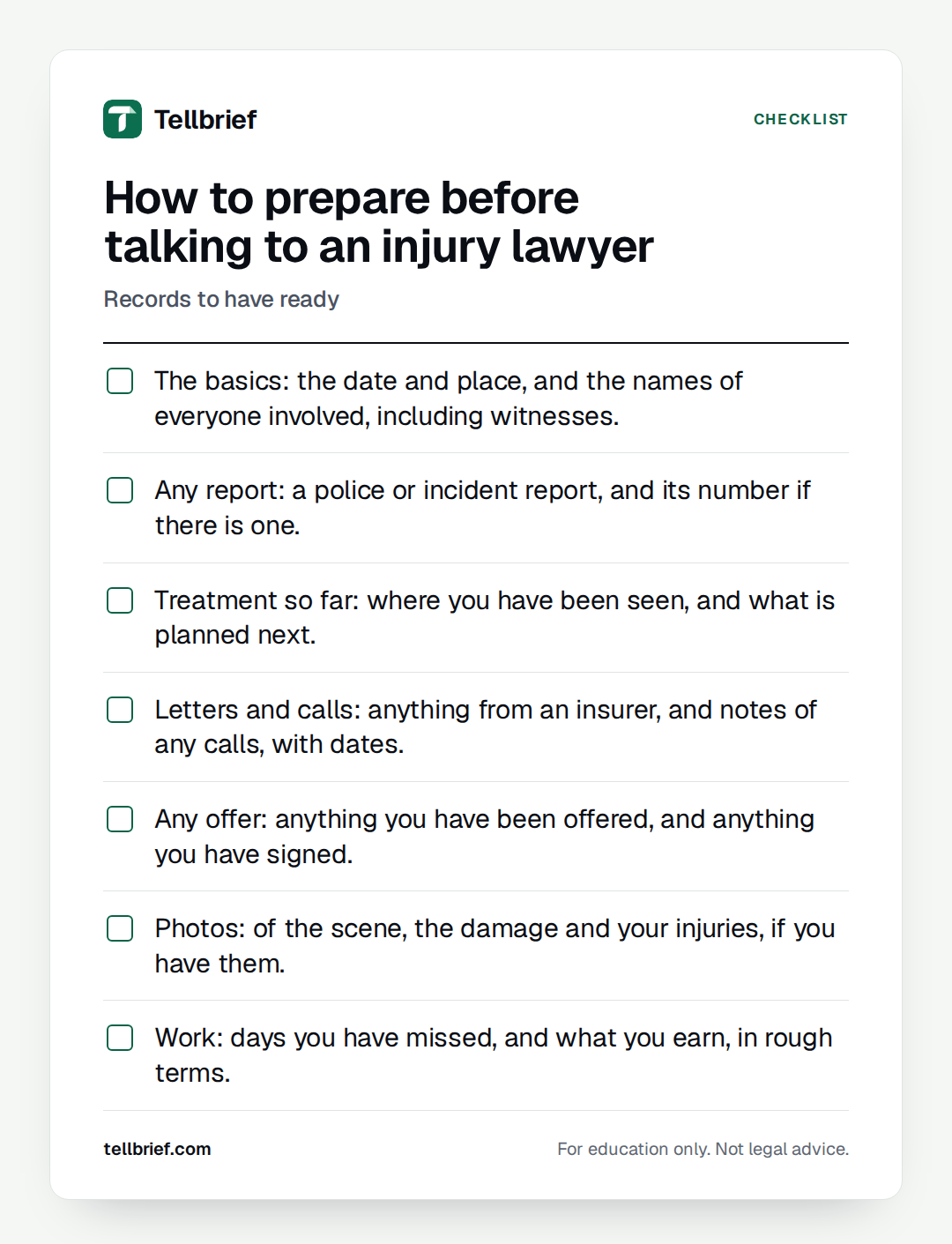
- The basics: the date and place, and the names of everyone involved, including witnesses.
- Any report: a police or incident report, and its number if there is one.
- Treatment so far: where you have been seen, and what is planned next.
- Letters and calls: anything from an insurer, and notes of any calls, with dates.
- Any offer: anything you have been offered, and anything you have signed.
- Photos: of the scene, the damage and your injuries, if you have them.
- Work: days you have missed, and what you earn, in rough terms.
The dates
Claims have deadlines, and they vary by state and claim type. Minnesota’s statutes, for example, set different periods for different kinds of action23, and claims against a municipality carry a separate notice step with a much shorter window4. Rather than working one out yourself, note the date it happened exactly, and make the deadline one of your first questions. A letter from an insurer may carry its own dates too; keep those with the letter.
Letters, calls and offers
It can help to keep everything in one place: letters unopened is too late, but opened and dated is ideal. If an insurer calls, you can write down what was asked and what you said. If you have been offered money, note the amount, who offered it, and whether a time limit came with it, and do not assume it is the only offer there will be. Whether to accept anything is a question to take advice on first.
Example: an offer with a Friday deadline
Made up for this guide
I was rear-ended at a junction six weeks ago. I went to the emergency department that night and have had two follow-ups for neck and back pain; physio starts next week. The other driver’s insurer has called twice and has now offered $4,000 if I sign a release by Friday. I have missed nine days of work. My main question: should I sign, and what happens if I don’t?
To write yours, fill in the brackets:
On [date], [what happened] at [place]. I was treated at [where] and have [follow-ups, treatment planned]. [Insurer] has [written, called, offered $… by (date)]. I have missed [days] of work. My main question: [the one that matters most].
What the lawyer may ask you first
Have a short answer ready for each. “I don’t know yet” is a fine answer.
- What happened, and when?
- Where have you been treated, and what happens next?
- What have insurers sent or said, and has anything been offered?
- Have you signed anything?
- What work have you missed?
- Is anything still getting worse, or not improving?
Questions worth asking your lawyer
- Is the first talk free, and how long is it?
- What deadlines apply to a claim like mine, and when do they run from?
- How do you charge: what percentage, and what costs come out on top?
- Should I talk to the insurer, or sign anything, before we speak again?
- What should I keep from now on?
What to leave out at first
Until the lawyer has checked for conflicts and said they can act for you, the names and a line on what happened can be enough. The check runs on names for a reason: the professional rules expect a lawyer to adopt reasonable procedures to determine the persons and issues involved before deciding whether a conflict of interest exists5, and a lawyer who has consulted with a prospective client must not use or reveal information obtained in the consultation, even where no client-lawyer relationship follows6. Medical records in full can wait. The lawyer can say what to send and when.
If you would rather answer questions than write, Tellbrief asks them for you, most of them one tap, and it turns your answers into a brief your lawyer can work from. See the personal injury sample brief to see what the lawyer receives.
Sources
Each quote was checked against its source on November 16, 2026. Laws and guidance can change after that date.
- Minn. Stat. § 604.01: Comparative fault; effect (opens in a new tab) ↩︎
- Minn. Stat. § 541.07: Two- or three-year limitations (opens in a new tab) ↩︎
- Minn. Stat. § 541.05: Six-year limitation (opens in a new tab) ↩︎
- Minn. Stat. § 466.05: Notice of claim against a municipality (opens in a new tab) ↩︎
- Minnesota Rules of Professional Conduct, Rule 1.7, comment 3 (opens in a new tab) ↩︎
- Minnesota Rules of Professional Conduct, Rule 1.18: Duties to prospective client (opens in a new tab) ↩︎
Questions about a first talk
These answers help you get ready for a lawyer. They don’t say what the law means for your situation, or what you should do.
What should I bring to a first talk with an injury lawyer?
What happened and when, where you have been treated, any letters or offers, and any report number. The date it happened matters most, because deadlines vary by state and claim type.
Should I accept an insurer’s offer?
An offer may come with a release that gives up claims described in it. Have a lawyer explain what the release covers before signing. Keep any deadline stated in the offer.
How do injury lawyers charge?
Ask the lawyer to explain the fee agreement in writing, including the percentage, any additional costs, when they are charged, and what happens if nothing is recovered. Fee requirements vary by state.
What if I don’t have any documents yet?
Say what you have and what exists: a report number, the name of a hospital, the insurer’s letters. The lawyer can tell you what to ask for and how.
I was partly at fault. Is it still worth calling?
Yes, it is worth asking. How fault affects a claim depends on your state’s rules: Minnesota’s comparative fault statute, for example, reduces what can be recovered in proportion to your share of fault, and bars recovery only where your fault was the greater. Your state’s rule may differ, and it is one of the things a first talk is for.
Have the date, the treatment and the offer on one page
Plain-language questions in the set, most of them one tap, free and with no account. Tellbrief turns your answers into a brief your lawyer can work from, and you keep a copy.