Fault, citations and disputed accounts: what to keep
For education only. Not legal advice. Tellbrief is not a law firm.
Two drivers, two accounts, one junction. When the drivers give different accounts, the evidence needs to be examined rather than treating either account as established.
In short
A citation is one officer’s view at the scene, not the decision in a claim. Fault is decided from the whole evidence: accounts, witnesses, damage, records, the scene itself. Keep your account written early and exact, and gather what could test either version.
On this page
What the lawyer needs to establish
Your account, fixed early and in detail: positions, speeds as you honestly know them, signals, lights, what you saw and when. Their account, as given: at the scene, in their insurer’s letters, in any report. And the independent material that can test both: witnesses, photographs, damage patterns, camera footage, vehicle data, the report of any attending officer. A citation, a ticket issued to you or to the other driver, is one piece of that material: it records an officer’s assessment, made quickly and without the full picture. In Minnesota, the uniform traffic ticket has the form and effect of a summons and complaint in the traffic case1; the claim is a separate question, decided on the whole of the evidence. Lawyers treat the citation as evidence to weigh, not as the answer.
What can test either account
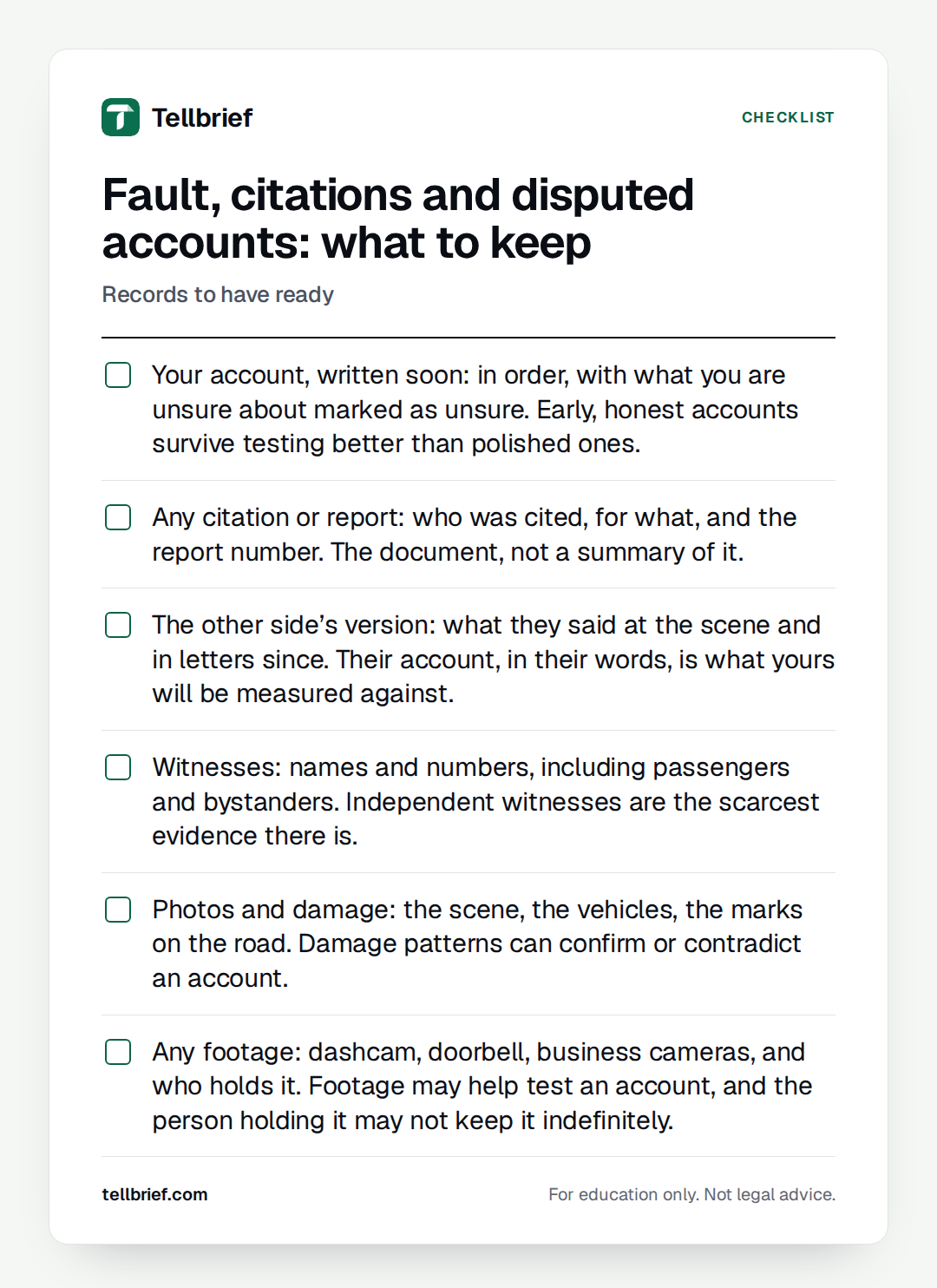
- Your account, written soon: in order, with what you are unsure about marked as unsure. Early, honest accounts survive testing better than polished ones.
- Any citation or report: who was cited, for what, and the report number. The document, not a summary of it.
- The other side’s version: what they said at the scene and in letters since. Their account, in their words, is what yours will be measured against.
- Witnesses: names and numbers, including passengers and bystanders. Independent witnesses are the scarcest evidence there is.
- Photos and damage: the scene, the vehicles, the marks on the road. Damage patterns can confirm or contradict an account.
- Any footage: dashcam, doorbell, business cameras, and who holds it. Footage may help test an account, and the person holding it may not keep it indefinitely.
If the accounts cannot both be right
It can help to resist filling gaps with what must have happened. “I don’t remember the light” is a stronger sentence, in the long run, than a confident guess that footage later contradicts. Where accounts conflict, lawyers look for the facts neither side can move: measurements, damage, timing from records. Your gathering should favour those. And where you were partly at fault, say so plainly to your own lawyer: how partial fault affects a claim varies by state. Minnesota’s comparative fault statute, for example, reduces any recovery in proportion to your share of fault, and bars recovery only where your fault was the greater2. Either way, it is a factor to plan around, not a confession that ends the conversation.
Example: two green lights and a café camera
Made up for this guide
At a crossroads, the other driver and I both say the light was green. He was cited at the scene for failing to yield; his insurer now writes that I was speeding and that their driver “had completed his turn”. A café on the corner has a camera facing the junction. My main question: what actually decides this, and what should be secured before the café’s footage is wiped?
Questions about disputed fault
Have a short answer ready for each. “I don’t know yet” is a fine answer.
- What happened, in order, and which parts are you unsure of?
- Was anyone cited, and what does the report say?
- What is the other side’s account, in their words?
- Who saw it, and how can they be reached?
- What photographs, damage or footage exist, and who holds them?
- Is any part of it, honestly, partly your fault?
Questions worth asking your lawyer
- What evidence will actually decide fault here?
- What should be requested now, before it is lost?
- How much does the citation matter, either way?
- If I was partly at fault, what does that do to the claim in our state?
If you would rather answer questions than reconstruct the scene, Tellbrief asks them for you, most of them one tap, and it turns your answers into a brief your lawyer can work from. See the personal injury sample brief to see what the lawyer receives.
Sources
Each quote was checked against its source on November 16, 2026. Laws and guidance can change after that date.
Questions about fault and citations
These answers help you get ready for a lawyer. They don’t say what the law means for your situation, or what you should do.
The other driver was cited. Does that mean I win?
It helps, and it is not the decision. The claim is decided on the whole evidence, and the cited driver’s insurer can still dispute fault. Treat the citation as one piece of evidence, not a decision about the entire claim.
I was the one cited. Is my claim over?
No. A citation is an officer’s quick assessment, made without the full picture. What it does to a claim depends on the whole of the evidence, which is for the lawyer to weigh. Bring the citation and the report, and be exact about what happened.
There were no witnesses and no cameras. What then?
Accounts, damage and the scene itself may still provide evidence. Write your account early and keep every photograph and document.
Should I argue it out with their insurer myself?
Set out your account once, in writing, on advice, rather than debating it across calls. Disputed fault is where representation earns its keep fastest.
Write your account while it is fresh
Plain-language questions in the set, most of them one tap, free and with no account. Tellbrief turns your answers into a brief your lawyer can work from, and you keep a copy.