Medical treatment and records after an accident
For education only. Not legal advice. Tellbrief is not a law firm.
Long before anyone argues about money, they argue from the medical timeline. It is built one appointment at a time, starting with the first.
In short
Your medical records are the claim’s spine: they show what was injured, what was treated, and how it developed. Gather where you have been treated rather than the records themselves. A lawyer requests them properly, and the timeline they form is what the other side will test.
On this page
What the lawyer needs to establish
Where you have been treated, in order, from the first attendance onward: emergency care, your own doctor, specialists, physio, scans, and anything you have been referred to but have not yet had. What each attendance records about how the injury happened and how it has developed. And whether there are gaps: treatment that stopped, referrals not followed, symptoms that began later. A gap in treatment or a delayed first visit does not explain itself. Write down when symptoms began, when you sought care, and why there was a gap. Your lawyer can examine the records and explain what questions they raise. All of it will be read closely by the other side, and a lawyer would rather build the explanation from the records than meet it in the insurer’s letter.
The treatment map
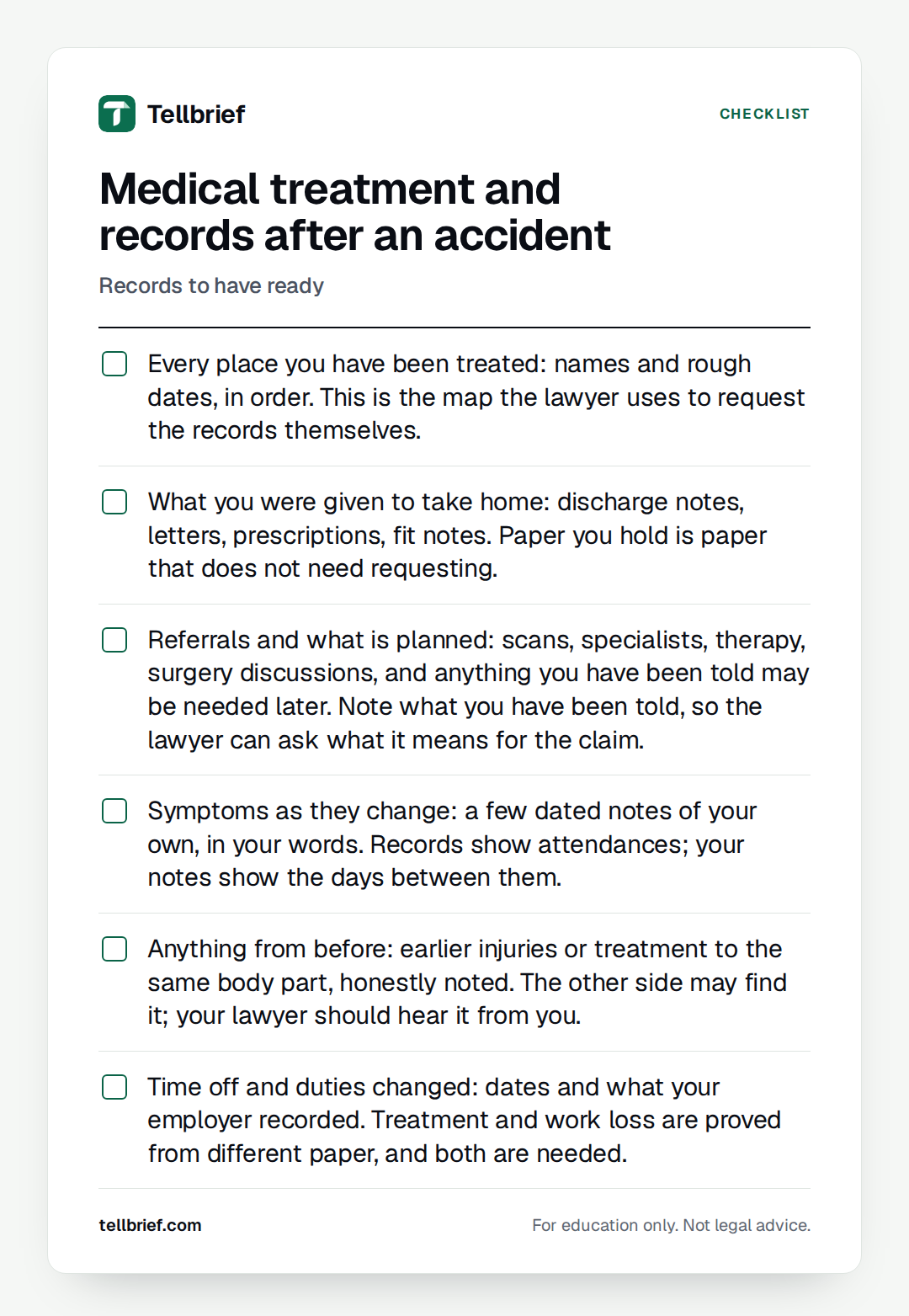
- Every place you have been treated: names and rough dates, in order. This is the map the lawyer uses to request the records themselves.
- What you were given to take home: discharge notes, letters, prescriptions, fit notes. Paper you hold is paper that does not need requesting.
- Referrals and what is planned: scans, specialists, therapy, surgery discussions, and anything you have been told may be needed later. Note what you have been told, so the lawyer can ask what it means for the claim.
- Symptoms as they change: a few dated notes of your own, in your words. Records show attendances; your notes show the days between them.
- Anything from before: earlier injuries or treatment to the same body part, honestly noted. The other side may find it; your lawyer should hear it from you.
- Time off and duties changed: dates and what your employer recorded. Treatment and work loss are proved from different paper, and both are needed.
Getting records, and what they cost
Records are requested from each provider by the lawyer, with your signed authority, rather than gathered by you one office at a time. In Minnesota, a provider may not release your health records without your signed and dated consent or a specific authorisation in state law, and a request made on a consent must not go beyond the limits the consent sets1. Providers may charge for copies, within limits the statute sets, and the statute sets the time for supplying them too2, which is one reason the list of providers matters early: a record requested in month one is evidence in hand; the same record chased in month nine is a delay. If you have been treated privately, or abroad, or by several services after moving, say so: those records exist in different systems and take longer to surface.
Example: an old shoulder injury and a new one
Made up for this guide
I was seen at the emergency department on the night of the crash and discharged with painkillers. My GP referred me for physio three weeks later when my shoulder did not settle; I have had five sessions. The physio thinks a scan is needed and has written to my GP. I also had treatment for the same shoulder two years ago after a fall at home. My main question: what records will the lawyer pull together, and does the old injury cause a problem?
Questions about your treatment
Have a short answer ready for each. “I don’t know yet” is a fine answer.
- Where have you been treated, in order, and what is planned next?
- What symptoms began later, or are not improving?
- Have you missed any referrals or stopped any treatment, and why?
- Have you had treatment to the same body part before?
- Who has written to whom about scans or specialists?
- What work have you missed, and what does your employer hold about it?
Questions worth asking your lawyer
- Which records will you request, and how long do they take?
- Should I keep going to treatment I have been advised, even if I feel I can manage?
- How do we handle the earlier injury to the same shoulder?
- What should I write down between appointments?
If you would rather answer questions than chase your own records, Tellbrief asks them for you, most of them one tap, and it turns your answers into a brief your lawyer can work from. See the personal injury sample brief to see what the lawyer receives.
Sources
Each quote was checked against its source on November 16, 2026. Laws and guidance can change after that date.
Questions about treatment and records
These answers help you get ready for a lawyer. They don’t say what the law means for your situation, or what you should do.
Should I get copies of my records myself?
The lawyer requests them with your authority, which keeps the set complete and the requests consistent. Bring what you already hold, and the list of everywhere you have been treated.
I didn’t go to a doctor straight away. Does that matter?
A delayed first visit is worth discussing with your lawyer. Write down when the symptoms began, when you first sought care, and what happened between those dates.
I stopped physio because I felt better, then worse. What should I do?
Tell the lawyer, and consider going back to the treating clinician so the record shows the development. Gaps explained by the record itself are far easier than gaps explained later.
Can the insurer see all my medical history?
Not automatically: what can be requested and shared depends on the authority you sign and the rules that apply. In Minnesota, a request made on your consent must not go beyond the limits the consent sets. Your lawyer handles what is sought and what is shared; ask what will be requested in your case before you sign any authority.
List everywhere you have been treated
Plain-language questions in the set, most of them one tap, free and with no account. Tellbrief turns your answers into a brief your lawyer can work from, and you keep a copy.