Who may be responsible for an accident: what to gather
For education only. Not legal advice. Tellbrief is not a law firm.
The person at the scene is the start of the list, not always the end of it. Who employed them, who controlled the place, who maintained the thing: each is a fact worth gathering while it is easy to get.
In short
Responsibility can sit in more than one place: the person involved, their employer, whoever controlled the property, whoever maintained the machine or vehicle, whoever made the product. Gather the facts that connect each candidate to what happened; the lawyer works out which connections the law recognises.
On this page
What the lawyer needs to establish
For each possible party, the connection between them and what happened. A driver may have been working, which brings an employer into the picture: Minnesota law, for example, makes a municipality subject to liability for the torts of its employees acting within the scope of their employment1. A fall may trace to whoever controlled or maintained the property, which is not always its owner: in Minnesota, a residential landlord covenants in every lease to keep the premises and common areas in reasonable repair2, so who was responsible for maintaining a place is a fact worth identifying in its own right. A machine or vehicle fault may trace to whoever serviced it, or made it: in product cases the maker’s identity is its own question, and Minnesota’s product liability statute requires a seller who is sued over a product to certify the identity of its manufacturer3. The lawyer tests each connection against the facts: employment, control, maintenance, design. Your part is to gather the connecting facts before they scatter: names, employers, signage, contracts mentioned at the scene, the company on the van, who arrived to inspect or repair.
The connecting facts
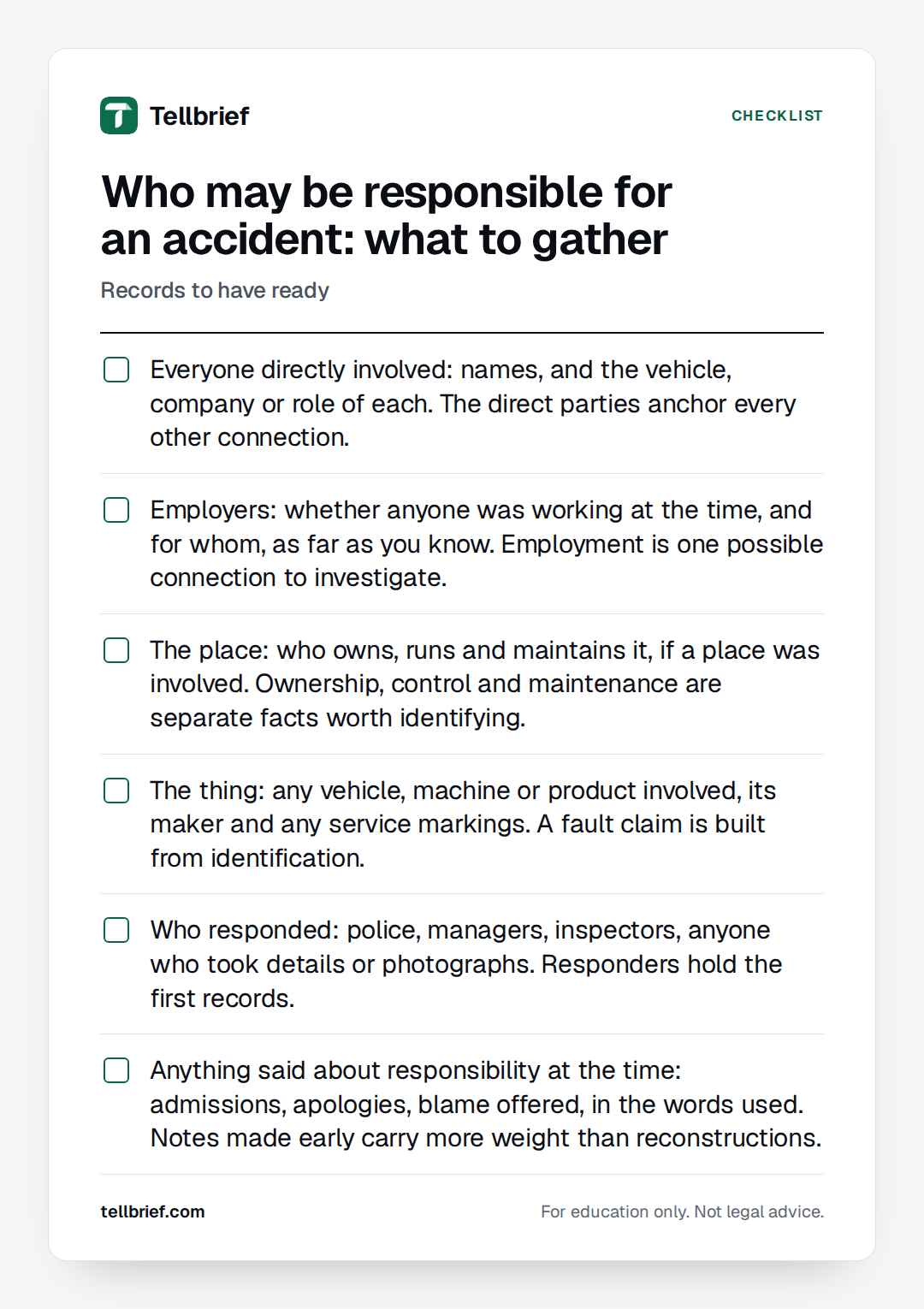
- Everyone directly involved: names, and the vehicle, company or role of each. The direct parties anchor every other connection.
- Employers: whether anyone was working at the time, and for whom, as far as you know. Employment is one possible connection to investigate.
- The place: who owns, runs and maintains it, if a place was involved. Ownership, control and maintenance are separate facts worth identifying.
- The thing: any vehicle, machine or product involved, its maker and any service markings. A fault claim is built from identification.
- Who responded: police, managers, inspectors, anyone who took details or photographs. Responders hold the first records.
- Anything said about responsibility at the time: admissions, apologies, blame offered, in the words used. Notes made early carry more weight than reconstructions.
Why it matters beyond blame
Identifying possible parties also helps the lawyer investigate what insurance or other coverage may apply to each. Do not assume that the person directly involved is the only possible party. A lawyer will also check the deadlines for each party separately, because they can differ: Minnesota’s statutes set different periods for different kinds of action45, and a claim against a municipality carries a separate notice step with a much shorter window6. A party identified late can be a claim lost on time rather than on merit.
Responsibility can also be shared, including with the injured person. Minnesota’s comparative fault statute reduces a recovery in proportion to the claimant’s own share of fault, and bars it only where that fault was the greater7; where two or more parties are liable, what each contributes follows their shares of fault, with exceptions the statute lists8. And where a party has no insurance, the lawyer will look for what else may respond: in Minnesota, uninsured and underinsured motorist coverages must be provided in your own auto policy9.
Example: a delivery van on its round
Made up for this guide
A delivery van reversed into me in a supermarket car park. The driver apologised and gave his name; the van carried a logistics company’s name, and he said he was “on his round”. The supermarket’s manager took my details and said their cameras cover the car park. My main question: is my claim against the driver, the company, the supermarket, or some combination, and what should be gathered for each?
Questions about who may be responsible
Have a short answer ready for each. “I don’t know yet” is a fine answer.
- Who was directly involved, and in what role?
- Was anyone working at the time, and for whom?
- Who controlled or maintained the place or the thing involved?
- What company names, signage or documents did you see?
- Who responded, and what records did they make?
- What was said at the scene about whose fault it was?
Questions worth asking your lawyer
- Who are the candidate parties here, and what would establish each?
- Do the deadlines differ between them?
- What should be asked for now, from whom, before records disappear?
- Whose insurance is likely to stand behind each party?
If you would rather answer questions than trace connections, Tellbrief asks them for you, most of them one tap, and it turns your answers into a brief your lawyer can work from. See the personal injury sample brief to see what the lawyer receives.
Sources
Each quote was checked against its source on November 16, 2026. Laws and guidance can change after that date.
- Minn. Stat. § 466.02: Tort liability of municipalities (opens in a new tab) ↩︎
- Minn. Stat. § 504B.161: Landlord covenants (reasonable repair) (opens in a new tab) ↩︎
- Minn. Stat. § 544.41: Product liability; limit on liability of nonmanufacturers (opens in a new tab) ↩︎
- Minn. Stat. § 541.07: Two- or three-year limitations (opens in a new tab) ↩︎
- Minn. Stat. § 541.05: Six-year limitation (opens in a new tab) ↩︎
- Minn. Stat. § 466.05: Notice of claim against a municipality (opens in a new tab) ↩︎
- Minn. Stat. § 604.01: Comparative fault; effect (opens in a new tab) ↩︎
- Minn. Stat. § 604.02: Apportionment of damages (opens in a new tab) ↩︎
- Minn. Stat. § 65B.49, subd. 3a: Uninsured and underinsured motorist coverages (opens in a new tab) ↩︎
Questions about who is responsible
These answers help you get ready for a lawyer. They don’t say what the law means for your situation, or what you should do.
The person who hurt me had no insurance. Is there still a claim?
Possibly: another party, an employer or a property controller may stand behind it, and in Minnesota your own auto policy must include uninsured motorist coverage. What applies depends on the facts and the state. Identifying every party early is what keeps those routes open.
Can more than one party share responsibility?
Yes, responsibility can be shared, including with the injured person in some cases. The shares are worked out from the facts, which is another reason the connecting evidence matters.
The company says the driver was a contractor, not an employee. Does that end it?
Not by itself. Whether someone counts as an employee or a contractor is worked out from the facts of how the work was organised and controlled, not only from the label the company uses. Tell the lawyer what you know: who set the hours, whose vehicle and tools were used, and who directed the work.
Should I contact the other parties myself?
Note who they are and leave contact to the lawyer. Early letters fix what is asked for and when, and they are part of the record.
Gather the connections while they are easy
Plain-language questions in the set, most of them one tap, free and with no account. Tellbrief turns your answers into a brief your lawyer can work from, and you keep a copy.