Medical bills, health insurance and liens: what to keep
For education only. Not legal advice. Tellbrief is not a law firm.
The treatment is the claim’s story; the bills are its ledger. Both need keeping, and the ledger has a habit of arriving in envelopes people are afraid to open.
In short
Three kinds of paper arrive: bills addressed to you, explanations from your health insurer of what it paid, and letters saying some amount may have to be repaid out of any settlement. Keep all three, unthrown and in date order. Which repayments are real, and for how much, is a lawyer’s checking job, not a worry to carry alone.
On this page
What the lawyer needs to establish
What the treatment has cost in total, who has actually paid what so far, and who is claiming any of it back. Those are three different numbers, and claims settle badly when they are muddled. A health insurer or public programme may assert a right to repayment for treatment it paid for. A medical provider may also claim an unpaid balance. Whether a claim is enforceable, and how much may be owed, depends on the applicable coverage, agreement and law. Those repayment rights are stated in law: Medicare pays conditionally, on reimbursement, where a liability or no-fault plan is the primary payer1; Minnesota’s Medical Assistance agency is subrogated to the recipient’s cause of action to the extent of the cost of the care it furnished2; a Minnesota hospital has a lien for the reasonable charges for its care on the injured person’s cause of action3; and an employer health plan enforces its own terms under the federal civil enforcement provision4. Which pot pays first is set by rules too: Medicare is secondary to automobile and liability cover1, and Minnesota’s no-fault statute sets an order of priorities for basic economic loss benefits5. A lawyer audits them at the end of the claim, and the audit can change the figures: Medicare’s recovery, for example, is reduced by regulation to take account of the cost of procuring the settlement where the claim was disputed6. Your part is to make sure every letter reaches the file, because a repayment claim discovered after the money is divided is a genuine problem.
The ledger, kept whole
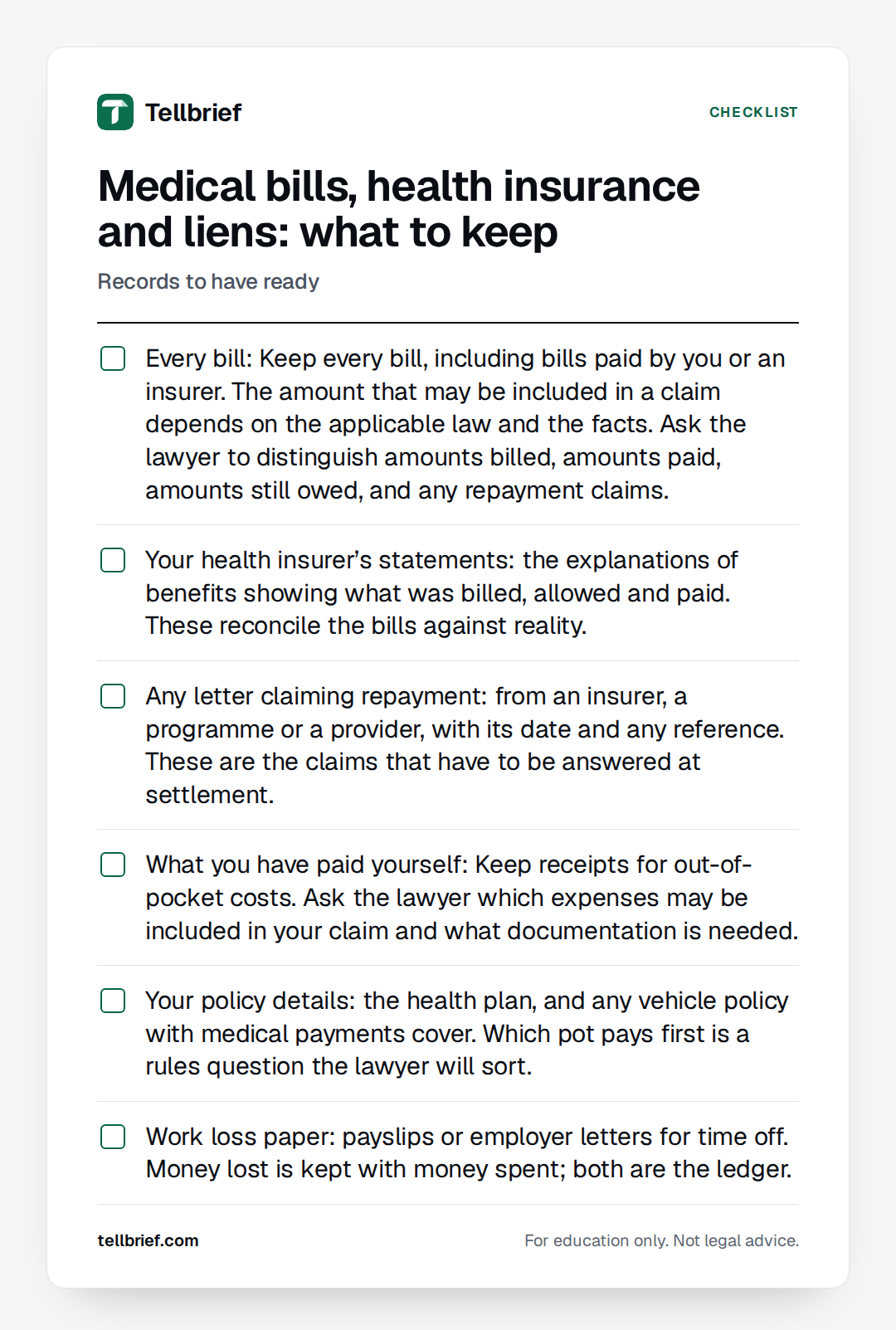
- Every bill: Keep every bill, including bills paid by you or an insurer. The amount that may be included in a claim depends on the applicable law and the facts. Ask the lawyer to distinguish amounts billed, amounts paid, amounts still owed, and any repayment claims.
- Your health insurer’s statements: the explanations of benefits showing what was billed, allowed and paid. These reconcile the bills against reality.
- Any letter claiming repayment: from an insurer, a programme or a provider, with its date and any reference. These are the claims that have to be answered at settlement.
- What you have paid yourself: Keep receipts for out-of-pocket costs. Ask the lawyer which expenses may be included in your claim and what documentation is needed.
- Your policy details: the health plan, and any vehicle policy with medical payments cover. Which pot pays first is a rules question the lawyer will sort.
- Work loss paper: payslips or employer letters for time off. Money lost is kept with money spent; both are the ledger.
Bills arriving while the claim runs
Treatment bills can arrive addressed to you even where an insurer will ultimately pay, and providers may chase them while the claim is unresolved. Open them, note the dates, and pass them to the lawyer rather than ignoring or paying them in a panic. Whether a bill should be paid now, held, or sent to a health insurer meanwhile is a practical decision the lawyer makes case by case, and it is much easier to make with the envelope in hand than from a collections letter later.
Example: $6,800 of bills and a $4,900 letter
Made up for this guide
Since the crash I have had hospital bills totalling about $6,800. My health insurer paid most of the big one and has written saying it may claim $4,900 back from any settlement. The physio clinic says I owe $620 myself. I have paid $140 in prescriptions and kept the receipts. My main question: who ends up paying what, and what should I do with each new letter as it arrives?
Questions about bills and repayment
Have a short answer ready for each. “I don’t know yet” is a fine answer.
- What has the treatment cost in total, as far as the bills show?
- Who has paid what: health insurer, vehicle cover, you?
- Have you had any letter claiming repayment from a settlement?
- What have you paid out of pocket, and do you have the receipts?
- Are any bills being chased, or with collections?
- What health cover do you have, and through whom?
Questions worth asking your lawyer
- Which of these repayment claims are real, and can any be reduced?
- What should I do with each bill as it arrives?
- Will the settlement figure I hear be before or after these are paid?
- What should I keep receipts for from now on?
If you would rather answer questions than sort envelopes, Tellbrief asks them for you, most of them one tap, and it turns your answers into a brief your lawyer can work from. See the personal injury sample brief to see what the lawyer receives.
Sources
Each quote was checked against its source on November 16, 2026. Laws and guidance can change after that date.
- Social Security Act § 1862(b), 42 U.S.C. § 1395y(b): Medicare as secondary payer (opens in a new tab) ↩︎
- Minn. Stat. § 256B.37: Medical Assistance subrogation (opens in a new tab) ↩︎
- Minn. Stat. § 514.68: Lien for hospital charges (opens in a new tab) ↩︎
- ERISA § 502(a)(3), 29 U.S.C. § 1132(a)(3): Civil enforcement (opens in a new tab) ↩︎
- Minn. Stat. § 65B.47: Priority of applicability of security for basic economic loss benefits (opens in a new tab) ↩︎
- 42 C.F.R. § 411.37: Amount of Medicare recovery when a primary payment is made (opens in a new tab) ↩︎
Questions about bills and liens
These answers help you get ready for a lawyer. They don’t say what the law means for your situation, or what you should do.
Do I have to repay my health insurer from a settlement?
Some repayment is claimed where the insurer paid for accident treatment, but the amount and the right itself depend on the plan and your state’s rules, and claims are checked and sometimes reduced. Keep every letter and let the lawyer audit them.
A bill has gone to collections. What should I do?
Tell the lawyer promptly and share the bills and any collection letters. Ask whether the bill should be sent to your health insurer, handled through other coverage, or addressed another way. Keep the correspondence and note any dates stated in it.
Should I just pay the small bills myself?
Keep the receipts if you do, and ask first: paying can be sensible, but some bills are better routed through health cover so the record and the totals stay straight.
What is the difference between the settlement and what I receive?
The amount you receive may differ from the settlement figure because fees, costs and any enforceable repayment claims may affect the final distribution. Ask the lawyer to show you the calculation using your figures.
Open every envelope and keep it
Plain-language questions in the set, most of them one tap, free and with no account. Tellbrief turns your answers into a brief your lawyer can work from, and you keep a copy.