Personal injury filing deadlines: what to ask
For education only. Not legal advice. Tellbrief is not a law firm.
“How long have I got?” is the right first question. It just does not have one answer, and a guide that printed one would be wrong for most readers.
In short
Anyone who gives you one deadline for an injury claim is guessing. The limit depends on the kind of claim, the state whose law applies, and who the claim is against, and some claims against government bodies have a much shorter notice step first. The useful thing to gather is the date it happened; the useful thing to ask is for your deadline, in writing.
On this page
Why the deadline is three questions, not one
First, the claim type: a road crash, a fall, medical care, an injury at work and a defective product can each run on different clocks, sometimes within the same incident. Minnesota’s statutes make the point concretely: separate sections set different periods for a tort resulting in personal injury1, for other injuries to the person2, and for actions against health care providers, which run from when the cause of action accrued3. An injury at work runs in a separate system again: Minnesota’s workers’ compensation chapter makes the employer’s liability under it exclusive4, sets its own notice requirements and time limits for compensation claims56, and provides that proceedings against a third party who caused the injury are separate, and may be taken even where compensation benefits are paid7. Second, the jurisdiction: time limits are set by state law and differ from state to state, and the state whose law applies is not always the one you live in. Minnesota’s conflict-of-laws statute provides that where a claim is substantively based on the law of one other state, that state’s limitation period applies8. Third, the defendant: claims involving a government body, a city bus, a public hospital, a state road, can have a preliminary notice step with a far shorter window than the main deadline, and missing it can end the claim before it starts. Minnesota’s version is a written notice that must be presented to the municipality within a period the statute sets, running from when the loss or injury is discovered9. A lawyer works your deadline out from those three facts, which is why the first consultation starts with them.
A child’s claim can run differently again: Minnesota’s tolling statute lists the plaintiff being under 18 as a disability that suspends the running of the limitation period until the disability is removed10.
The three facts the deadline turns on
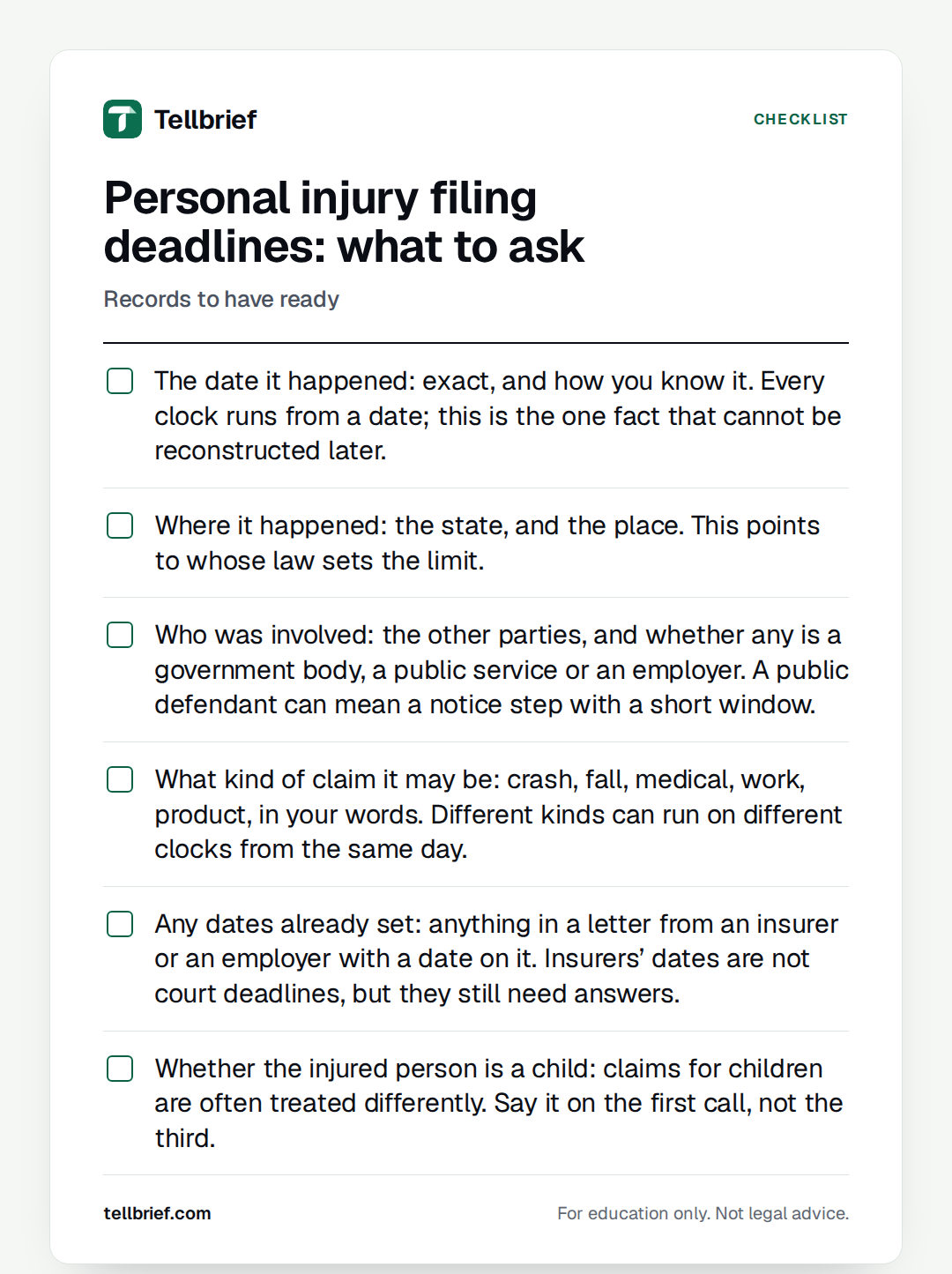
- The date it happened: exact, and how you know it. Every clock runs from a date; this is the one fact that cannot be reconstructed later.
- Where it happened: the state, and the place. This points to whose law sets the limit.
- Who was involved: the other parties, and whether any is a government body, a public service or an employer. A public defendant can mean a notice step with a short window.
- What kind of claim it may be: crash, fall, medical, work, product, in your words. Different kinds can run on different clocks from the same day.
- Any dates already set: anything in a letter from an insurer or an employer with a date on it. Insurers’ dates are not court deadlines, but they still need answers.
- Whether the injured person is a child: claims for children are treated differently. Say it on the first call, not the third.
Two clocks people confuse
An insurer’s deadline, “our offer closes Friday”, is a negotiating date set by the insurer, not the legal deadline for your claim. The two are easily confused, and the confusion is not always accidental. Note both, and ask the lawyer to tell you which is which, and to give you the legal one in writing. In Minnesota, a civil action is commenced when the summons is served on the defendant, or when it is delivered for service in the way the court rules set out11; a letter to an insurer is not one of those steps. An offer’s own closing date does not move the statutory period either1. If you are reading this because a date is close, that is the reason to call today rather than after the weekend: not because every deadline is short, but because yours is unknown until someone works it out.
Example: a city pavement and a friend’s three years
Made up for this guide
I fell on a broken pavement outside the station on 2 September and broke my ankle. A friend says I have “three years for personal injury”, but the pavement belongs to the city, and someone at the hospital said claims against the city are different. I have not written to anyone yet. My main question: what is my actual deadline, and is there a notice I should already have given?
What the lawyer needs to establish
Have a short answer ready for each. “I don’t know yet” is a fine answer.
- What happened, and on what exact date?
- Where did it happen, and in which state?
- Who is the claim likely to be against, and is any of them a public body?
- Have you given any notice, or signed anything, so far?
- Is the injured person under 18?
- What letters have you had, and what dates are on them?
Questions worth asking your lawyer
- What is my deadline, and will you give it to me in writing?
- Is there a notice step before it, and when does that run out?
- Are there several clocks running on different parts of this?
- What has to happen well before the deadline, not just by it?
If you would rather answer questions than work out dates, Tellbrief asks them for you, most of them one tap, and it turns your answers into a brief your lawyer can work from. See the personal injury sample brief to see what the lawyer receives.
Sources
Each quote was checked against its source on November 16, 2026. Laws and guidance can change after that date.
- Minn. Stat. § 541.07: Two- or three-year limitations (opens in a new tab) ↩︎
- Minn. Stat. § 541.05: Six-year limitation (opens in a new tab) ↩︎
- Minn. Stat. § 541.076: Health care provider actions (opens in a new tab) ↩︎
- Minn. Stat. § 176.031: Employer’s liability exclusive (opens in a new tab) ↩︎
- Minn. Stat. § 176.141: Notice of injury (opens in a new tab) ↩︎
- Minn. Stat. § 176.151: Time limitations (opens in a new tab) ↩︎
- Minn. Stat. § 176.061: Third-party liability (opens in a new tab) ↩︎
- Minn. Stat. § 541.31: Conflict of laws; limitation periods (opens in a new tab) ↩︎
- Minn. Stat. § 466.05: Notice of claim against a municipality (opens in a new tab) ↩︎
- Minn. Stat. § 541.15: Periods of disability not counted (opens in a new tab) ↩︎
- Minnesota Rules of Civil Procedure, Rule 3.01: Commencement of the action (opens in a new tab) ↩︎
Questions about injury deadlines
These answers help you get ready for a lawyer. They don’t say what the law means for your situation, or what you should do.
Is the deadline the same in every state?
No. Time limits for injury claims are set by state law and vary, sometimes by a lot, and different claim types within one state vary too. That is why any single figure quoted without your facts is unreliable.
What if the deadline has already passed?
Ask anyway. The statutes themselves list grounds on which the running of a period is suspended, and some periods run from when a cause of action accrued rather than from the day of the injury, so a date that looks passed is not always the end of it. Only a lawyer with your dates can say. Do not assume either way.
Does telling the insurer stop the clock?
Writing to an insurer is not the same as starting a claim in the way the deadline requires. Ask the lawyer what step actually protects the date in your state.
I was hurt at work. Is it the same deadline?
Work injuries involve a separate compensation system, with its own notice requirements and time limits, and sometimes a claim against someone else as well. The two have different dates; both belong in the first conversation.
Get your deadline in writing
Plain-language questions in the set, most of them one tap, free and with no account. Tellbrief turns your answers into a brief your lawyer can work from, and you keep a copy.