Recorded statements and insurance adjusters: what to know
For education only. Not legal advice. Tellbrief is not a law firm.
The call comes early, sounds friendly, and is recorded. What it is for depends entirely on which insurer is on the line.
In short
Two questions decide most of it: whose insurer is asking, yours or the other side’s, and whether you have taken advice yet. Your own policy may expect your cooperation; the other side’s adjuster is building their file, not yours. It is reasonable to say you will call back, and to decide after advice.
On this page
What the lawyer needs to establish
Whose insurer is asking. Your own insurer insures you, and your policy may include a duty to cooperate with their investigation, which can include a statement. In Minnesota, your own no-fault plan may itself prescribe a period within which you must notify the insurer of the accident and the possibility of a claim for benefits1; what else your policy requires is in the policy, so have the lawyer check yours. The other side’s insurer insures the person you may claim against; their adjuster’s job is to assess that claim, and your recorded words become part of their evidence. Minnesota’s rules of evidence treat your own statement, offered against you, as a statement by a party-opponent rather than hearsay2. A lawyer will also want to know what stage things are at: what you have already said or signed, whether fault is disputed, and how your injuries are developing, because a statement given in week one describes week one, and injuries do not always stay as they first appeared. The legal deadlines behind all of this are a separate subject: the guide to injury filing deadlines covers how they are worked out.
Before you decide about a statement
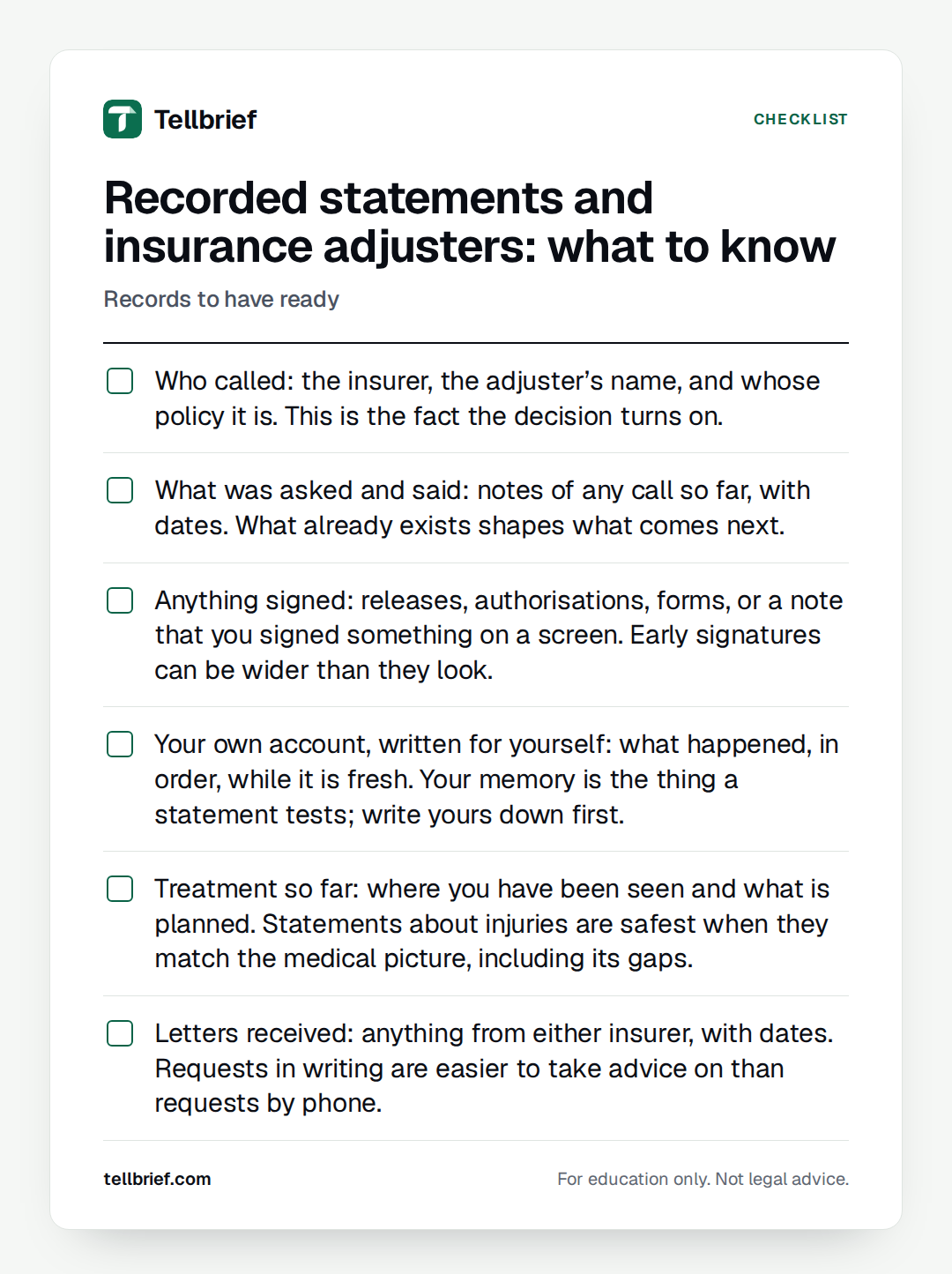
- Who called: the insurer, the adjuster’s name, and whose policy it is. This is the fact the decision turns on.
- What was asked and said: notes of any call so far, with dates. What already exists shapes what comes next.
- Anything signed: releases, authorisations, forms, or a note that you signed something on a screen. Early signatures can be wider than they look.
- Your own account, written for yourself: what happened, in order, while it is fresh. Your memory is the thing a statement tests; write yours down first.
- Treatment so far: where you have been seen and what is planned. Statements about injuries are safest when they match the medical picture, including its gaps.
- Letters received: anything from either insurer, with dates. Requests in writing are easier to take advice on than requests by phone.
What adjusters listen for
An account that shifts between tellings; injuries described as minor that later are not; admissions about speed, attention or fault offered casually; and gaps between what is said and what the records show. None of that requires you to be guarded about the truth. It requires the truth to be accurate and complete at the time you give it, which is hard in the first days, on painkillers, about an event you saw once, quickly. That, rather than suspicion, is the practical reason lawyers want a statement to wait until the facts and the medical picture are clearer. Signatures deserve the same care: in Minnesota, a provider may not release your health records without your signed and dated consent or a specific authorisation in Minnesota law3, so read an authorisation for the records and the period it covers before signing it.
Example: a friendly call two days after the crash
Made up for this guide
The other driver’s insurer called two days after the crash, while I was still off work with whiplash. The adjuster was pleasant and asked to “take a quick recorded statement to get my side moving”. I said I was not sure how my neck would be in a month, and that I would call back. They said delay could slow my claim. My main question: was I right to pause, and what should happen before any statement is given?
Questions to prepare for the lawyer
Have a short answer ready for each. “I don’t know yet” is a fine answer.
- Whose insurer has contacted you, and what have they asked for?
- Have you already given a statement, written or recorded, to anyone?
- Have you signed anything, including on a screen?
- Is fault disputed, and by whom?
- How are your injuries developing since the accident?
- What does your own policy say about cooperating, as far as you know?
Questions worth asking your lawyer
- Do I have to give this statement, and what happens if I wait?
- Should the statement be given at all, and if so, when and how?
- What have I already said or signed that we need to work around?
- What should I say if they call again before we speak?
If you would rather answer questions than handle insurer calls unprepared, Tellbrief asks them for you, most of them one tap, and it turns your answers into a brief your lawyer can work from. See the personal injury sample brief to see what the lawyer receives.
Sources
Each quote was checked against its source on November 16, 2026. Laws and guidance can change after that date.
Questions about recorded statements
These answers help you get ready for a lawyer. They don’t say what the law means for your situation, or what you should do.
Can I refuse a recorded statement?
For the other side’s insurer, you can decline or postpone until you have taken advice. Your own insurer is different: your policy may require cooperation, and in Minnesota your own no-fault plan may set its own period for notifying it of the accident and a possible claim. Which insurer is asking is the question to settle first.
The adjuster says delay will hurt my claim. Is that true?
It is a reason you will hear, and it is worth testing with a lawyer rather than accepting on the call. Legal deadlines are real but they are measured differently from an adjuster’s timetable; the deadlines guide covers the difference.
I already gave a statement. Have I ruined my claim?
Not necessarily. Tell the lawyer what you said, as exactly as you can, and ask for a copy or transcript to be obtained. Giving an early statement does not, by itself, answer every question about the claim. Tell the lawyer what you said and ask how it affects the next steps.
Should I let them record a short call just about the car?
Even a call about damage can range wider than the car. Note what is asked, and take advice on where the line is in your case.
Settle whose insurer it is first
Plain-language questions in the set, most of them one tap, free and with no account. Tellbrief turns your answers into a brief your lawyer can work from, and you keep a copy.