Child support and spousal maintenance: what to gather
For education only. Not legal advice. Tellbrief is not a law firm.
Arguments about support are arguments about inputs. Arrive with the inputs documented, and the conversation can be about the answer.
In short
Support is arithmetic on established figures: each parent’s income, how much time the children spend with each, and what the children and the household cost. Gather the documents behind each figure. The formulas and the terms used vary by state; the figures are what travel.
On this page
What the lawyer needs to establish
Child support and spousal maintenance are governed by different rules. Child support calculations can depend on each parent’s income, parenting arrangements and children’s expenses.12 Spousal maintenance may involve additional factors, including financial need and ability to pay.3 The rules, calculations and terminology vary by state. A lawyer can apply the rules in your state to the figures you bring. Federal law requires every state to have child support guidelines, and the amount the guidelines produce is presumed correct unless a court finds it unjust or inappropriate in the particular case; a court that sets a different amount must make a written finding explaining why applying the guidelines would be unjust or inappropriate.4
The figures behind the calculation
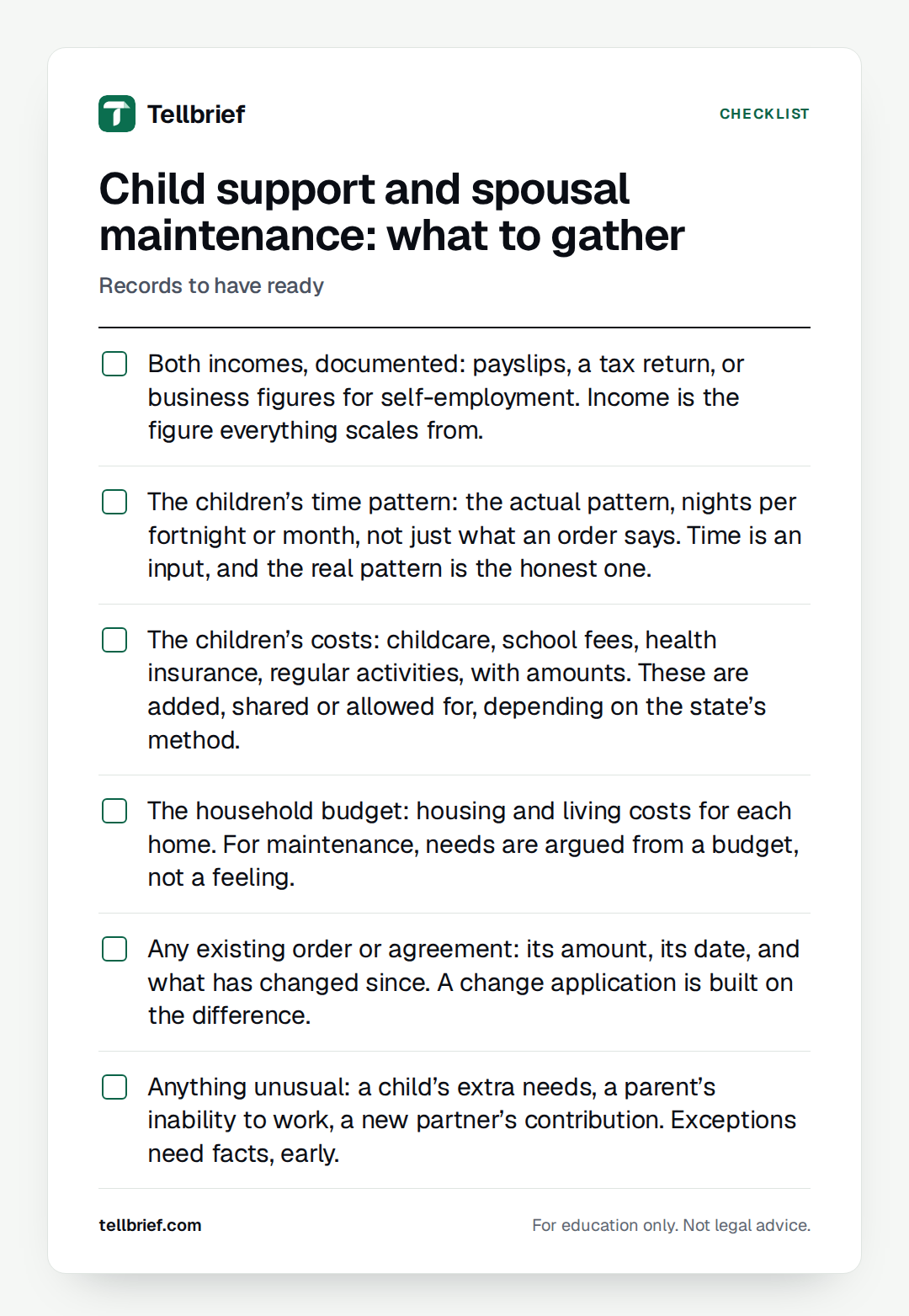
- Both incomes, documented: payslips, a tax return, or business figures for self-employment. Income is the figure everything scales from.
- The children’s time pattern: the actual pattern, nights per fortnight or month, not just what an order says. Time is an input, and the real pattern is the honest one.
- The children’s costs: childcare, school fees, health insurance, regular activities, with amounts. These are added, shared or allowed for, depending on the state’s method.
- The household budget: housing and living costs for each home. For maintenance, needs are argued from a budget, not a feeling.
- Any existing order or agreement: its amount, its date, and what has changed since. A change application is built on the difference.
- Anything unusual: a child’s extra needs, a parent’s inability to work, a new partner’s contribution. Exceptions need facts, early.
If you are seeking a change
If you are seeking a change, gather the figures from when the existing order was made and the figures now. Include dates and documents showing any change in income, employment, parenting arrangements or children’s expenses.5 The rules for changing an order vary by state, so ask the lawyer what standard applies and what evidence is needed. Parents can also agree a support figure between them; in Minnesota, an agreed arrangement is put into the order only as approved by the court.1
Example: a 2023 order and two changed incomes
Made up for this guide
Our support order is from 2023, when I worked part-time and our son was in nursery five days a week. I am now full-time, he is at school with after-school club two days, and his father’s overtime has roughly doubled his pay. We have never recalculated. My main question: on the current figures, what should support be, and what is the process for changing the order?
Questions to prepare before the meeting
Have a short answer ready for each. “I don’t know yet” is a fine answer.
- What does each of you earn, and what documents show it?
- How is the children’s time actually shared?
- What do the children cost, item by item?
- Is there an existing order, and what has changed since it was set?
- Is anyone’s income hard to pin down, and why?
- Are there needs or circumstances the formula would not see?
Questions worth asking your lawyer
- How is support calculated in our state, and what would it give on these figures?
- Which of my figures is weakest, and what would strengthen it?
- Can a change be agreed, or must it go back to court?
- From what date would any change take effect?
If you would rather answer questions than build a budget, Tellbrief asks them for you, most of them one tap, and it turns your answers into a brief your lawyer can work from. See the family law sample brief to see what the lawyer receives.
Sources
Each quote was checked against its source on November 16, 2026. Laws and guidance can change after that date.
- Minn. Stat. § 518A.35: Guideline used in child support determinations (opens in a new tab) ↩︎
- Minn. Stat. § 518A.36: Parenting expense adjustment (opens in a new tab) ↩︎
- Minn. Stat. § 518.552: Maintenance (opens in a new tab) ↩︎
- 42 U.S.C. § 667: State guidelines for child support awards (opens in a new tab) ↩︎
- Minn. Stat. § 518A.39, subd. 2: Modification of a child support order (opens in a new tab) ↩︎
Questions about support and maintenance
These answers help you get ready for a lawyer. They don’t say what the law means for your situation, or what you should do.
Can support be worked out without court?
Yes: the guideline figure can be calculated and agreed, and then made binding in the way your state requires. Knowing the guideline answer is what makes the agreement informed.
The other parent is self-employed and says they earn little. What helps?
Documents beyond a payslip: tax returns, business accounts, and the household’s actual spending. Income that is hard to pin down is a common problem, and there are established ways of approaching it.
Does a new partner’s income count?
The calculation runs on the two parents’ incomes. A new partner’s position differs by the kind of order and by state: in Minnesota, a court changing child support does not consider a spouse’s financial circumstances, while living with a new partner can be a ground to revisit maintenance, where the economic benefit of the arrangement is one factor the court weighs. Ask the lawyer for your state’s position.
How often can support be reviewed?
It depends on the order and the law in your state. Ask the lawyer what circumstances permit a review, what evidence is required and when any change could take effect.
Document the inputs before you argue the answer
Plain-language questions in the set, most of them one tap, free and with no account. Tellbrief turns your answers into a brief your lawyer can work from, and you keep a copy.