Financial disclosure in divorce: what to gather
For education only. Not legal advice. Tellbrief is not a law firm.
Almost everything in a divorce settlement is arithmetic on top of disclosure. The side with the complete, documented picture negotiates from facts; the other side negotiates from guesses.
In short
Disclosure is the exchange of the full financial picture: income, accounts, property, pensions and debts, each backed by a document. Gather yours completely and in date order. What each document establishes is set out below, because that is what the other side, and the court, will use it for.
On this page
What the lawyer needs to establish
Two things: that your picture is complete, and what the documents actually prove. A settlement divides what exists, so the lawyer works from a list where every item has a value and a paper behind it: what you earn, what you hold, what you owe. The exact forms, the period covered and the duty’s wording vary by state. California’s statute states the underlying expectation plainly: a full and accurate disclosure of all assets and liabilities, and of all income and expenses, made in the early stages of the case, with a continuing duty to update it fully and accurately when things change.1 Where your picture has gaps, a business, seasonal income, cash work, the lawyer needs to know that too, because unexplained gaps are where disclosure disputes start.
The documents, and what each establishes
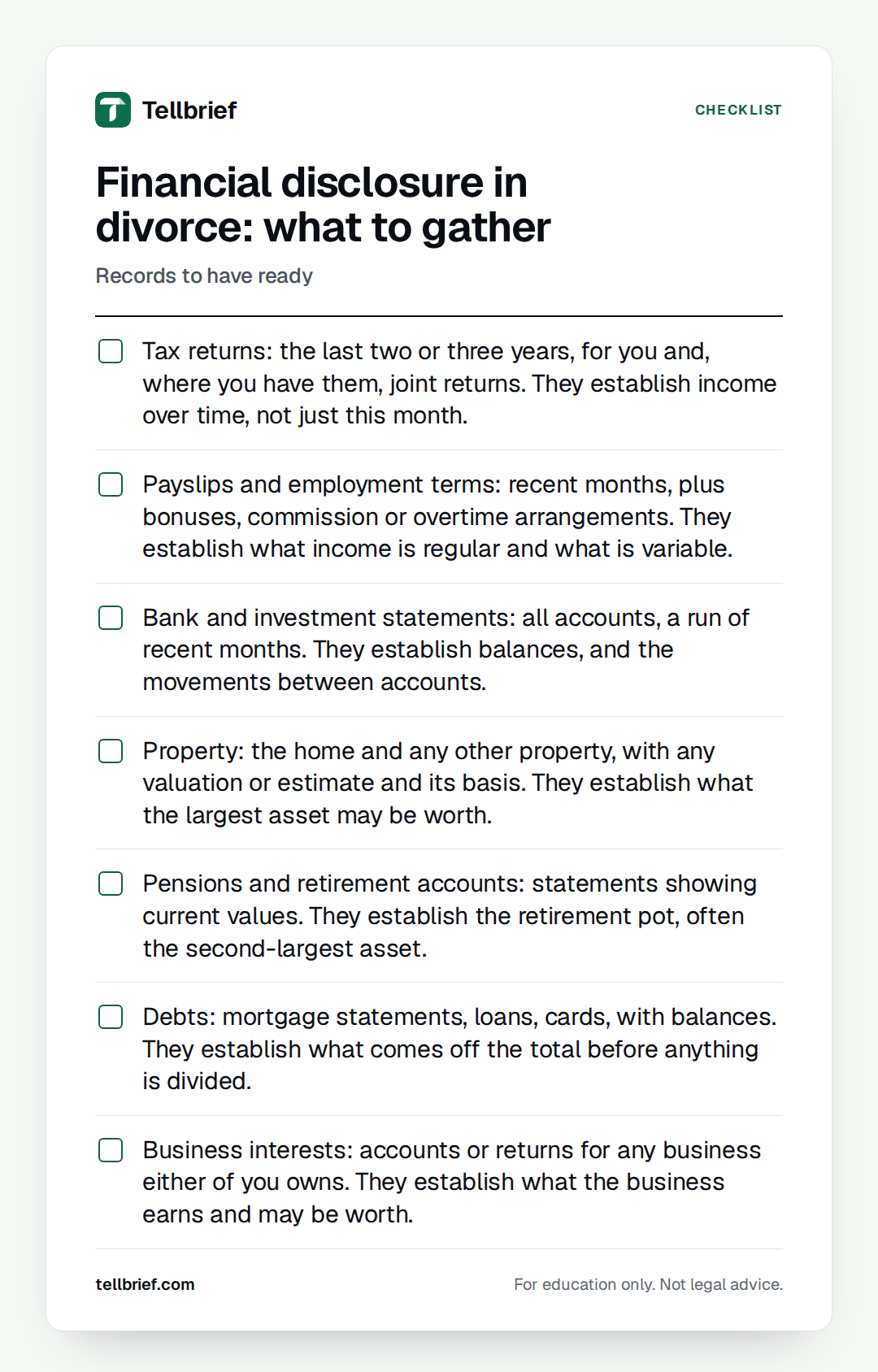
- Tax returns: the last two or three years, for you and, where you have them, joint returns. They establish income over time, not just this month.
- Payslips and employment terms: recent months, plus bonuses, commission or overtime arrangements. They establish what income is regular and what is variable.
- Bank and investment statements: all accounts, a run of recent months. They establish balances, and the movements between accounts.
- Property: the home and any other property, with any valuation or estimate and its basis. They establish what the largest asset may be worth.
- Pensions and retirement accounts: statements showing current values. They establish the size of the retirement pot.
- Debts: mortgage statements, loans, cards, with balances. They establish what comes off the total before anything is divided.
- Business interests: accounts or returns for any business either of you owns. They establish what the business earns and may be worth.
Complete beats tidy
It can help to disclose the awkward items rather than leave them for the other side to find: the account you barely use, the loan from family, the bonus that was unusual this year, each with a note of what it is. An account discovered later can raise questions about whether financial disclosure was complete and accurate. Tell your lawyer about every account, including ones you rarely use, and explain anything that may need context. The stakes are real: in Minnesota, a court can relieve a party from a judgment for fraud, misrepresentation or other misconduct of the other side, or for newly discovered evidence.2 This is one reason to tell your lawyer about anything that may have been omitted, even if you are unsure whether it matters. If you believe the other side’s picture is incomplete, that is a separate gathering, covered in the guide to money or property that may have been moved or spent. Minnesota law draws the spending line in the same place: transferring, concealing or disposing of marital assets outside the usual course of business or the necessities of life, without the other side’s consent, can lead the court to compensate the other side in the division.3
Example: her side complete, his through a company
Made up for this guide
We are divorcing after eleven years. I have gathered three years of tax returns, a year of statements for our joint account and my own account, the mortgage statement, and my pension statement. My husband is a contractor paid through his own company; I have his company’s last filed accounts but nothing about his personal drawings. My main question: is my side complete, and how is his income established when it comes through a company?
Questions to prepare before the meeting
Have a short answer ready for each. “I don’t know yet” is a fine answer.
- What do you earn, and what documents prove it over time?
- What accounts exist, in whose names, including any you barely use?
- What property is there, and what is it worth, on what basis?
- What is owed, and to whom?
- Is there a business, and how does money move between it and the household?
- Is there anything you would rather I heard from you first?
Questions worth asking your lawyer
- What period must my disclosure cover here, and in what form?
- What establishes the other side’s income if it is not a salary?
- What happens if something surfaces later that was not disclosed?
- What should I not move, close or spend while this is gathered?
If you would rather answer questions than gather statements, Tellbrief asks them for you, most of them one tap, and it turns your answers into a brief your lawyer can work from. See the family law sample brief to see what the lawyer receives.
Sources
Each quote was checked against its source on November 16, 2026. Laws and guidance can change after that date.
Questions about financial disclosure
These answers help you get ready for a lawyer. They don’t say what the law means for your situation, or what you should do.
Do I have to disclose accounts my spouse does not know about?
An account discovered later can raise questions about whether financial disclosure was complete and accurate. Tell your lawyer about every account, including ones you rarely use, and explain anything that may need context.
How far back does disclosure go?
The required period depends on the applicable rules, the documents requested and the issues in the case. Ask your lawyer which statements and tax returns are required before deciding how much to gather.
My spouse handles all the money. What can I gather?
What you have access to: joint statements, returns you signed, the mortgage, anything in your name. Note what you cannot access; that list is itself information the lawyer can act on.
What if I have already spent or moved money since we separated?
Say so, with amounts and dates, rather than tidying it up. Spending is judged in context, and your lawyer needs the real picture to advise on it.
Gather yours completely, in date order
Plain-language questions in the set, most of them one tap, free and with no account. Tellbrief turns your answers into a brief your lawyer can work from, and you keep a copy.