Prenuptial agreements: what to have ready
For education only. Not legal advice. Tellbrief is not a law firm.
A prenuptial agreement is a contract about money and property, signed before the wedding and generally effective when the marriage takes place. Some statutes also address what happens if the marriage is declared void.
In short
A prenup can settle property, debts and spousal support between the two of you. It cannot settle child custody, and it cannot cut a child’s right to support. Whether an agreement will be enforced depends on the law that governs it and the circumstances of signing. Requirements can include a written agreement, financial disclosure, access to independent legal advice, enough time to consider the terms and a voluntary signature.
On this page
- What the lawyer needs to establish
- What a prenup can decide
- What it cannot decide: children
- What makes one hold up
- The documents, and what each establishes
- What can get one thrown out
- When to look at it again
- Example: a business, a house, and children from a first marriage
- Questions to prepare before the meeting
- Questions worth asking your lawyer
- Questions about prenuptial agreements
What the lawyer needs to establish
Three things: what each of you owns and owes, which state’s law will govern the agreement, and whether the signing process will meet that state’s conditions. A premarital agreement is an agreement between prospective spouses, made in contemplation of marriage and effective upon marriage.123
There is no single national rule, and the differences are in the details that decide cases. About half the states have adopted a version of the Uniform Premarital Agreement Act, a model law written in 1983; the Uniform Law Commission counts 26 adopting jurisdictions, about half with significant amendments.4 A newer model act from 2012, the Uniform Premarital and Marital Agreements Act, applies to agreements made both before and during marriage, with additional procedural requirements.54 Other states use their own statutes instead; New York has not adopted the uniform act and sets its own signing formalities, covered below.6 So the first question is never “what does a prenup say” but “which state’s version of these rules applies to us.”
What a prenup can decide
Property. The uniform act lets the two of you contract about the rights and obligations of each of you in any property of either or both of you, whenever and wherever acquired; about who may buy, sell, transfer, mortgage or otherwise manage property; and about how property is disposed of on separation, divorce, death, or another event you name.123 Without an agreement, the defaults do this work instead, and they differ sharply by state. In the nine community property states listed by the IRS (Arizona, California, Idaho, Louisiana, Nevada, New Mexico, Texas, Washington and Wisconsin), property acquired during the marriage is generally community property.7 New York’s statute, by contrast, has the court distribute marital property equitably, while separate property (property acquired before marriage, or received by gift or inheritance) remains separate.6
Debts. Financial obligations belong in the financial disclosure. North Carolina and Texas expressly allow a premarital agreement to cover other personal rights and obligations, subject to public policy and criminal law.23 The newer uniform act’s notice to signers specifically identifies agreeing to pay the other person’s bills and debts as a possible term.4 What the agreement can do with a particular debt depends on the law that governs it. Bring statements for mortgages, loans, credit cards and tax debts so the lawyer can identify what needs to be addressed.
Spousal support, with limits. The uniform act lists the modification or elimination of spousal support among the things a prenup may cover.23 Two limits recur. In California, a provision on spousal support is not enforceable if the person giving up support was not represented by independent counsel at signing, or if the provision is unconscionable when it comes to be enforced.1 North Carolina’s statute and the newer uniform act also provide protection where a spousal-support waiver would leave a person eligible for public assistance. The conditions for a court to order support depend on the applicable statute.24
Death and paperwork. A prenup can provide for the making of a will, trust or other arrangement to carry out its terms, and for ownership and disposition of a life insurance death benefit.23 New York’s statute likewise allows a contract to make a testamentary provision or waive the right to elect against a will.6
Which law reads it, and anything else lawful. The agreement can name the choice of law governing its construction, a clause that matters if there is any chance of a move.23 The uniform act adds a catch-all: any other matter, including personal rights and obligations, that does not violate public policy or a statute imposing a criminal penalty.23
What it cannot decide: children
The statutes draw this line in the same words in state after state: “The right of a child to support may not be adversely affected by a premarital agreement.”123 The newer uniform act makes a term that adversely affects a child’s right to support unenforceable, and states that a term defining the parties’ rights or duties about custody “is not binding on the court.” Its commentary gives the reason: parents do not have the power to waive the rights of their children, or to remove the court’s duty to protect children’s best interests.4 New York’s statute allows a provision for a child’s custody, care, education and maintenance, but only “subject to” the state’s custody law: the court’s own standard, applied when the question arises.6
You can record your intentions about children, but those provisions cannot remove the court’s authority to decide custody and child support under the law that applies when the question arises.1234
What makes one hold up
A signed writing. A premarital agreement must be in writing and signed by both parties, and it is enforceable without consideration.123 In states under the newer act, it must be in a record and signed by both.5 New York requires more: it must be subscribed by the parties and acknowledged or proven in the manner required to entitle a deed to be recorded.6
A voluntary signature. Every version of these rules starts here: the agreement is not enforceable against a party who did not execute it voluntarily.123 California’s statute adds that the agreement must not have been executed under duress, fraud or undue influence, and that both parties must have had capacity to enter into it.1
Full financial disclosure. Before signing, each side is entitled to a fair and reasonable disclosure of the other side’s property and financial obligations. It can be given up only voluntarily and expressly, in a separate writing, and a side who already had adequate knowledge of the other’s finances stands differently from one who did not.23 The newer act defines adequate disclosure concretely: a reasonably accurate description and a good-faith estimate of value of the other party’s property, liabilities and income.4
Independent counsel for each side. The statutes treat this differently. In California, an agreement is treated as involuntary unless the party it is enforced against was represented by independent legal counsel at signing, or waived counsel expressly in a separate writing after being advised to seek it.1 In states under the newer act, a party must have had access to independent legal representation: a reasonable time, before signing, to decide whether to retain a lawyer, to locate one, get advice and consider it. Access also requires that the other party is represented, and that the party can pay for a lawyer or the other party agrees to pay the reasonable fees.54 Where a side signs without a lawyer, the newer act requires the agreement itself to carry a notice of waiver of rights, or a plain-language explanation of the rights being modified or waived; California requires a written explanation of the terms and of the rights being given up, in a language the unrepresented party is proficient in, delivered before signing.154
Time before the wedding. California sets a floor in days: for agreements signed on or after January 1, 2020, not less than seven calendar days must pass between first presentation of the final agreement and signing, whether or not that party has a lawyer.1 California sets a seven-calendar-day requirement. The newer uniform act requires reasonable time to obtain and consider independent legal advice. Other states have their own rules.154 The newer act’s commentary collects the split in the cases: courts found agreements involuntary where a significantly revised version was presented three days before the wedding, while another court enforced an agreement presented the day before.4 Timing can become relevant when a party later challenges whether the agreement was signed voluntarily. Its effect depends on the governing law and the circumstances.
The documents, and what each establishes
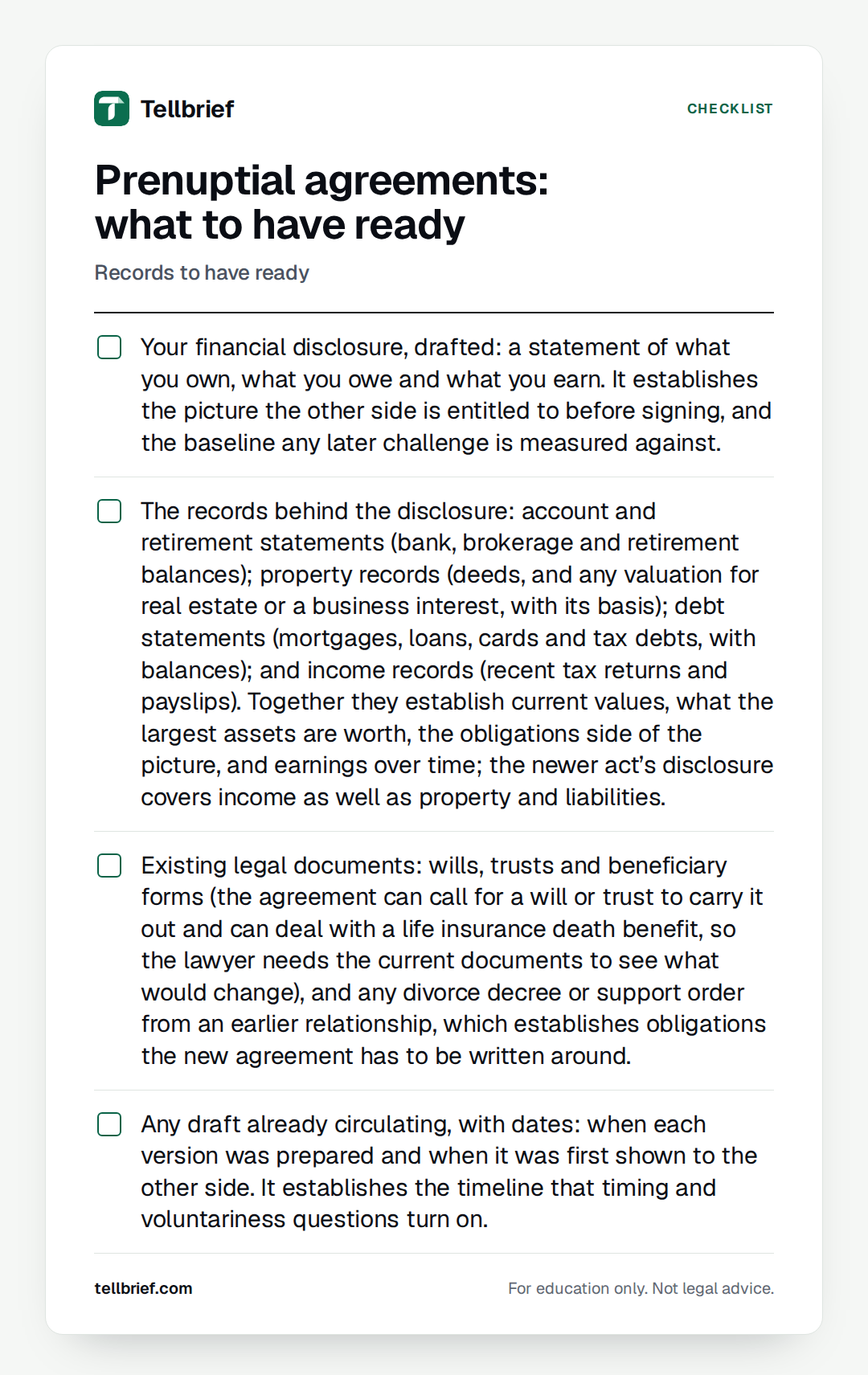
- Your financial disclosure, drafted: a statement of what you own, what you owe and what you earn. It establishes the picture the other side is entitled to before signing, and the baseline any later challenge is measured against.24
- The records behind the disclosure: account and retirement statements (bank, brokerage and retirement balances); property records (deeds, and any valuation for real estate or a business interest, with its basis); debt statements (mortgages, loans, cards and tax debts, with balances); and income records (recent tax returns and payslips). Together they establish current values, what the largest assets are worth, the obligations side of the picture, and earnings over time; the newer act’s disclosure covers income as well as property and liabilities.24
- Existing legal documents: wills, trusts and beneficiary forms (the agreement can call for a will or trust to carry it out and can deal with a life insurance death benefit, so the lawyer needs the current documents to see what would change), and any divorce decree or support order from an earlier relationship, which establishes obligations the new agreement has to be written around.23
- Any draft already circulating, with dates: when each version was prepared and when it was first shown to the other side. It establishes the timeline that timing and voluntariness questions turn on.14
What can get one thrown out
The statutes identify several grounds on which a premarital agreement may be challenged.
It was not voluntary. A signing the party can show was not their free act. This ground stands on its own in every version of the act.1235
It was unconscionable when signed, and the disclosure failed. Under the uniform act, hard terms alone do not defeat an agreement. The party challenging it must also show that before signing they were not given the disclosure described above, did not waive it in writing, and did not have, or reasonably could not have had, adequate knowledge of those finances.23 Whether an agreement was unconscionable is decided by the court as a matter of law.23
In newer-act states, the process failures stand alone. No access to independent legal representation, a missing notice of waiver of rights for an unrepresented signer, or inadequate financial disclosure each make the agreement unenforceable, without any need to prove the terms were unconscionable.54
Support terms have their own failure modes. The public-assistance override applies here too.24 California tests a support provision again at the time of enforcement.1 New York requires maintenance terms to have been fair and reasonable when made and not unconscionable when the final judgment is entered.6
States differ on what else can be raised. Texas’s statute states that the remedies and defenses in its enforcement section are the exclusive ones, common-law remedies and defenses included.3 What counts as a route in is itself a state question.
When to look at it again
A signed prenup does not update itself. Under the cited uniform-act statutes, a premarital agreement may be amended or revoked after marriage only through a written agreement signed by both parties.123 Check the governing state’s requirements before making a change. A change in circumstances changes nothing on its own; the paper has to be redone in the same form. Events worth taking back to a lawyer:
- Children arrive. Custody and child support stay with the court, as above, so the arrangements for children need their own documents, made at the time.
- A business starts, grows or is sold. Ask whether the agreement’s existing terms address the business, its ownership, its income and changes in its value. Property acquired after the wedding may be covered by the agreement, depending on its wording and the governing law.3
- A move to another state. The agreement may name the law that governs how it is read.23 A move to another state can raise questions about which law governs the agreement and how it will be interpreted.5 Ask a lawyer to review the agreement before relying on it after a move.
Support terms, in particular, can be tested against circumstances at the time they are enforced, in California and New York expressly.16
Example: a business, a house, and children from a first marriage
Made up for this guide
We are getting married in four months. I own a small bakery and the building it sits in. My fiancé owns his house with a mortgage, has student loans, and has two children from his first marriage who live with him half the week. We agree the bakery stays mine and the house stays his. My main questions: what do we each have to lay out before we can sign anything, and can the agreement say anything about the children?
Questions to prepare before the meeting
Have a short answer ready for each. “I don’t know yet” is a fine answer.
- What do you own, what do you owe, and what do you earn, each with a document behind it?
- What is the agreement mainly for: a business, property from before the marriage, debts, children from an earlier relationship?
- Which state’s law should govern it, and where will you be living after the wedding?
- When is the wedding, and how much time sits between now, the final draft, and signing?
- Has anything been drafted, or promised, already, in writing or out loud?
- Is there anything you would rather your lawyer heard from you first?
Questions worth asking your lawyer
- What must our disclosure include in this state, and in what form?
- Does this state require anything at signing beyond both signatures?
- How much time should there be between the final draft and signing, here?
- Which terms in our draft would a court in this state look at hardest?
- If our plans change after the wedding, what has to be redone, and how?
If you would rather answer questions than gather the documents, Tellbrief asks them for you, most of them one tap, and it turns your answers into a brief your lawyer can work from. See the family law sample brief to see what the lawyer receives.
Sources
Each quote was checked against its source on November 16, 2026. Laws and guidance can change after that date.
- Cal. Fam. Code sections 1610 to 1617, California’s Uniform Premarital Agreement Act, especially sections 1612 and 1615 (opens in a new tab) ↩︎
- N.C. Gen. Stat. chapter 52B, Uniform Premarital Agreement Act, especially sections 52B-4 and 52B-7 (opens in a new tab) ↩︎
- Tex. Fam. Code chapter 4, subchapter A, Texas’s Uniform Premarital Agreement Act, especially sections 4.003 and 4.006 (opens in a new tab) ↩︎
- Uniform Premarital and Marital Agreements Act (2012), Uniform Law Commission: Prefatory Note; section 9 and its comment; section 10 and its comment (opens in a new tab) ↩︎
- N.D. Cent. Code chapter 14-03.2, Uniform Premarital and Marital Agreements Act, especially sections 14-03.2-02, 14-03.2-05 and 14-03.2-08 (opens in a new tab) ↩︎
- N.Y. Dom. Rel. Law section 236, Part B: definitions, agreements of the parties, and disposition of property (opens in a new tab) ↩︎
- IRS Publication 555, Community Property (Rev. December 2024) (opens in a new tab) ↩︎
Questions about prenuptial agreements
These answers help you get ready for a lawyer. They don’t say what the law means for your situation, or what you should do.
Do we both need our own lawyer?
In some states, effectively yes for parts of the agreement. California makes a waiver of spousal support unenforceable if the person giving it up had no independent counsel at signing; states under the newer uniform act make access to independent legal representation a condition of enforcement; the 1983 uniform act does not name counsel as a condition. Whatever the state, each side’s lawyer works for that side only.
Can a prenup decide custody or child support, for children we may have later?
No. A child’s right to support may not be adversely affected by a premarital agreement, and a term about custody is not binding on the court. The court decides both when the question is real, under its own standards.
Our wedding is in three weeks. Is it too late?
Three weeks may or may not be enough. Tell the lawyer your wedding date before work on the agreement begins. The applicable state’s requirements and the circumstances of signing matter.
Can we change the agreement after the wedding?
Yes, but only in the same form: a written agreement signed by both parties. Changed circumstances alone do not amend it.
Start with what each of you owns and owes
Plain-language questions in the set, most of them one tap, free and with no account. Tellbrief turns your answers into a brief your lawyer can work from, and you keep a copy.