How to prepare for a family lawyer
For education only. Not legal advice. Tellbrief is not a law firm.
A first meeting with a family lawyer starts with safety and dates, then moves to the story. Have those ready and the meeting can start where it needs to.
In short
It helps to be able to say whether everyone is safe, who is involved, whether anything has been filed or ordered, where the children are and how they are doing, and the one thing you most want settled. Dates matter here: any hearing or deadline goes at the top.
On this page
Safety first
If anyone is unsafe, that comes before everything else, including this list. A lawyer may ask about safety at the very start, and how they can reach you without making things worse: which phone, which email, what times. It can help to decide that in advance, and to say it plainly.
What to have at hand
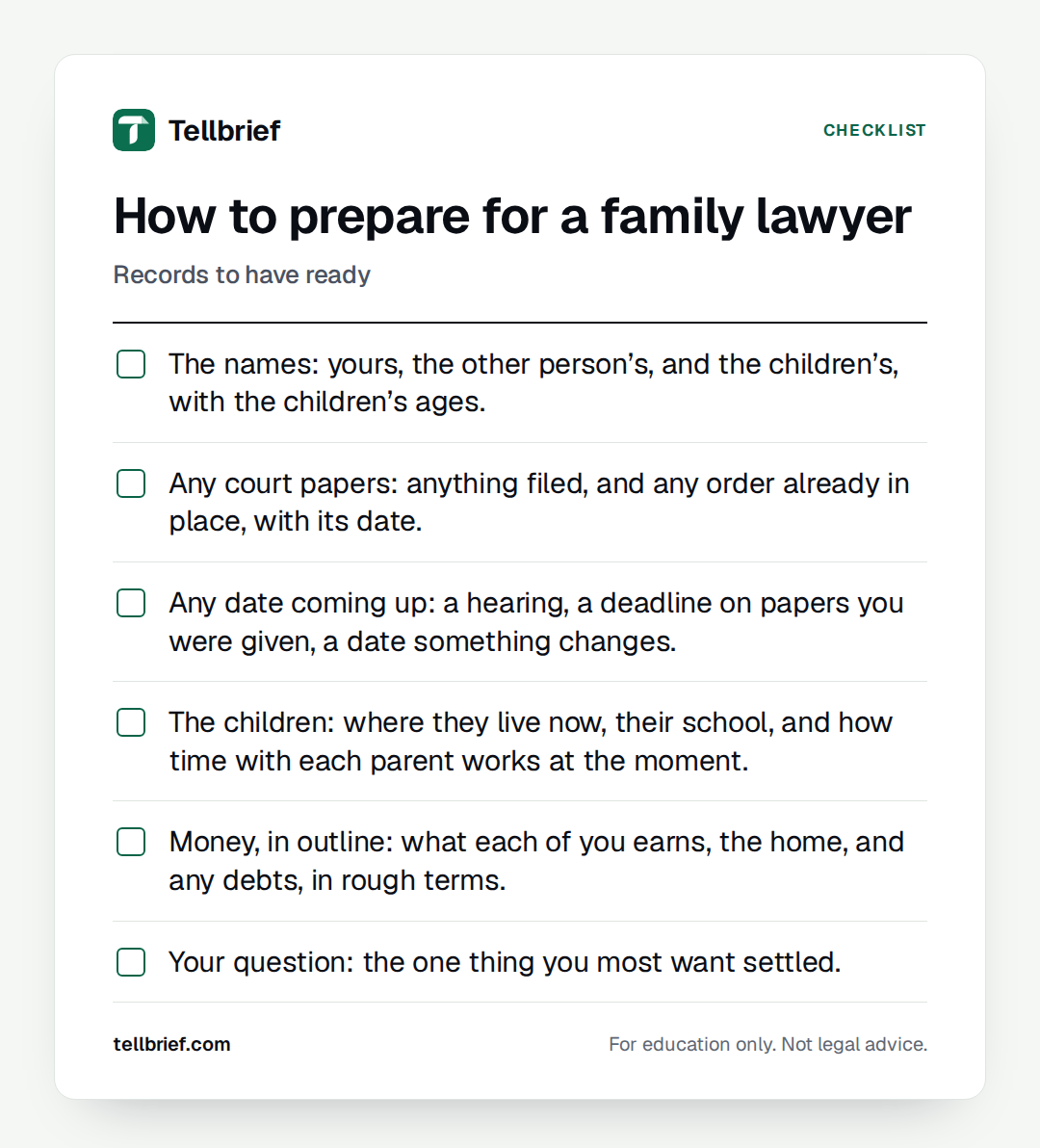
- The names: yours, the other person’s, and the children’s, with the children’s ages.
- Any court papers: anything filed, and any order already in place, with its date.
- Any date coming up: a hearing, a deadline on papers you were given, a date something changes.
- The children: where they live now, their school, and how time with each parent works at the moment.
- Money, in outline: what each of you earns, the home, and any debts, in rough terms.
- Your question: the one thing you most want settled.
What has happened, in order
A short timeline can help: when you separated or when things changed, what has been filed or agreed, and what is happening now. Dates can be approximate if you label them that way. What was said and what was signed are worth separating: the lawyer works from what happened, and what it means is their part. Deadlines run from the papers, not from when you get round to them: in a Minnesota divorce, for example, the respondent has 30 days in which to answer the petition, and where the papers are served by publication the 30 days do not begin until the publication period ends.1
How to reach you safely
It can help to note which ways of reaching you are safe and which are not: an email the other person can see, a phone that is shared, post to the home. The firm can then use the safe ones. If you are given a link or a form, the same thinking applies to where you open it.
Example: separated three months, nothing filed
Made up for this guide
We separated three months ago and I am staying with my sister. Our children, eight and five, are with me in the week and with their father most weekends; nothing has been filed and there is no order. He has said he will apply to court if we cannot agree about Christmas. The house is in both our names. My main question: what should be settled first, and does anything need to happen before Christmas?
To write yours, fill in the brackets:
We [separated / are separating] [when]. The children are [ages] and are living [where, and how time is shared]. [Nothing has been filed / papers were filed on (date) / an order from (date) says …]. The home is [rented / owned by …]. My main question: [the one that matters most].
What the lawyer may ask you first
Have a short answer ready for each. “I don’t know yet” is a fine answer.
- Is everyone safe, and how can we reach you safely?
- Has anything been filed, or ordered, and is any date coming up?
- Where are the children living, and how is their time shared now?
- How long have you and the children lived where you are now?
- What do you each earn, and what do you own or owe, in rough terms?
- Are you and the other person still talking?
Questions worth asking your lawyer
- Is the first meeting free, and how long is it?
- Whose names do you need before we talk about the details?
- Does anything need to happen quickly, and what can wait?
- How do you charge for this kind of case?
- What should I avoid doing or signing before we talk again?
- How will you reach me, and what should I do if that stops being safe?
What to leave out at first
Until the lawyer has checked for conflicts and said they can act for you, the names and a line on what it is about can be enough. The check matters because a lawyer generally cannot represent clients whose interests are directly adverse when that creates a concurrent conflict of interest. Some conflicts may be consentable if the applicable professional-conduct rules are satisfied and the affected clients give informed consent in writing. Firms are expected to have procedures to identify the people involved before a matter is opened.2 A lawyer who has received significantly harmful information from a prospective client can also be barred from acting for the other side in the same matter, which is another reason the names come first and the details wait.3 Long message threads and private details can wait. The lawyer can say what to send and when.
If you would rather answer questions than write, Tellbrief asks them for you, most of them one tap, and it turns your answers into a brief your lawyer can work from. See the family law sample brief to see what the lawyer receives.
Sources
Each quote was checked against its source on November 16, 2026. Laws and guidance can change after that date.
- Minn. Stat. § 518.12: Time for answering (opens in a new tab) ↩︎
- ABA Model Rule 1.7: Conflict of Interest: Current Clients, with comments, as adopted in the Minnesota Rules of Professional Conduct (opens in a new tab) ↩︎
- ABA Model Rule 1.18: Duties to Prospective Client, as adopted in the Minnesota Rules of Professional Conduct (opens in a new tab) ↩︎
Questions about a first meeting
These answers help you get ready for a lawyer. They don’t say what the law means for your situation, or what you should do.
What should I bring to a first meeting with a family lawyer?
The names, any court papers or orders, any date coming up, where the children are, and your main question. The story can be short; dates and papers carry most of it.
What if I am worried about my safety?
Say so at the start, before anything else. A lawyer can plan the meeting, and how to reach you, around keeping you safe.
Do I need to bring financial records?
Rough terms are enough for a first meeting: what each of you earns, the home, and any debts. Statements can come later if the lawyer asks.
My ex has already seen a lawyer. Does that matter?
It can. Tell the lawyer: firms check names for conflicts, and the other person may already have consulted the same firm.
How much does a family lawyer cost?
It depends on the lawyer and the case, so ask before you book: whether the first meeting is free, and how they charge.
Have safety, dates and names on one page
Plain-language questions in the set, most of them one tap, free and with no account. Tellbrief turns your answers into a brief your lawyer can work from, and you keep a copy.