Domestic violence and safety at the first consultation
For education only. Not legal advice. Tellbrief is not a law firm.
A first consultation about a relationship that is not safe is two consultations in one: how to have the conversation safely, and only then what the law can do.
In short
Safety planning comes before legal planning: a safer way to make contact, a meeting that does not create additional risk, and an honest account of what is happening, at whatever level of detail you can manage. The lawyer’s part is to explain what protection exists in your state and what each step would involve.
On this page
If you are in danger now
If you are in immediate danger, call 911 if it is safe to do so. If you need help making a safety plan or finding support, contact the National Domestic Violence Hotline at 800-799-SAFE (7233), or visit thehotline.org. You can also text “START” to 88788, or use the live chat on the Hotline’s website. If using your phone or computer could put you at risk, use a safer device if possible: a call, a text or a chat can each leave traces on a device someone else can check.
Making contact safely
Before anything else, think about the channel. If your phone, email or post may be seen, say so in the first message and name a safer one: a trusted person’s phone, a new email address, a time of day. A firm that handles family work will be used to this and can adapt how it writes, calls and books. If leaving the house for a meeting is itself a risk, ask about a phone or video call, and about what name will appear on any bill, letter or caller ID. In Minnesota, a lawyer who has consulted with a prospective client must not use or reveal information obtained in the consultation, except as the rules on former clients allow; those rules permit disclosure only within stated exceptions, such as to prevent reasonably certain death or substantial bodily harm, or to comply with a court order.12
What the lawyer needs to establish
What is happening, in the plainest terms you can manage: physical violence, threats, control of money, movement, contact with others, or behaviour that frightens you, with rough dates for the most serious or most recent incidents. Whether children are present in the home, and what they see or hear. Whether there has been any police involvement, medical treatment, or earlier order. And what you are most afraid will happen next, because that is what any protective step has to answer. You do not need a complete history or perfect dates: a lawyer can work from what you have, and detail can be added as it becomes safe to gather.
What helps, kept safely
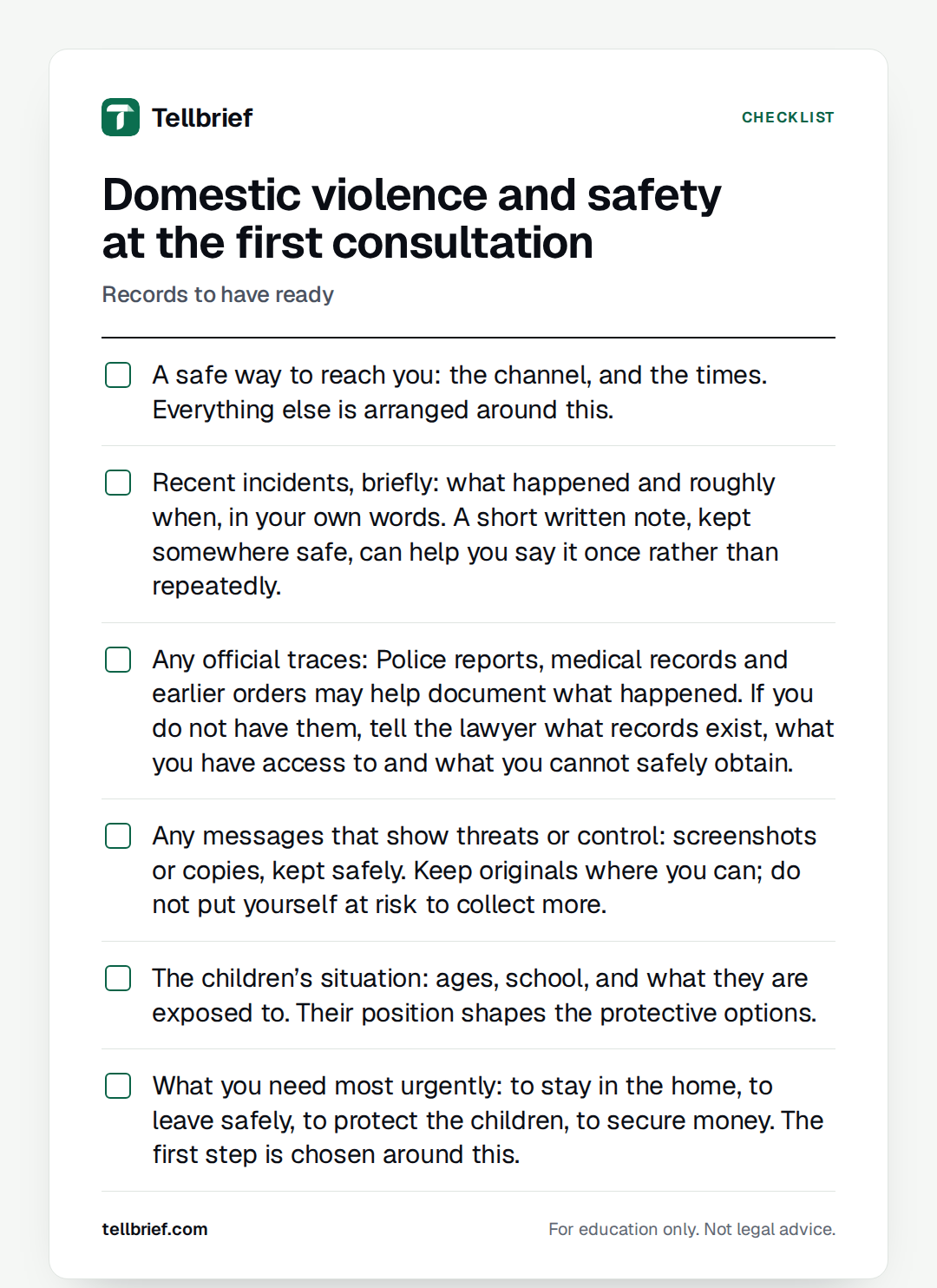
- A safe way to reach you: the channel, and the times. Everything else is arranged around this.
- Recent incidents, briefly: what happened and roughly when, in your own words. A short written note, kept somewhere safe, can help you say it once rather than repeatedly.
- Any official traces: Police reports, medical records and earlier orders may help document what happened. If you do not have them, tell the lawyer what records exist, what you have access to and what you cannot safely obtain.
- Any messages that show threats or control: screenshots or copies, kept safely. Keep originals where you can; do not put yourself at risk to collect more.
- The children’s situation: ages, school, and what they are exposed to. Their position shapes the protective options.
- What you need most urgently: to stay in the home, to leave safely, to protect the children, to secure money. The first step is chosen around this.
What protection can look like
Courts may offer legal protection for people experiencing domestic violence, threats or other conduct covered by state law. The available orders, eligibility requirements, procedures and protections differ by state. A local lawyer or domestic violence advocate can explain which options may apply. In Minnesota, for example, an order for protection can rest on physical harm, on the infliction of fear of imminent physical harm, or on terroristic threats, and the relief can include restraining the abusing party, excluding them from the home, and temporary arrangements for children and support.3 Protection is also wider than orders: safe housing, money you can reach, documents you may need if you leave quickly. A first consultation can cover the practical list as well as the legal one, and nothing has to be decided in it.
Example: control without violence, and a sister’s phone
Made up for this guide
My husband checks my phone most days, so I am writing from my sister’s. He has never hit me, but he controls all the money, has threatened to take the children to his mother “for good”, and last month he stood in the doorway and would not let me leave for an hour. Our children are six and three. My main question: what are my options, and what can be done without him finding out I have taken advice?
Questions to prepare before the meeting
Have a short answer ready for each, and only for what you can safely say. “I can’t answer that yet” is a complete answer.
- How can we reach you without creating risk?
- What has been happening, and what happened most recently?
- Are the children safe, and what do they see?
- Has there been police or medical involvement, or any order before?
- What are you most afraid of next?
- What would you want to happen, if it could be arranged safely?
Questions worth asking your lawyer
- What protective orders exist here, and what would applying involve?
- How do we keep this advice itself confidential?
- What should I gather or copy while I decide, and where can it be kept safely?
- What should I do if things escalate before we speak again?
If writing is safer than talking, Tellbrief’s questions can be answered in your own time, from a device you trust, most of them one tap. Your lawyer’s firm sees your name, email and the topic first. The firm clears the names before your answers are opened. If the firm declines, your answers are deleted unread. See the family law sample brief to see what the lawyer receives.
Sources
Each quote was checked against its source on November 16, 2026. Laws and guidance can change after that date.
- ABA Model Rule 1.18: Duties to Prospective Client, as adopted in the Minnesota Rules of Professional Conduct (opens in a new tab) ↩︎
- ABA Model Rule 1.6: Confidentiality of Information, as adopted in the Minnesota Rules of Professional Conduct (opens in a new tab) ↩︎
- Minn. Stat. § 518B.01: Domestic Abuse Act; orders for protection (opens in a new tab) ↩︎
Questions about safety and advice
These answers help you get ready for a lawyer. They don’t say what the law means for your situation, or what you should do.
There has been no physical violence. Is it still worth calling?
Yes. In Minnesota, for example, an order for protection can cover terroristic threats and the infliction of fear of imminent physical harm, even without physical violence. Other states have their own eligibility requirements. Confinement, financial control and intimidation are also things to tell the lawyer, because they shape the safety plan and any application. You do not need to have the label for it before you call.
Will the lawyer have to report what I say?
Information shared with a lawyer before representation may receive confidentiality protections, but the rules and exceptions depend on the circumstances and applicable law. Ask the lawyer how your information will be handled before sharing details.
I am not ready to leave or apply for anything. Can I still get advice?
Yes. Advice does not commit you to acting on it. A first consultation can help you understand your options, discuss a safety plan and decide whether you want to take any further step.
What if the other person finds out I called?
Safe-contact planning can help reduce that risk: agree the channel, the name used, and what happens if a message is seen, before anything is sent to you.
Agree a safe way to reach you first
Plain-language questions in the set, most of them one tap, free and with no account. Tellbrief turns your answers into a brief your lawyer can work from, and you keep a copy.