Temporary orders in divorce and custody: what to gather
For education only. Not legal advice. Tellbrief is not a law firm.
A divorce or custody case can take months to finish. Temporary orders are how life is arranged in the meantime, and they are decided on the facts of right now.
In short
Temporary orders set the interim rules: where children live for now, who pays what for now, who is in the home for now. Asking for them turns on current facts, this month’s income, outgoings and the children’s routine, so gather the present tense, not the history.
On this page
What the lawyer needs to establish
What cannot wait for the final outcome. That is some mix of: where the children will live and how time is shared for now; money for the household and the children in the interim; who stays in the home; and sometimes protection, where safety is in issue. The lawyer needs the current position in numbers and dates: what each of you earns now, what the household costs now, how the children’s week runs now. What these orders are called, how they are applied for, and how long they take vary by state, so the local version of the process is part of the first meeting. In Minnesota, for example, a temporary order is applied for by motion and can cover temporary custody and parenting time, temporary maintenance and child support, and the temporary use of the family home, and it is decided on affidavits and argument rather than full evidence, unless a side asks in time for oral testimony or the court orders it.1
The present tense, documented
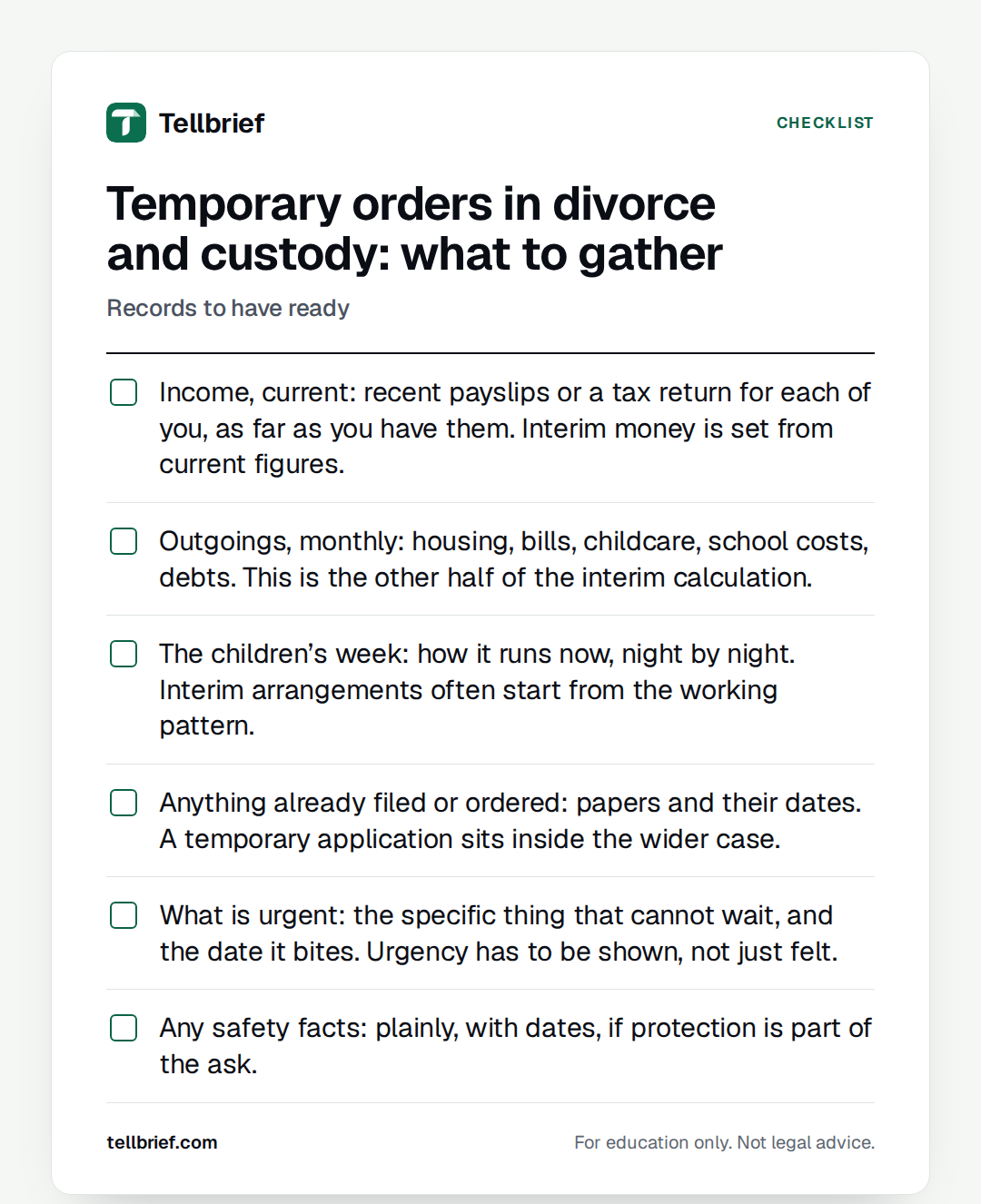
- Income, current: recent payslips or a tax return for each of you, as far as you have them. Interim money is set from current figures.
- Outgoings, monthly: housing, bills, childcare, school costs, debts. This is the other half of the interim calculation.
- The children’s week: how it runs now, night by night. Interim arrangements start from the working pattern.
- Anything already filed or ordered: papers and their dates. A temporary application sits inside the wider case.
- What is urgent: the specific thing that cannot wait, and the date it bites. Urgency has to be shown, not just felt.
- Any safety facts: plainly, with dates, if protection is part of the ask.
Interim is not a rehearsal
A temporary arrangement may become part of the history a court considers later, but it does not automatically determine the final arrangement.1 Keep a record of what has actually happened, when it began and whether both parents agreed to it. Ask the lawyer how the court in your state treats the existing arrangement. It is also why agreeing an interim arrangement between you, if you safely can, is worth exploring first: the lawyer can say what an agreement would need to cover to hold. In Minnesota, agreed changes to parenting time can be written up as a stipulation and submitted for the court to make into an order, using a form the courts publish.2 That is a route for agreed changes to parenting time; temporary orders are a separate application, covering the wider interim arrangements while the case is decided. A Minnesota temporary order runs until it is amended or vacated, the case is dismissed, or the final decree is entered, and the court can revoke or modify it before then.1
Example: a mortgage unpaid and Saturdays only
Made up for this guide
We separated six weeks ago. I am in the house with our two children; my husband is at his brother’s and has stopped paying toward the mortgage, saying his lawyer will sort it out. I work part-time. The children are with him on Saturdays. My main question: what can be put in place now about the mortgage and the children’s time, and what will the court want from me?
Questions to prepare before the meeting
Have a short answer ready for each. “I don’t know yet” is a fine answer.
- What is the one thing that cannot wait, and when does it bite?
- What do you each earn now, and what does the household cost?
- How does the children’s week actually run at the moment?
- Has anything been filed, and are there any orders already?
- Is anyone unsafe?
- Have you two been able to agree anything, even for now?
Questions worth asking your lawyer
- What can temporary orders cover in our state, and what can they not?
- How quickly could we be heard?
- What will the court want to see from me?
- What should I keep paying, or not stop paying, meanwhile?
If you would rather answer questions than gather paper, Tellbrief asks them for you, most of them one tap, and it turns your answers into a brief your lawyer can work from. See the family law sample brief to see what the lawyer receives.
Sources
Each quote was checked against its source on November 16, 2026. Laws and guidance can change after that date.
Questions about temporary orders
These answers help you get ready for a lawyer. They don’t say what the law means for your situation, or what you should do.
How long do temporary orders last?
Until the case is decided or the order is changed, whichever comes first. An order can be revisited before the final outcome; ask the lawyer what your state requires for a change.
Do I need a hearing, or can we agree?
Some arrangements can be agreed between the parties and submitted to the court for approval. Whether a hearing is still required depends on the type of request and the court’s procedure. Ask the lawyer whether your proposed arrangement needs a hearing or an order.
What if my ex has already applied?
Bring the papers and note their dates: there may be a deadline to respond. The gathering is the same list, made quickly.
Will the temporary arrangement decide the final one?
A temporary order does not automatically decide the final arrangement. The court’s treatment of the existing arrangement depends on the applicable law and the facts. Ask the lawyer what significance the current routine may have in your case.
Bring this month’s figures, not the history
Plain-language questions in the set, most of them one tap, free and with no account. Tellbrief turns your answers into a brief your lawyer can work from, and you keep a copy.