When money or property may have been moved or spent
For education only. Not legal advice. Tellbrief is not a law firm.
“He is hiding money” and “the statements show $18,000 leaving the joint account in March” lead to very different meetings. This guide is about arriving with the second kind of sentence.
In short
Suspicion is a starting point, not a finding. Gather in three piles: what documents show, what you have been told, and what you suspect without proof. The lawyer’s job is to work out which pile can be moved into the first, and whether anything needs to happen quickly to protect what is left.
On this page
What the lawyer needs to establish
What can be proved, from paper, today: balances that changed, transfers with dates and destinations, assets that existed in earlier documents and are absent now. Then what is inference: spending that seems out of pattern, explanations that do not match the statements. A lawyer keeps the two separate because courts do. Moving or spending marital money is not automatically wrongful: households spend, businesses pay bills, and some transfers have ordinary explanations. What matters is the pattern, the timing against the separation, and whether the explanation offered matches the documents. Minnesota law frames it the same way: each side owes the other a fiduciary duty over marital assets once a divorce is in contemplation or under way, and a transfer outside the usual course of business or the necessities of life, made without consent, can be compensated in the division.1 Where money is still moving, there is also a timing question: some steps to protect assets exist, they vary by state, and they are judged on evidence rather than suspicion. In Minnesota, for example, serving the divorce summons itself restrains both sides from disposing of assets except for the necessities of life, the necessary generation of income or preservation of assets, by an agreement in writing, or to retain counsel,2 and a court can restrain transfers in a temporary order as well.3
Known, told, and suspected
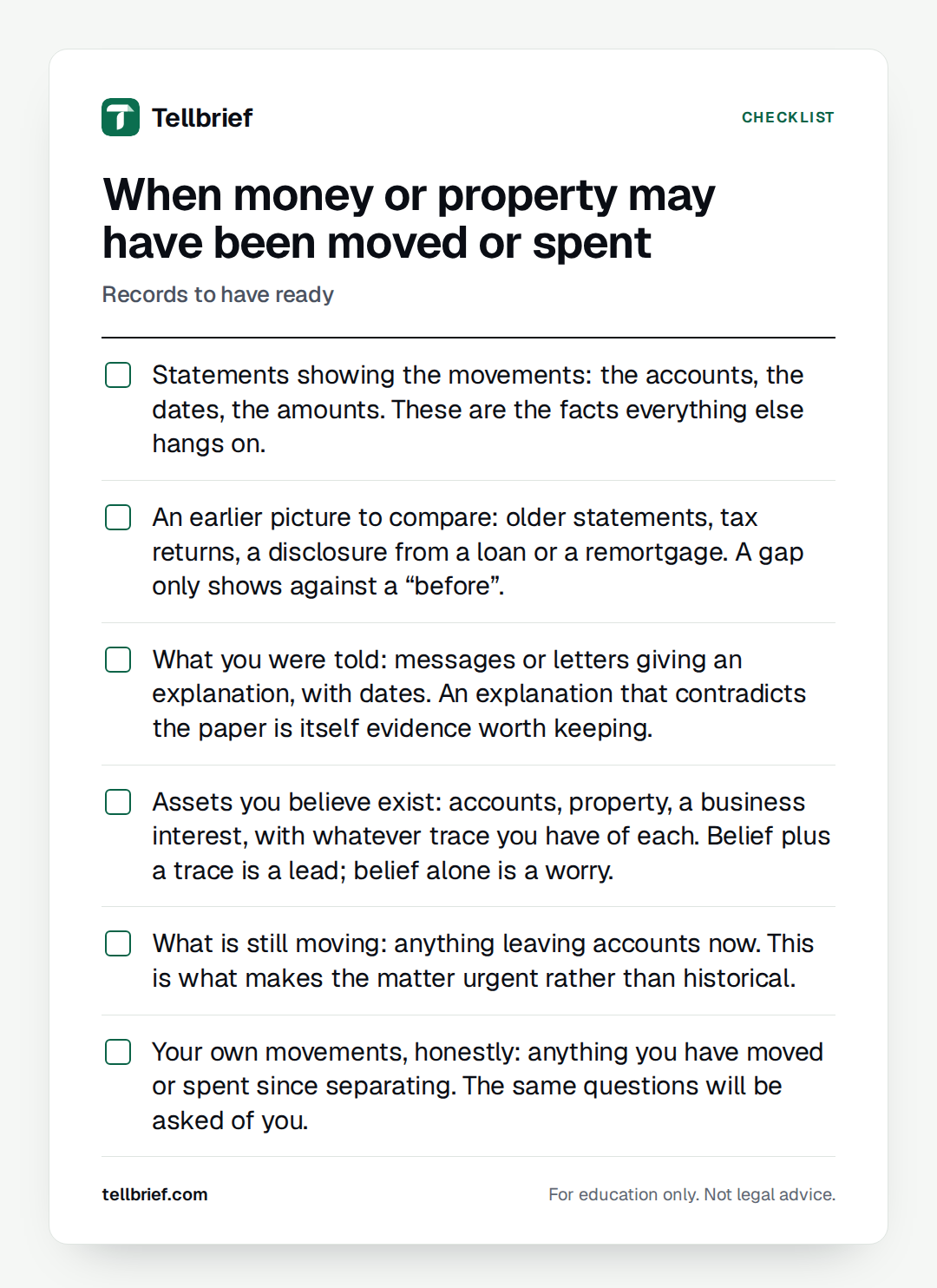
- Statements showing the movements: the accounts, the dates, the amounts. These are the facts everything else hangs on.
- An earlier picture to compare: older statements, tax returns, a disclosure from a loan or a remortgage. A gap only shows against a “before”.
- What you were told: messages or letters giving an explanation, with dates. An explanation that contradicts the paper is itself evidence worth keeping.
- Assets you believe exist: accounts, property, a business interest, with whatever trace you have of each. Belief plus a trace is a lead; belief alone is a worry.
- What is still moving: anything leaving accounts now. This is what makes the matter urgent rather than historical.
- Your own movements, honestly: anything you have moved or spent since separating. The same questions will be asked of you.
What not to do
It can help to resist two temptations. The first is investigating by intrusion. Accessing another person’s computer without authorization, or unlawfully intercepting or disclosing private communications, can create separate legal problems.45 Do not try to obtain information through access you are not entitled to. Tell your lawyer what you can access and what you cannot. Note what you can lawfully see, and leave the rest to the lawyer’s tools: in Minnesota those include depositions, written interrogatories and orders to produce documents.6 A side that fails to disclose, or disobeys an order to provide discovery, can be sanctioned, including by having designated facts taken as established and by being refused permission to use material it failed to disclose.7 The second is confronting with the suspicion before the paper is gathered: explanations invented on the spot are hard to test, while documents gathered quietly either confirm the pattern or clear it.
Example: $18,000 in four transfers
Made up for this guide
Since we separated in June, about $18,000 has left our joint savings in four transfers to an account I do not recognise. Our statements from the remortgage last year showed $41,000 in that account. My husband says the money went on “business costs”, but his business has its own account, and he has not shown me anything. Nothing has moved in the last three weeks. My main question: what can be done to establish where it went, and should anything be frozen meanwhile?
Questions to prepare before the meeting
Have a short answer ready for each. “I don’t know yet” is a fine answer.
- What do the documents actually show, with dates and amounts?
- What were you told, by whom, and does it match the paper?
- What did the picture look like a year or two ago?
- Is money still moving now?
- What assets do you believe exist that are not in the current picture?
- What have you moved or spent yourself since separating?
Questions worth asking your lawyer
- What can be established from what I have, and what is still only suspicion?
- What tools exist here to trace or recover money, and what do they cost?
- Is there anything that should be protected now, before the next step?
- What should I stop doing, or not start doing, while this is looked into?
If you would rather answer questions than sort statements, Tellbrief asks them for you, most of them one tap, and it turns your answers into a brief your lawyer can work from. See the family law sample brief to see what the lawyer receives.
Sources
Each quote was checked against its source on November 16, 2026. Laws and guidance can change after that date.
- Minn. Stat. § 518.58, subd. 1a: Transfer, encumbrance, concealment, or disposition of marital assets (opens in a new tab) ↩︎
- Minn. Stat. § 518.091: Summons; temporary restraining provisions (opens in a new tab) ↩︎
- Minn. Stat. § 518.131: Temporary orders and restraining orders (opens in a new tab) ↩︎
- Minn. Stat. § 609.891: Unauthorized computer access (opens in a new tab) ↩︎
- Minn. Stat. § 626A.02: Interception and disclosure of wire, electronic, or oral communications prohibited (opens in a new tab) ↩︎
- Minnesota Rules of Civil Procedure, Rule 26: Duty to Disclose; General Provisions Governing Discovery (opens in a new tab) ↩︎
- Minnesota Rules of Civil Procedure, Rule 37: Failure to Make Disclosures or to Cooperate in Discovery; Sanctions (opens in a new tab) ↩︎
Questions about moved or hidden money
These answers help you get ready for a lawyer. They don’t say what the law means for your situation, or what you should do.
Is moving money before a divorce illegal?
It depends on what was moved, when, whose it was and what your state’s rules and any orders say. Ordinary spending continues; deliberate concealment is treated differently. The documents are what decide which description fits.
Can a lawyer find hidden accounts?
There are lawful tools for requiring disclosure and testing whether it is complete. If a party fails to provide required financial information or disobeys a discovery order, the court may impose consequences under the applicable rules. A gap in the financial picture is a reason to investigate, not proof of wrongdoing. What can be done in your case depends on the traces you start with.
Should I tell my spouse I know?
Not before the paper is gathered and you have taken advice. What is said, and when, can be a tactical decision; documents first is the safer order.
What if I am the one accused?
If you are the person being questioned, gather the statements, explanations and dates. Let the documents show what happened rather than relying on a general explanation.
Arrive with the statements, not just the suspicion
Plain-language questions in the set, most of them one tap, free and with no account. Tellbrief turns your answers into a brief your lawyer can work from, and you keep a copy.