Custody and parenting time: what to have ready
For education only. Not legal advice. Tellbrief is not a law firm.
Questions about children are answered from their week: where they are, who does what, and what a normal week actually looks like.
In short
Have ready how the children’s time works now, week by week: where they sleep, school and care, who takes them to what. Add any order in place, what is not working, and what you would change. A real week, written down, is worth more than a summary.
On this page
The week as it is
Write down a real recent week: where the children slept each night, who took them to school and activities, who was there when they were ill or off school. If the arrangement has changed over time, note when, and whether it was agreed or just happened. The gap between what was agreed and what happens is the point.
What to write down
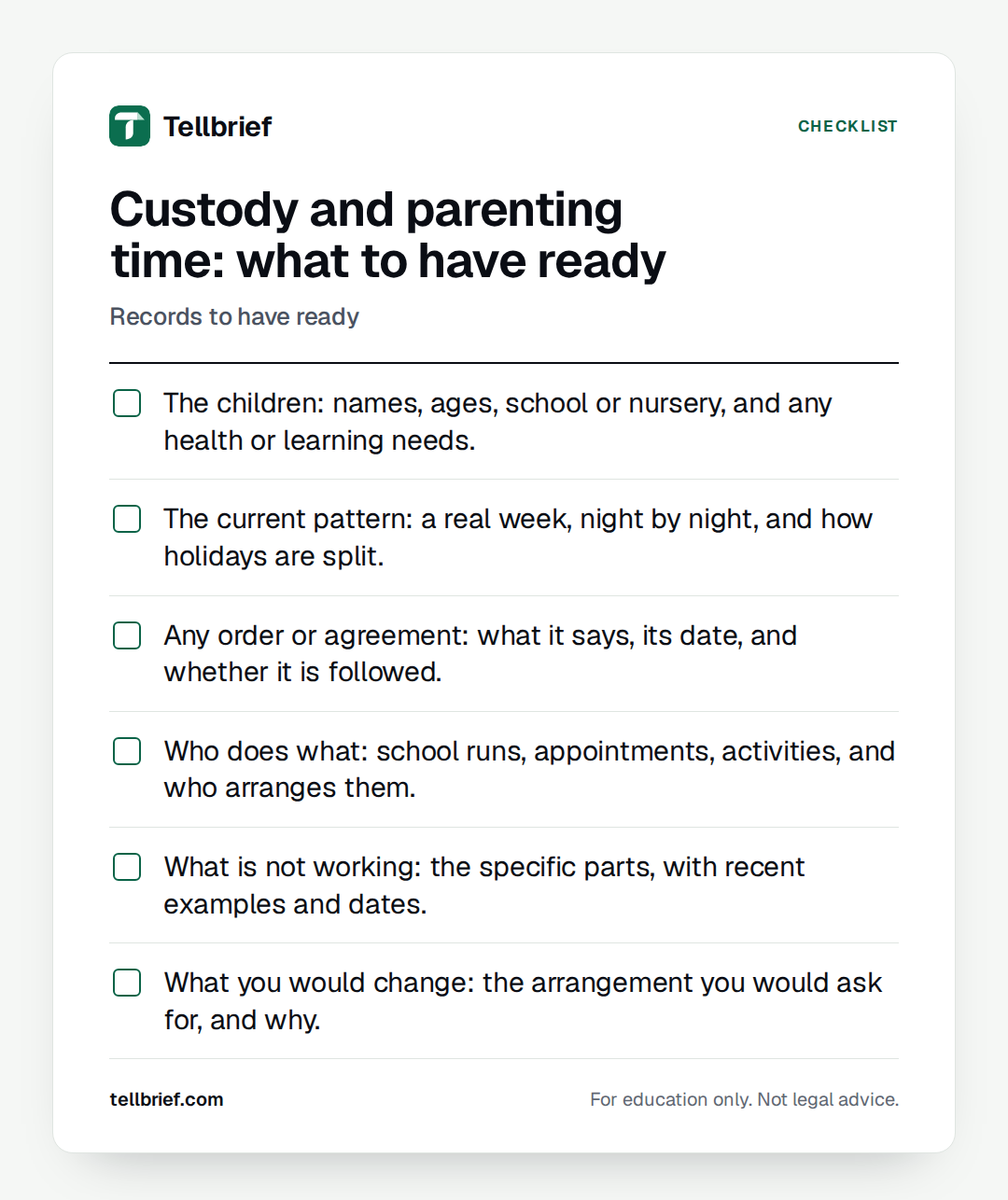
- The children: names, ages, school or nursery, and any health or learning needs.
- The current pattern: a real week, night by night, and how holidays are split.
- Any order or agreement: what it says, its date, and whether it is followed.
- Who does what: school runs, appointments, activities, and who arranges them.
- What is not working: the specific parts, with recent examples and dates.
- What you would change: the arrangement you would ask for, and why.
Safety and worries
If you have worries about the children’s safety or care with either parent, say so plainly and early, with the facts rather than conclusions: what happened, when, and who saw it. A lawyer can then tell you what weight it carries and what, if anything, should happen quickly.
Talking and messages
It can help to note how you and the other parent communicate, and whether it works. Long message threads rarely need sending at this stage. A few recent examples, with dates, show more than a whole history, and the lawyer can ask for more if it matters.
Example: an order from 2023 and late returns
Made up for this guide
Our daughter is nine. On paper she is with me in the week and her dad every other weekend, under an order from 2023. In practice he has kept her most Sundays this term and brought her back late on school nights twice. He has said he wants her half the week from January, when his shifts change. I am not against more time, but the late returns are affecting school. My main question: how do changes like this usually get settled, and what should I be writing down now?
How a court decides
When a court decides arrangements for a child, the child’s best interests are central to the decision.1 The factors a court considers and the weight given to each depend on the law in your state. Bring the details of the child’s actual week, relationships, schooling and needs so the lawyer can explain which facts matter in your case. A child’s own preference is among the factors Minnesota law lists, where the court finds the child to be of sufficient ability, age and maturity to express an independent, reliable preference.1 If you and the other parent agree a change, it can be written up as a stipulation and put to the court to be made into an order; Minnesota courts publish stipulation forms for agreed changes to parenting time.2
What you may be asked about the children
Have a short answer ready for each. “I don’t know yet” is a fine answer.
- How old are the children, and where do they go to school?
- How does their week actually run at the moment?
- Is there an order, and is it being followed?
- What would you change, and what has prompted it now?
- Are there any worries about either home?
- Are you and the other parent able to talk about the children?
Questions worth asking your lawyer
- What can be agreed between us, and what needs a court?
- What should I be writing down from now on?
- Does anything need to happen before the next school term?
- How do you charge for this kind of case?
If you would rather answer questions than write, Tellbrief asks them for you, most of them one tap, and it turns your answers into a brief your lawyer can work from. See the family law sample brief to see what the lawyer receives.
Sources
Each quote was checked against its source on November 16, 2026. Laws and guidance can change after that date.
Questions about custody and parenting time
These answers help you get ready for a lawyer. They don’t say what the law means for your situation, or what you should do.
Should I keep a diary of what happens?
A simple record of dates, handovers and anything unusual can help, kept as it happens rather than written up later. Ask the lawyer what is worth recording in your case.
The other parent does not follow our order. What should I gather?
The order itself, and a short list of recent examples with dates: what the order says, and what happened instead.
Can arrangements change without court?
Parents can agree changes between them, and an agreed change can be written up and put to the court to be made into an order. Until it is, the existing order is the one in force, so whether an agreed change should also be put into an order is worth asking, especially if the old order says something different.
What if my child does not want to go?
Say so, with their age and what they have said. How much weight a child’s wishes carry depends on their age and the case, and the lawyer can explain it for yours.
Arrive with a real week written down
Plain-language questions in the set, most of them one tap, free and with no account. Tellbrief turns your answers into a brief your lawyer can work from, and you keep a copy.