Document request list for new business clients

For education only. Not legal advice. Tellbrief is not a law firm.
Once a business client signs, the first real work is getting their papers. A short list matched to the matter asks for what you need and leaves out what you’d only have to protect.
In short
Ask for documents once the names clear and the client has hired you, and only for what the matter needs. Number the list, give a date, and say how to send sensitive files, since Rule 1.6(c) asks for reasonable efforts to prevent unauthorized access. Keep a record of what arrives. It ends with a request email and a reminder to copy.
On this page
Ask once the names clear
Documents can arrive before you’re ready for them. The comment to ABA Model Rule 1.18, as Minnesota adopted it, says that “Prospective clients, like clients, may disclose information to a lawyer, place documents or other property in the lawyer's custody, or rely on the lawyer's advice.”1 So send the request list after the conflict check clears and the engagement letter is signed. Until then, the conflict check form asks for names only, and the Rule 1.18 checklist covers what comes before the engagement.
Ask only for what the matter needs
Every file a client sends is one more thing the firm has to protect. Rule 1.6(c) says:
“A lawyer shall make reasonable efforts to prevent the inadvertent or unauthorized disclosure of, or unauthorized access to, information relating to the representation of a client.”2Rule 1.6(c)
A list built for the matter keeps the pile small. If the engagement is limited, ask only for what the scope covers; the limited-scope letter template shows how to write the scope down.
Lists by matter
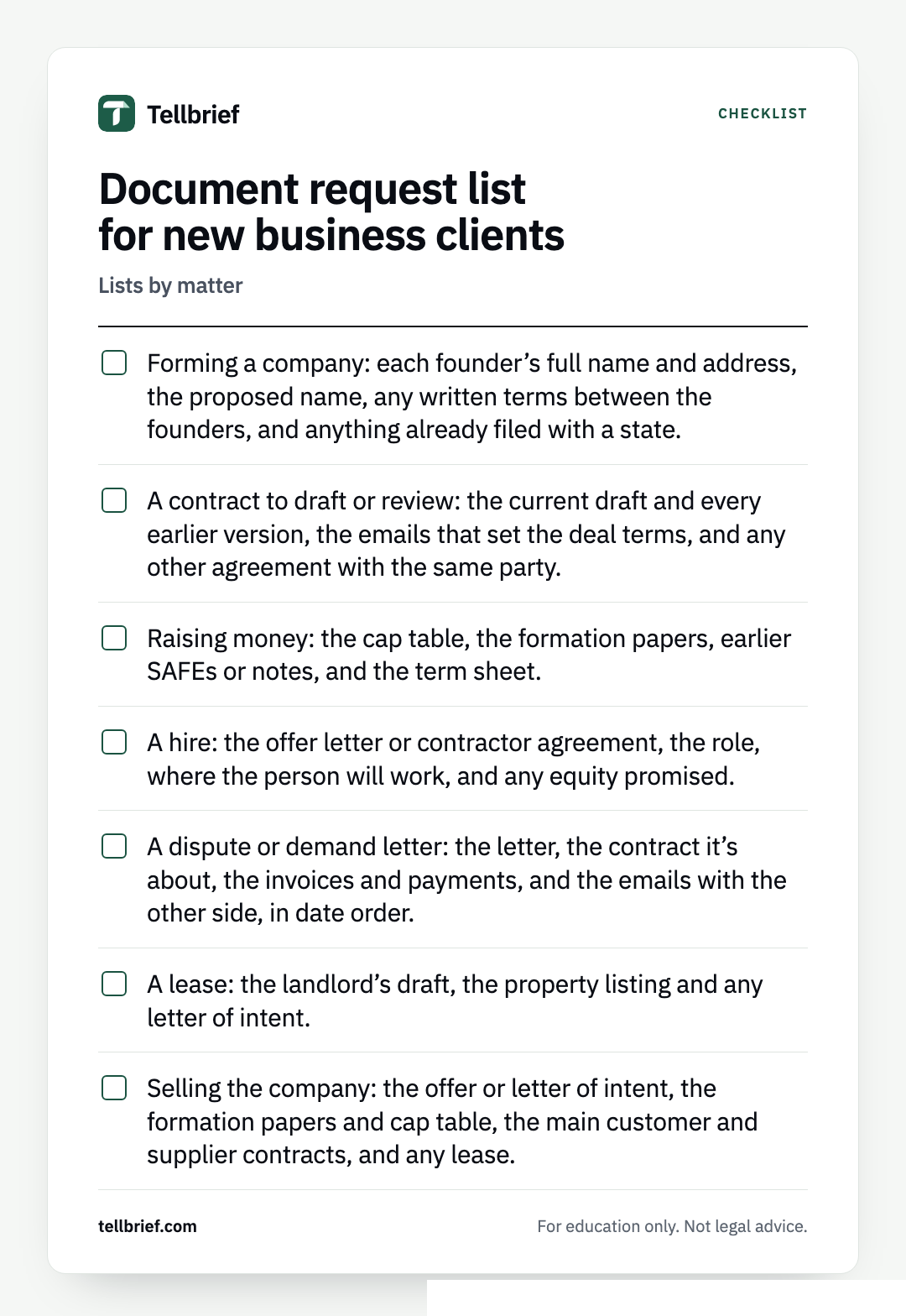
- Forming a company: each founder’s full name and address, the proposed name, any written terms between the founders, and anything already filed with a state.
- A contract to draft or review: the current draft and every earlier version, the emails that set the deal terms, and any other agreement with the same party.
- Raising money: the cap table, the formation papers, earlier SAFEs or notes, and the term sheet.
- A hire: the offer letter or contractor agreement, the role, where the person will work, and any equity promised.
- A dispute or demand letter: the letter, the contract it’s about, the invoices and payments, and the emails with the other side, in date order.
- A lease: the landlord’s draft, the property listing and any letter of intent.
- Selling the company: the offer or letter of intent, the formation papers and cap table, the main customer and supplier contracts, and any lease.
The first-call checklist covers what to learn on the call, which tells you which list to send.
Say how to send them
Comment [18] to Rule 1.6 says that when transmitting a communication with client information, “the lawyer must take reasonable precautions to prevent the information from coming into the hands of unintended recipients.”2 The factors it names include “the sensitivity of the information and the extent to which the privacy of the communication is protected by law or by a confidentiality agreement.”2 So say in the request how to send files, and name the kinds you don’t want by plain email under your firm’s policy, such as ID documents or bank statements.
Make the list easy to finish
- Number each item, so the client can reply “I don’t have 4.”
- Say what to do if a document doesn’t exist: tell you, and don’t make one.
- Ask for every version of a contract, not just the last.
- Give a date, tied to the first deadline in the matter.
- Ask for file names that say what each file is.
Keep a record of what came in
Note each document you receive and the date. Rule 1.16(d) lists, among the steps a lawyer takes when representation ends, “surrendering papers and property to which the client is entitled.”3 Minnesota’s version adds paragraph (e), which says those include, “in all representations, the papers and property delivered to the lawyer by or on behalf of the client.”3 The disengagement letter template covers handing the file back.
Know the matter before they sign
With Tellbrief, a new client answers about 30 questions before the first call, including what the matter is and what kind of documents they already have, and you read their brief once the names clear. So you know which list to send before the engagement letter comes back. Start a free pilot; your first three briefs are free.
See it first: the demo dashboard · a demo brief · the questions your client answers
A request email you can copy
Subject: Documents for [matter]: [firm]
Hi [name],
Thank you for signing our engagement letter. To get started on [matter], please send us the documents below by [date]. If you don’t have one, just tell us, and please don’t create anything new for this list.
1. [Document]
2. [Document]
3. [Document]
4. [Every earlier version of the agreement, if there are any]
5. [Any other agreement with the same party]How to send them: please use [your firm’s secure upload link or method]. Please don’t email [ID documents, bank statements, or anything else your firm’s policy names].
If anything on the list raises a question, reply and ask, or we can go through it on our call on [date].
[Lawyer], [firm]
A reminder you can copy
Subject: Still needed: documents for [matter]
Hi [name], thank you for what you’ve sent so far. We’re still missing [numbers and names of the items]. [One line on why they matter for the next step.] Could you send them by [date], or let us know if you don’t have them?
[Lawyer]
Sources
Each quote was checked against its source on November 3, 2026. Laws and guidance can change after that date.
- ABA Model Rule 1.18: Duties to Prospective Client, as adopted in Minnesota (opens in a new tab) ↩︎
- ABA Model Rule 1.6: Confidentiality of Information, with comments, as adopted in the Minnesota Rules of Professional Conduct (opens in a new tab) ↩︎
- ABA Model Rule 1.16: Declining or Terminating Representation, as adopted in Minnesota, with Minnesota’s paragraph (e) (opens in a new tab) ↩︎
Questions about document requests
What documents should a new business client send?
Only what the matter needs. For a contract, the draft and every earlier version; for a dispute, the letter, the contract and the emails with the other side, in date order. The lists above go matter by matter.
When should a lawyer ask a new client for documents?
After the conflict check clears and the client has hired you. The comment to Rule 1.18 notes that prospective clients, like clients, may place documents in the lawyer’s custody.
How should clients send sensitive documents to a lawyer?
Comment [18] to Rule 1.6 says a lawyer must take reasonable precautions to prevent client information from coming into the hands of unintended recipients, and names factors such as its sensitivity. Tell clients which method your firm uses.
What if the client doesn’t have a document on the list?
Ask them to say so rather than make something new. A missing document can be a fact worth knowing in itself.
Should we keep a log of documents received?
It helps when the matter ends. Rule 1.16(d) lists surrendering papers and property to which the client is entitled among the steps on termination, and Minnesota’s paragraph (e) says those include papers delivered by or on behalf of the client.
Know the matter before you send the list
Each brief lists the issues to raise, the documents to ask for and the work you could offer, so you can quote before you hang up. Your first three briefs are free. Setup is one 15-minute call, and you see each client’s names before anything else.