Law firm contact form disclaimer to copy

For education only. Not legal advice. Tellbrief is not a law firm.
A contact form invites strangers to tell you about their matter. What the form says next to the message box affects how much you hear before you’ve checked a single name.
In short
Comment [2] to Rule 1.18 says a consultation is likely if a lawyer’s advertising invites information about a potential representation without clear and reasonably understandable warnings, and a person responds. A warning beside the form can say no relationship exists yet, ask for names only and say not to send details. It ends with wording to copy.
On this page
When a form becomes a consultation
Comment [2] to ABA Model Rule 1.18, as Minnesota adopted it, addresses a lawyer’s advertising “in any medium”:
“For example, a consultation is likely to have occurred if a lawyer, either in person or through the lawyer's advertising in any medium, specifically requests or invites the submission of information about a potential representation without clear and reasonably understandable warnings and cautionary statements that limit the lawyer's obligations, and a person provides information in response.”1Rule 1.18, comment [2]
The same comment gives the contrast: “a consultation does not occur if a person provides information to a lawyer in response to advertising that merely describes the lawyer's education, experience, areas of practice, and contact information, or provides legal information of general interest.”1 A box headed “Tell us about your matter” asks for information about a potential representation, so the words around it matter.
Why it matters for conflicts
Rule 1.18(b) says: “Even when no client-lawyer relationship ensues, a lawyer who has consulted with a prospective client shall not use or reveal information obtained in the consultation, except as Rule 1.9 would permit with respect to information of a former client.”1 Rule 1.18(c) goes further: it bars representing a client with interests materially adverse to that person “in the same or a substantially related matter if the lawyer received information from the prospective client that could be significantly harmful to that person in the matter,” subject to the exceptions in paragraph (d).1
The case to plan for is a long message from the other side of a current client’s matter. The Rule 1.18 checklist covers the rest of intake.
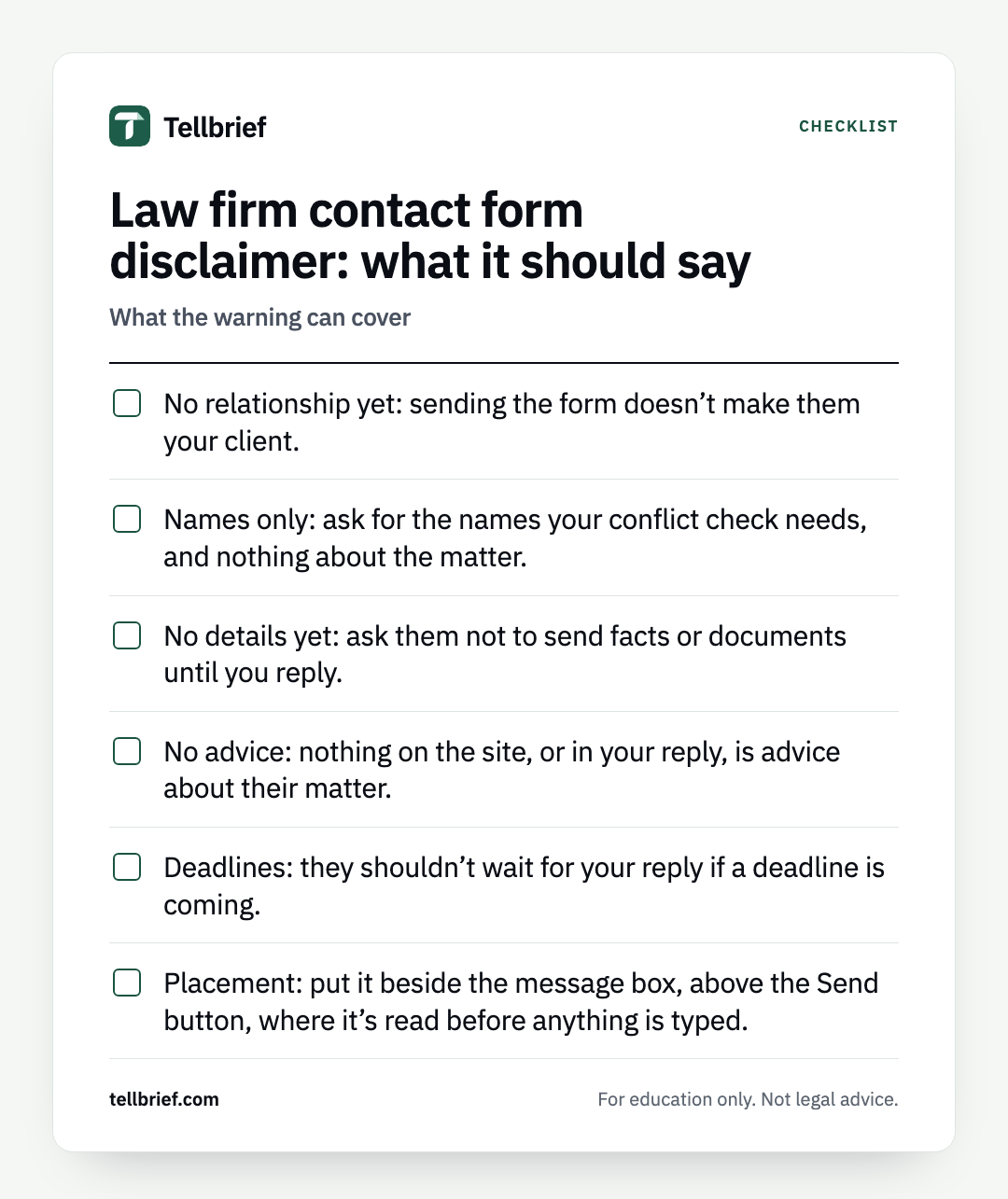
What the warning can cover
- No relationship yet: sending the form doesn’t make them your client.
- Names only: ask for the names your conflict check needs, and nothing about the matter.
- No details yet: ask them not to send facts or documents until you reply.
- No advice: nothing on the site, or in your reply, is advice about their matter.
- Deadlines: they shouldn’t wait for your reply if a deadline is coming.
- Placement: put it beside the message box, above the Send button, where it’s read before anything is typed.
Comment [5] adds another option: a lawyer “may condition a consultation with a prospective client on the person's informed consent that no information disclosed during the consultation will prohibit the lawyer from representing a different client in the matter.”1 Whether a line on a web form can give informed consent is a question for your state’s rules and ethics opinions.
Ask for less
A warning does less work when the form asks for less. Swap the open message box for the fields a conflict check needs: the person’s name, their company and the other side. The conflict check form lists them, the conflict check guide covers the search, and the intake form template asks the rest once the names clear.
When someone sends the story anyway
Some people will paste everything into whatever box you give them. Comment [4] says a lawyer “should limit the initial consultation to only such information as reasonably appears necessary” to decide whether to take the matter.1 Read for the names, run the check, then reply. If a name doesn’t clear, the guide to declining representation has an email to send, and there’s a non-engagement letter template for the full letter.
Names before the story
Tellbrief asks a new client for the names first. You see only those, with the brief locked, until you clear them; if a name matches, you press Decline and the brief is deleted unread. Start a free pilot; your first three briefs are free.
See it first: the demo dashboard · a demo brief · the questions your client answers
Wording for the form
Put this beside the fields, above the Send button.
Before you write to us
Sending this form doesn’t make [firm] your lawyer, and we haven’t agreed to represent you. Please give us only the names below, so we can check for conflicts. Don’t send details about your matter, or any documents, until we’ve replied. [Your firm’s wording, under your state’s rules, on how anything sent before we reply is treated.] Nothing on this site is legal advice. If you have a deadline coming up, don’t wait for us: talk to a lawyer now.
Your full name: [ ]
Your company’s legal name: [ ]
Anyone else involved, including the other side: [ ]
Best email or phone: [ ]
An auto-reply you can copy
Subject: We received your message: [firm]
Thank you for contacting [firm]. We’ve received your message and will reply by [time frame].
We haven’t agreed to represent you, and this email isn’t legal advice. Before we discuss any matter, we check every name for conflicts. If you haven’t already, please reply with only your full name, your company’s legal name, and the names of anyone else involved, including the other side. Please don’t send details or documents yet.
If a deadline is coming up, don’t wait for our reply. Legal matters can have time limits.
[Lawyer], [firm]
Sources
Each quote was checked against its source on November 3, 2026. Laws and guidance can change after that date.
Questions about contact form disclaimers
Do law firms need a disclaimer on their contact form?
Comment [2] to Rule 1.18 says a consultation is likely to have occurred if a lawyer’s advertising invites information about a potential representation without clear and reasonably understandable warnings, and a person responds. Check your state’s version and its ethics opinions.
Does a website visitor become a prospective client?
Comment [2] says it depends on the circumstances. A person who responds to advertising that merely describes the lawyer and gives contact information is, in its words, not a “prospective client.”
What should a law firm contact form ask for?
The names a conflict check needs: the person, their company and anyone else involved, including the other side. The story can wait until the names clear.
What if someone sends confidential details anyway?
Comment [4] says a lawyer should limit the initial consultation to only such information as reasonably appears necessary to decide whether to take the matter. Get the names, run the check, and follow your firm’s policy for the rest.
Can a form ask visitors to agree that what they send won’t disqualify the firm?
Comment [5] says a lawyer may condition a consultation on the person’s informed consent that no information disclosed will prohibit the lawyer from representing a different client in the matter. Whether a website line does that is a question under your state’s rules.
Get the names before the message
Each brief lists the issues to raise, the documents to ask for and the work you could offer, so you can quote before you hang up. Your first three briefs are free. Setup is one 15-minute call, and you see each client’s names before anything else.