Personal injury intake checklist

For education only. Not legal advice. Tellbrief is not a law firm.
An injury intake has one job before anything else: find out whether there’s still time, and whether anyone has already made the case harder.
In short
One possible order: the date, what happened, who was hurt and who else was involved, with those names checked before the details. Then whether a government party was involved, the kinds of care so far (not diagnoses or records), any insurer contact or offer, and whether another lawyer is involved.
On this page
Ten questions, in one possible order
Each answer can change how fast you call back, or whether the rest matters.
- When did it happen? The exact date if they know it. Each state sets its own time limits for injury claims, so an older date is a reason to look at the call sooner.
- What happened? A short list (a crash, a fall, a dog bite, an injury at work, a product, medical care) and a sentence in their words. It tells you whether it’s a case you take, and whether different rules may apply, as they can for work injuries and medical care.
- Who was hurt? The caller, their child, or a family member who died. A minor or a death changes who can bring the claim, so it helps to know at the start.
- Who else was involved? The other driver, the property owner, the employer or the maker of the product, and their insurer if known. These names go to your conflict check before you hear more; how to run a conflict check covers the search.
- Was a government vehicle, road, building or employee involved? In some states, claims against a government body come with a notice requirement and a shorter deadline. Your state’s rules decide.
- What care have they had? An ambulance or emergency room, a doctor, physical therapy or a chiropractor, surgery or a hospital stay, or none yet. And are they still being treated?
- Have they missed work? And are medical bills arriving?
- What insurance is there? Theirs and the other side’s. Was there a police or incident report? Are there photos or witnesses?
- Have they talked to an insurer? A recorded statement, anything signed, or an offer received. An offer can come with a date to accept it.
- Have they talked to another lawyer? If someone already represents them on this, it’s worth knowing before going further.
A made-up example
A caller says a city bus hit her car 14 months ago. She went to urgent care, then physical therapy for three months, and the transit agency’s insurer offered her $3,000 last week. Three answers matter before the rest: the date, the government party and the offer. Each one is a reason to call her back today.
Kinds of care, not diagnoses
To decide whether to take a case, the kinds of care they’ve had and whether it’s ongoing may be enough. The diagnosis or the records, may not be needed, and a form sent before you’ve taken the matter may not be the place for them. A form can ask the client to leave them out. Records can come later, once you’re engaged, through the authorization your firm uses.
Many inquiries arrive through a website form
If yours do, the form is your first intake. A short warning above the message box can keep callers from sending the whole story before you’ve checked the names; the contact form disclaimer guide has wording. Asking for the date and the other party’s name on the form itself lets an old date or a conflict show up before anyone calls back.
If you take the case
On contingent fees, Rule 1.5(c), as Minnesota adopted it, says a contingent fee agreement “shall be in a writing signed by the client” and shall state how the fee is worked out, including the percentages on settlement, trial or appeal, and how expenses are handled.1 Your state’s version applies, and some states add their own requirements for injury cases.
If you don’t
One way to decline: promptly, in writing, with no view on the claim, and a line saying that time limits may apply and that they may want to speak to another lawyer soon. What to say when you decline has wording, and the non-engagement letter template fills it in. The Rule 1.18 intake checklist covers what you owe someone you consulted but didn’t take on.
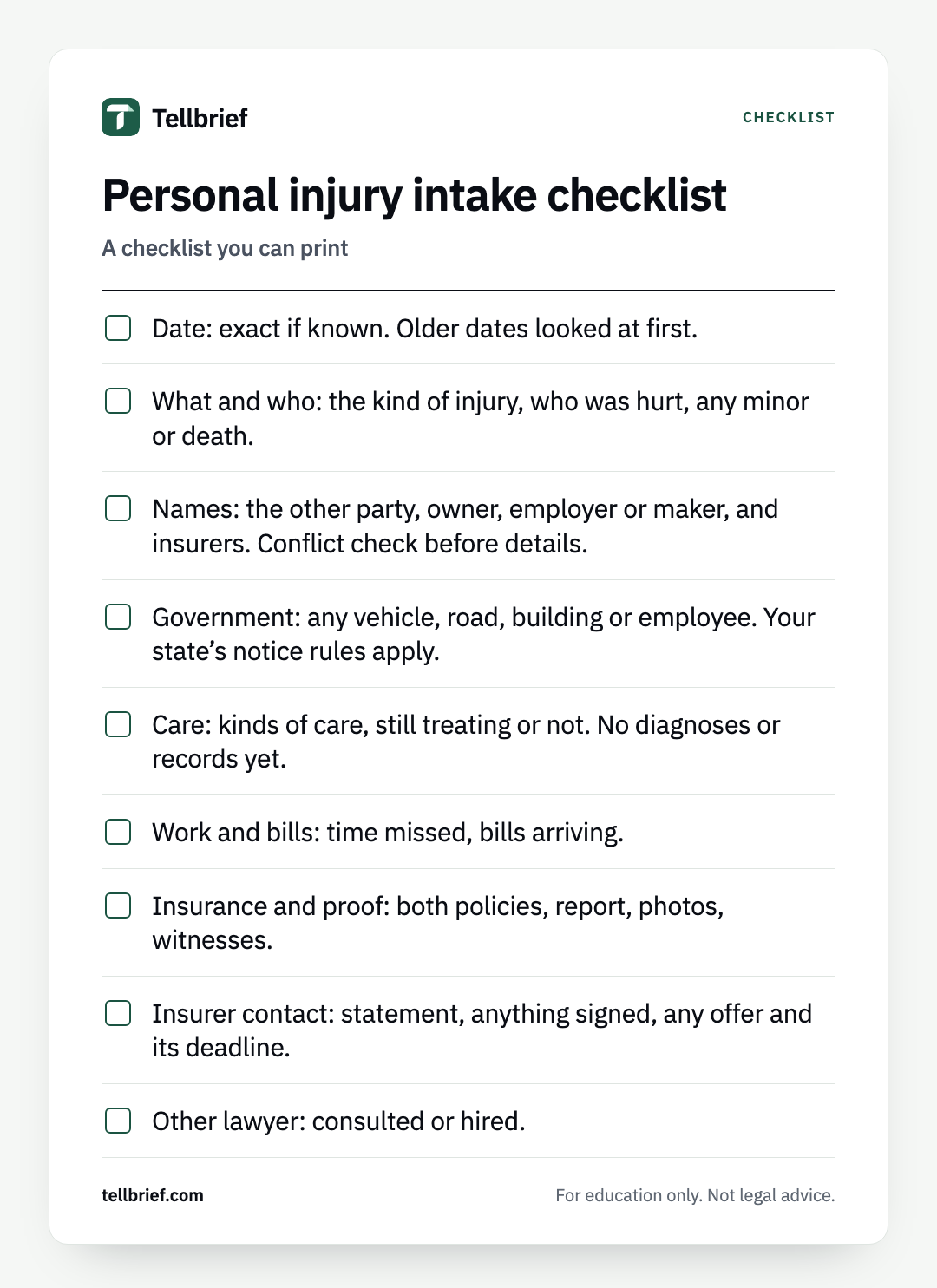
A checklist you can print
- Date: exact if known. Older dates looked at first.
- What and who: the kind of injury, who was hurt, any minor or death.
- Names: the other party, owner, employer or maker, and insurers. Conflict check before details.
- Government: any vehicle, road, building or employee. Your state’s notice rules apply.
- Care: kinds of care, still treating or not. No diagnoses or records yet.
- Work and bills: time missed, bills arriving.
- Insurance and proof: both policies, report, photos, witnesses.
- Insurer contact: statement, anything signed, any offer and its deadline.
- Other lawyer: consulted or hired.
Tellbrief’s injury questions ask these in plain words, most with one tap, and never ask for a diagnosis or records. The brief flags an old date, a government party and any offer at the top. Start a free pilot; your first three briefs are free.
See it first: the demo dashboard · a demo brief · the injury questions your client answers
Other practices: the family law intake form template and the estate planning intake questionnaire.
Sources
Each quote was checked against its source on November 7, 2026. Laws and guidance can change after that date.
Questions about injury intake
Why ask for the date before what happened?
The date is what tells you how soon to call. If a deadline may be close, the rest of the intake can happen on the phone.
Should intake ask for medical records?
Kinds of care can be enough to decide whether to take a case. Records can come after engagement.
What if the caller already gave a recorded statement?
It’s worth noting, along with whether they have a copy or remember what they were asked, so it can come up on the first call.
What if a government party is involved?
Notice rules for claims against a government body differ by state and can be short, so it’s one of the first answers to look into.
Try it on your next three injury calls
Each brief flags an old date, a government party and any settlement offer at the top, then what happened, the care so far and the insurance. You see the names before anything else. Your first three briefs are free, and setup is one 15-minute call.